Between my order for the Dario Argento box set finally arriving and my partner buying me the second Werner Herzog box set (featuring 'Even Dwarves Started Small', 'Fata Morgana', 'The Enigma of Kaspar Hauser', 'Heart of Glass' and ' Stroszek'), I've got plenty of films to write about.
But between moving house and an imminent mini-break in Scotland for the New Year (Hogmanay with the Scots - methinks some drinking is going to be done), I've not had the chance to watch them, or to update this blog.
Normal service will be resumed (hopefully) during the second week of January.
In the meantime, here's hoping everyone had a Merry Christmas; and my best wishes for a Happy New Year.
Jumat, 28 Desember 2007

Senin, 24 Desember 2007
CHRISTMAS SPECIAL: Bad Santa
 There are some films which will forever embody the spirit of Christmas, films which communicate directly the goodness, charity and common humanity we are all, in our heart of hearts, capable of. Films like ‘It’s a Wonderful Life’, ‘Miracle on 34th Street’ and any of a raft of ‘A Christmas Carol’ adaptations.
Then there’s ‘Bad Santa’.
For anyone unacquainted with (or should I say untainted by) this slab of seasonal cynicism, the plot centres around veteran safe-cracker Willie Stokes (Billy Bob Thornton), who spends one month out of the year dressed as a department store Santa while he and his elf-disguised midget partner Marcus (Tony Cox) case the joint preparatory to a Christmas Eve heist.
Willie hates Christmas. He hates kids. Particularly the ones that sneeze chocolate over him or pull his beard off. He boozes on the job. He eyes up women. Prissy store manager Bob (John Ritter, in his last film role) catches him engaging in rigorous intercourse with a portly shopper in the women’s dressing rooms. His romantic homily to the lady in question: “Oh yeah, baby, you ain’t gonna shit right for a month.”
Bob takes his concerns to hard-talking store detective Gin (Bernie Mac), who has Willie surveilled. Worried that the cops are targeting him, Willie moves into the home of Thurman Merman (Brett Kelly), an overweight and much bullied kid left in the care of his less-than-compos-mentos grandmother while his father serves a jail sentence for white collar crime.
Thurman’s beguilingly naïve fascination with Santa (he spends most of the film plaguing Willie with questions about the North Pole, reindeer and why his beard is fake*), is mirrored by Willie’s budding relationship with free-living barmaid Sue (Lauren Graham), whose attraction to him is explained by her self-confessed Santa fetish (“fuck me Santa, fuck me Santa, fuck me Santa” is high on the list of the film’s many jaw-droppingly politically incorrect lines).
Willie’s drinking, professional disenfranchisement and tendency to self-loathing come to a head when his and Marcus’s scam is uncovered by Gin, who demands fifty percent of their haul. Willie borrows Thurman’s father’s car and runs a hosepipe through the window. On the verge of succumbing to asphyxia, he is interrupted by Thurman, sporting an ugly black eye. Willie squints at him. “Who did this?” Cut immediately to Willie, dressed in Santa outfit, repeatedly punching Thurman’s chief tormentor in the face as ‘March of the Toreadors’ rings out triumphantly on the soundtrack**. Another immediate cut: Willie having a heart-to-heart with Marcus: “I feel like I’ve turned a corner. I beat the shit out of some kid today, but I did it for a reason. I feel my life has a purpose.”
Black humour is often the most effective: it shocks you into laughing. This sequence, which raises the bar beyond every bad taste, censor-baiting, downright offensive moment that has come before, is just as swiftly superseded by Willie and Marcus’s attempts to toughen Thurman up by teaching him the rudiments of boxing. Here the humour derives from a foul-mouthed drunkard, a midget and an eight-year-old kid punching each other in the balls ... repeatedly. Like so much of ‘Bad Santa’, it shouldn’t be funny. Really. By any right-thinking, socially-responsible standards, it shouldn’t be funny.
Consider these random samplings of dialogue:
Thurman tells Willie he wishes he could have a pink elephant for Christmas. Willie: “Wish in one hand, shit in the other, see which fills up first.”
Willie and Marcus come across a safe that is considered nigh on uncrackable. Willie cites the case of an expert cracker he once did time with who couldn’t access it. Willie: “They said he could get into anything. Even Margaret Thatcher’s pussy.” Marcus: “And that’s a good thing?”
Willie approached by a mother and child whilst stuffing his face in the department store cafetia. “Why don’t you go tell Santa what you want for Christmas?” the mother urges. “I’m on my fucking lunch break! Jesus Christ!” Willie expostulates, half-masticated food spewing from his mouth.
Consider these random images:
Willie slumped drunk in Santa’s grotto, bottle in hand, pissing himself.
Willie walking to work, again in full Santa uniform, finishing off a bottle of vodka at eight o’clock in the morning and hurling the empty receptacle at the windscreen of a nearby Mercedes.
The LAPD putting eight bullets in Willie’s/Santa’s back as he tries to deliver Thurman’s Christmas presents, the neighbour children screaming and crying at the sight.
Yup, Terry Zwigoff’s film is wrong on every conceivable level. Its hero is a drunkard, a thief and a vulgarian. There’s more swearing than ‘Goodfellas’, ‘Scarface’ and ‘Reservoir Dogs’ put together. There isn’t the vaguest trace element of a moral imperative anywhere.
And yet it’s the funniest and – in the final analysis – most perversely poignant Christmas movie I’ve ever seen. To slightly misquote Tiny Tim, “God help us, one and all.”
* Willie: “My hair fell out ’cause I went with a woman who wasn’t clean.” Thurman: “Mrs Santa?” Willie: “No, Mrs Santa’s sister.”
** ‘Bad Santa’ boasts the best use of classical music since ‘Battle Royale’ – the safe-cracking scene, perfectly edited to the clanging percussion of the ‘Anvil Chorus’, is a standout.
Jumat, 21 Desember 2007
A Canterbury Tale
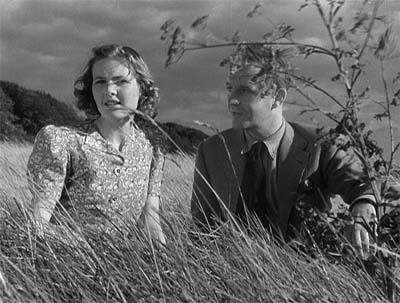
The first half of Powell and Pressburger’s output consisted, superficially at least, of propaganda pieces. Films like ‘49th Parallel’ and ‘One of Our Aircraft is Missing’ were funded by the Ministry of Information, while production of ‘The Life and Death of Colonel Blimp’ – inspired by David Low’s satirical cartoon strip – provoked enough controversy that Churchill fired off memos about it.*
‘49th Parallel’ was an invitation to American involvement; ‘One of Our Aircraft’ a tribute to the indomitable British spirit. ‘Blimp’ fell into the category of “what we are fighting for”, the eponymous Colonel’s gentlemanly, old-school style of soldiering held up as outmoded in the face of the then-contemporary conflict. ‘A Canterbury Tale’ belongs to a smaller, less remembered sub-genre of wartime propaganda: the Home Front film.
A disparate trio descend upon a small village near Canterbury: former sales assistant Alison Smith (Sheila Sim), now assigned to duties as a Land Girl; former cinema organist Peter Gibbs (Dennis Price), now a sergeant in the army, his regiment about to be posted overseas; and former coffee-drinking American Sgt Bob Johnson (John Sweet**), now stationed in England and not enamoured of the national propensity for tea drinking.
Local squire Thomas Colpeper (Eric Portman) strives to retain some sense of tradition and rural identity, giving illustrated talks to the visiting soldiers and expounding on the history and culture of the area. He believes in “pouring knowledge into people’s heads, by force if necessary”. Not that his latest potential converts (or modern day pilgrims, as Pressburger’s sometimes overly literal script paints them) don’t have other things on their mind: Alison is haunted by past holidays in the area with her fiancé, now missing in action. Johnson is cut up because his girl back home has stopped writing to him. Gibbs is looking for something more spiritual. On top of this, there’s the “Glueman”, attacking girls by night, smearing glue into their hair.
The investigation into the Glueman’s identity is the thin peg upon which the meandering narrative is hung. You’ll twig the guilty party from the get-go. The film’s real concerns are an investigation into Englishness: Powell’s camera captures the timeless beauty of the landscape. History and tradition are at the forefront (in a scene that should be twee but is actually quite wonderful, Johnson, a lumberman by trade, befriends a wheelwright twice his age, their mutual respect based on an understanding of how long wood should be aged and when it should be cut; “you can’t hurry an elm” remains my favourite line), with the occasional troop carrier crashing through the woods or Spitfire roaring overhead as a reminder of modernity.
Speaking of Spitfires, the film’s opening sequence offers its most celebrated moment – often cited as a precursor to the bone-to-spaceship jump cut in Kubrick’s ‘2001: A Space Odyssey’. Chaucer’s pilgrims set out for Canterbury, some walking, some on horseback. A falconer releases his bird. It soars into the sky, majestically. Cut: a Spitfire replaces it, engine shattering the silence, swooping down over a landscape that hasn’t changed.
Finally, with the protagonists finding their way to Canterbury – to the cathedral itself – the scene is set for a small helping of everyday miracles. It’s here that the script is at its most strained, individual resolutions feeling a little too pat. But after two unhurried hours of pastoral idyll (including an hilarious ‘Swallows and Amazons’-type scene where two rival gangs of children stage their own manoeuvres, neatly mocking those Gibbs and his regiment are engaged on), who’s complaining? ‘A Canterbury Tale’ isn’t the most memorable, most offbeat, most challenging or most indulgent film Powell and Pressburger made, but it’s still a film that only they could have created.
*See the introduction to the published screenplay (Faber & Faber) and A.L. Kennedy’s BFI chapbook on ‘Blimp’ for more information.
**Sgt John Sweet was a real-life American soldier whom Powell had seen in an amateur production. His performance makes it clear that he wasn’t a professional actor, but there’s an unpretentiousness to his screen persona that, stopping just short of “gee whiz” cornball hokum, is somehow endearing.
Senin, 17 Desember 2007
The Small Back Room

My thanks to Beyond the Valley of the Cinephile for inviting all film-loving bloggers to contribute to a week-long Powell and Pressburger blog-a-thon, the only excuse I need to wax lyrical about one of my personal favourites.
‘The Small Back Room’ is an adaptation of a novel by Nigel Balchin, one of the most popular and well-respected British writers of his time. The title refers to the sub-basement office occupied by a research and development team – ‘boffins’, to use the vernacular. Professor Mair (Milton Rosmer) is a man of science, lending his acumen to projects designed to assist the war effort and effect a swifter victory for the Allies. His team includes Sammy Rice (David Farrar), the brains of the outfit but a man with his personal demons, and the walking case of nerves Corporal Taylor (Cyril Cusack), whose cuckolding by his wife is an open secret in the department.
Not that Sammy fares much better. Limping from a wound which has resulted in a tin foot, fighting the pain with beer and prescription drugs that do nothing for him, Sammy valiantly tries to stay off the Scotch – the only thing guaranteed to dull the pain – for the sake of his on-off girlfriend Susan (Kathleen Byron). Matters are complicated in that Susan is secretary to Sammy’s oleaginous boss R.B. Waring (Jack Hawkins). Waring is more salesman than scientist, schmoozing with government contacts – a scene involving a minister’s visit (the politico, billed as “A Guest” in the credits, is immediately recognisable as Robert Morley) is one of the best bits of political satire that side of ‘Yes, Minister’ – and not really caring about the poor bastard in the firing line who has to use the product.
The narrative centres around several (personal and professional) challenges to Sammy’s equilibrium. Firstly, a new type of unexploded bomb has been discovered. Designed to resemble a harmless thermos flask, but producing deadly results if handled, this is “Jerry’s” latest booby-trap. As the film opens, Sammy is approached by idealistic Captain Stuart (Michael Gough) to give a professional opinion on the device with only the barest amount of information to go on. The best he can offer is to be called to the scene the next time one is discovered. Secondly, he is summoned to give evidence at committee on a new, still-being-tested piece of ordnance, the Reeves gun, which Sammy can see is badly flawed, but which Waring wants to push through to government contract stage.
Sammy’s clash with Waring over the Reeves gun leads to ministerial resignation and potentially negative changes within the research department. It also fuels a stand-up row between him and Sue. She walks out on him. He goes back on the whisky, big time. Trashing his apartment in the throes of a drunken rage, Sammy gets a call – Stuart has tried to defuse one of the new UXBs and died in the attempt. Another device has been found, buried in the treacherously unstable pebbles of Chesil Sand. Frustrated, angry and hungover, an emotionally unstable Sammy presents himself at the scene and begins to defuse the bomb …
‘The Small Back Room’ operates pithily and effectively on three levels: knife-in-the-back political satire, nail-chewing suspense thriller, and character study of an alcoholic. Make no mistake, ‘The Small Back Room’ is up there with ‘The Lost Weekend’ and ‘Withnail and I’ as one of the greatest drinking movies ever made. Take the scene where Sammy, terrified of being alone, agrees to meet Sue at his apartment only for her to be kept late at work. He sits at a bare table and regards two objects: an (as yet) unopened bottle of whisky and a clock. He stares the clock out through the passage of an hour. He begins to hallucinate. The endlessly ticking clock, every tick hideously and surreally amplified, insinuates itself into the pattern of the wallpaper. The whisky bottle swells so that it occupies the entire room, bearing down on Sammy, forcing him up against the wall. Remember the magnificently off-the-wall cold turkey sequence in ‘Trainspotting’? … ‘The Small Back Room’ did it first.
Then there’s Sammy going off the wagon: argument with Sue; exeunt girlfriend; uncertain future at work. He heads for his local and implores barman Knucksie (a pre-‘Carry On’ Sid [billed as Sidney] James) to serve him whisky. Knucksie, well aware of Sammy’s inability to handle the hard stuff, refuses. Sammy starts wrecking the joint. “Knucksie,” he slurs, “has anyone ever given you a thick ear?” The barman stares him down: “Not without paying cash for it.”
I don’t think anyone’s given a more convincing performance of a drunkard violently (and pitifully) losing it as Farrar does here.
All of this makes the climactic scene that much more tense. Actually, ‘tense’ doesn’t do it justice. ‘The Small Back Room’ delivers its payoff in a twelve-minute scene that is sweatily, agonisingly, sphincter-tighteningly unbearable. Sammy treads slowly out towards the UXB, the pebbles of Chesil Bank cascading beneath his feet with every step. He nearly blows himself to shit just latching up supports around the device. Then he takes a couple of monkey wrenches to the cylinder to try to open it … If you’re not watching through your fingers whilst desperately needing to pee by this point, then congratulations: you officially have nerves of steel.
Bomb disposal scenes are a staple of cinema. Bond movies ‘Goldfinger’ and ‘Octopussy’ … child’s play. TV spin-off ‘Sweeney 2’ … amateur hour. ‘The Small Back Room’, as I may have mentioned before, did it first and did it best. Its only shortcoming is that Powell and Pressburger directed it. In the all-time P&P greatest movies list, arguably half a dozen features rank above ‘The Small Back Room’ … but that shouldn’t detract from one simple fact: it’s the best film of its kind bar none.
Kamis, 13 Desember 2007
Tony Passarelli: too blessed to be stressed
I know Tony Passarelli, a Nottingham-based independent film-maker, through my partner Paula, who acted in his short film, ‘Ignorance is Bliss?’ I talked to him recently about some of his productions:
Before we look at the films, can I ask about your influences? Which directors inspire you?
At this point I should reel off some of the great directors from cinema history, right?
Well, truth be told, I don’t have any one great influence. Not even a list of those I would consider the true greats. What inspires me is a great film. There are so many factors that go into painting a great tale onto celluloid, whether it’s a fantastic performance from the actors or just a script that is almost impossible to fail or a great director working his magic and creating something memorable out of an otherwise mundane tale.
If you had to pick just one director?
Tarantino! There goes my credibility at the start of the interview … lol! I’m just the kid that never grew up I suppose.
What was your first film and how did you come to make it?
At school. It was before fancy things like drama lessons came about. I was pretty much a drop out. I’d turned my back on the whole education thing by the age of 15. The only subject I liked was English, but I got dropped from the O-level group because my spelling and grammar held me back. That was the end of my collaboration with the educational side of life!
It came about one day when I wouldn’t do a damn thing in Maths and my peers followed suit (a rebel without a cause but one who had his followers) and the teacher Mr Booth had a one-on-one chat with me and asked, “What would you like to do?”
I answered, after giving it some thought, in an innocent 15-year-old kind of way: “Make a film”. Sounds really bizarre looking back on it now, but when you’re a kid everything makes sense because you don’t have the time to procrastinate! Anyway, Mr Booth was into filming weddings at the weekends as a sideline. I think he was onto a good screw – about £150 for a weekend’s work! This was back in 1985 when people didn’t have video cameras, but he had one.
So he said alright. Something followed on along the lines of “What do you want to make?” and I said “We’ll make a film about gangsters and prizefighting”. So we made a 50 minute film called ‘Prizefighter’ which he filmed and directed and I told everyone their parts and lines. It involved kids from two Maths groups and it was watched by the entire school. It just happened. I never thought it was an unusual thing to do.
I guess I just didn’t give a stuff, really. Best attitude to have!
IGNORANCE IS BLISS?
‘Ignorance is Bliss?’ is a dark, thought-provoking film. How did you get the idea?
I mulled on the idea of a man who had the worst thing happen to him that could and then had something even worse come upon him. A sort of walking curse. But I wanted the protagonist to be intellectually deaf and dumb to it all. Just a suffering wretch of a human being. Basically the main character, Carl, is the zombie in the movie. He only utters one meaningful line in the film: “You want to know something? Nightmares are God’s way of telling us we’re not in control.”
The title is supposed to be a question to the viewer: Ignorance is bliss? Because the audience sees the nightmare in the end, but Carl still cannot remember it. The nightmares have brought his life to a stop. He can’t get past his loss and grieving because he can’t even get a decent night’s sleep. Would he be better off remembering the dreams, even though in the nightmare scene he goes insane?
I didn’t think I got the pay-off with that film. It’s a learning curve. My inexperience as a film-maker rather than the viewers not getting it.
Obviously, your films are made on a very low budget - possibly no budget. How did you achieve the make-up effects on Paula?
All the credit goes to Adam Poole. I told him what I had in mind and he took the idea and ran with it. I can't remember the cost. I think I said “Just give me the bill.” It ended up being peanuts anyhow. Adam has got a gift. The effects would have probably cost a few grand in Hollywood.
The make up was fantastic. Paula Harrison is a real trooper. As a director you couldn't ask for a better actress to work with. She gave a solid performance throughout the film and never complained about the latex face mask she had to endure. It isn’t easy to give a performance where your mobility is limited and you have to watch how much you can move your mouth or eyes. Too much expression could have made the mask crack. Maybe that’s why Paula was so great at doing scenes in one take. She wasn’t going to have to go through hours of hell again!
Adam Poole gives a very understated, introspective performance. He features in all three of the films we're looking at, as well as doing the make-up effects on 'Ignorance is Bliss'. Would you say that he brings as much to the creative process as you do?
As a package he’s great. Any film-maker would give their right arm for some one like Adam to be on their team. He’s versatile and getting more so as he’s learning what happens behind the lens.
I know I've always got a lead man to fall back on. He can do the pretty boy roles, but can tackle deep characters as well. He’s mucking in and learning to think with an eye for the camera. He’s moved on from being obsessed with the performance and now thinks about the shot composition, how we want it to look on film. Adam really is an artistic person. It comes naturally to him.
Is he more talented than me? More versatile I'd say. We compliment each other very well. He’ll want ‘just one more shot’ for ever and a day. Whereas I'll say “That’s it, I've had enough.” He’ll push me to do a few more takes and I’ll be the one to draw the line and say “That’s it.” That’s the trouble with perfectionists, they’ll go on forever! Adam pushes me and I let him know when he’s gone beyond enthusiasm.
LIFE’S GREAT
‘Life’s Great’ is the very opposite of ‘Ignorance is Bliss?’ - warm, poignant, life-affirming. I understand you made it to enter a competition. How difficult was it to bring the film it at exactly 60 seconds?
It was for the Orange BAFTA competition. A one minute short based on the theme of ‘Celebrate’. It was Adam’s baby, that one. He came up with three different films, but because Christmas-time is busy for every one, we only made the one. That was the easiest one as well! It’s a feelgood film. Very cosy, not like our usual work. If anyone is feeling down they should take a minute out of their lives to watch ‘Life’s Great’. Sometimes we all need an emotional pick me up.
They're running the competition again this year. The theme is ‘Unite’. I've got an idea, but again it’s whether I get the time to shoot it. The editing isn’t a problem. In fact putting a 60 sec short together is a joy.
THE GOOD SHOPPER
‘The Good Shopper’ is different again. This time you use the documentary format to address the importance of Fair Trade products. The closing frames of the film show you volunteering at a Fair Trade stall. Why is this issue so important to you?
I wrote a drama called 'The Good Shopper' a couple of years back. Everyone agreed to play the parts and I gave them the script, but it never got made. The scene at the end is me on the Nottingham Oxfam Campaign group’s Fair Trade stall. I’m still a member of the group, although I do all my campaigning online these days.
Because I had that footage it gave me the idea to do a documentary. The same title but completely different film – different to all the other films I’ve done. I’m not looking for any praise with this one, I’m not taking much interest in what the viewer thinks of the cinematography or direction. I want is for the viewer to look and listen and realise they can make a difference in the world. I have a real passion and I get to show it in this film. Maybe I could become the Chris Martin of the film world. Print out the Make Trade Fair logo on my left hand.
I’d prefer the viewer to watch ‘The Good Shopper’ than for me to talk about it. If you ask me to recommend just one of my films then that is the one. It isn’t about entertainment. It’s about the real world and we’re all in it.
What of future projects? Further documentaries? Any plans for a full-length feature?
I like the documentary format for the reason that post-production is just as creative as the filming. Not as much fun as a one minute film but pretty close. The subject would have to really interest me, though.
I’m looking at a short we filmed last year called ‘Kid’s Talk’ but didn’t fully complete. I’m looking at what we have got and going to try and weave some magic in the editing suite. If I manage to create the finished article you’ll be able to see that we’re getting stronger on the technical side. Some very nice shots. Looking more polished than our previous efforts.
Besides ‘Kid’s Talk’ and the 60 second short for BAFTA, Adam and another mate Nathan Rose are both working on different short films. I’ve got a little gem called ‘Belial’ but I try not to plan ahead, though. Plans can go wrong.
As for a full feature, no way – it’s a back breaker, a killer! I just can’t do it. I haven’t got financing, I haven't got a full crew. I’ve done two ‘Prizefighter’ films and I tried to do another but it was too big. It drained me. I had to quit and that makes me feel guilty for every who gave their time and energy to the project.
If writing came easy to me then I could do a full screenplay or even a novel. The short film ‘Belial’ that I may do is so rich in material. I could take the story to so many places: fallen angels Belial and Satan plus all the other stuff that could be created with that world. I’ve seen the ‘Prophecy’ films and think they’re pretty poor. I guess Hollywood don’t want to upset religious groups or be accused of blasphemy. Maybe it’s a good thing that I just stick to short films.
Thanks for the interview, Tony. Is there anything or anyone I’ve missed?
I’d like to mention Lee Hallam. He’s a great musician and I've used his songs in both ‘The Good Shopper’ and ‘Ignorance is Bliss?’. I don't have to worry about getting music for my flicks. If we do ‘Belial’, Lee has agreed to play the lead role.
I’m happy doing shorts and pretty blessed to have a great pool of talented friends ready and willing to muck in. I'm too blessed to be stressed.
Rabu, 12 Desember 2007
Accident

Joseph Losey directed ‘The Servant’ from a script by Harold Pinter based on a novel by Robin (nephew of W. Somerset) Maugham. Likewise, ‘Accident’ re-teamed Losey and Pinter for an adaptation of a novel by Nicholas (son of Oswald) Moseley. And, of course, Dirk Bogarde was back in the fold: between ‘The Servant’ and ‘Accident’, he and Losey had made ‘King and Country’ and ‘Modesty Blaise’ together.
‘Modesty Blaise’ is the odd-man-out of their films, a lightweight bit of fluff: fun but forgettable). ‘King and Country’, however, was a shattering anti-war film comparable to Kubrick’s ‘Paths of Glory’, in which Bogarde plays an officer who defends Tom Courtenay’s simpleton private in a court martial for desertion, an offence punishable by execution. As such, Losey’s pre-occupation with class, society and hypocrisy are again to the fore, Losey’s cinematic microcosm being the trenches of the First World War.
‘Accident’, the final Losey/Bogarde picture, is again about class. But the microcosm here is the groves of academe. The dreaming spires of Oxford. Granted, it’s the perfect milieu for an examination of repression, thwarted ambition, staid traditionalism and social hypocrisy, dark emotions lurking behind the leisurely punts down the river, the elegant soirées and the endless games of cricket or tennis … but compared to the more explicit portrayal of social degeneracy and power games in ‘The Servant’ or the brutal backdrop of wartime suffering in ‘King and Country’, ‘Accident’ suffers from the worst affliction that can befall a motion picture (I use this cornball term advisedly: motion = movement; picture = visual): inertia.
Everything about ‘Accident’ is sluggish. With the titular accident happening offscreen, the ‘action’ is limited to book-lined rooms, manicured lawns and the sun-dappled river. Gerry Fisher’s colour-saturated cinematography prettifies everything when the script calls for the starkness of Douglas Slocombe’s crisp black-and-white lensing on ‘The Servant’. Pinter’s script, typically oblique, is heavy with pregnant pauses. Elsewhere in his ouevre this is hugely effective – small pockets of silence which hidden meanings and suggestions seep into – but here they drag on to the point of … well, we’re back at that word again: inertia.
Fortunately, a cluster of great performances hold the attention: Bogarde gives a finely nuanced turn as Stephen, an Oxford don going through a mid-life crisis; Stanley Baker is ruggedly effective as Stephen’s colleague Charley, whose success as an academic, novelist, TV pundit and womaniser throws into sharp relief Stephen’s sense of self-doubt; Vivien Merchant anchors the film as Stephen’s homely wife; and Jacqueline Sassard is luminous as Anna, the student Stephen lusts after.
Two scenes remain in the mind long after the rest of the film has faded: a dinner party which ends in drunken embarrassment, the veneer of Stephen’s home life cracking apart to reveal his desperate insecurities; and Stephen’s less-than-proper attentions towards Anna as she drifts in an out of consciousness following the accident, a scene so suggestive and ambiguous that it finally – at the last post – lifts the film into the realms of the memorable.
Senin, 10 Desember 2007
The Servant
You can see why ‘The Servant’, with its themes of class hypocrisy, sexual politics, role reversal and power games, shocked audiences of 1963 … but with Bogarde in the lead role they should have seen it coming. From the delinquent gunning down George Dixon in ‘The Blue Lamp’ to the tortured Melville Farr in ‘Victim’, the man had already established himself as British cinema’s dark horse, no matter how many ‘Doctor’ films might have persuaded a swooning female fanbase to the contrary.
‘The Servant’ opens with Hugo Barrett (Bogarde) crossing a busy street on his way to a job interview with layabout toff Tony (Edward Fox). Behind him, framed so that it occupies the top third of the screen, is a sign reading ‘Thomas Crapper’ – the business premises of the company named after the sanitation magnate. A popular misconception is that Thomas Crapper invented the flush toilet, the word ‘crap’ deriving from his surname. Both were in use before Crapper’s prominence in his chosen profession. But these are asides. Losey may have included the shot to trade on these misconceptions. If so, then it works well. Barrett is a decidedly unsanitary character.
Arriving for his appointment, Barrett finds his prospective employer napping. “Too many beers at lunchtime,” Tony says candidly. Again, a first impression that gets to the heart of the character. Tony’s drinking worsens as the film progresses and his icy society girlfriend Susan (Wendy Craig) leaves him.
The events leading up to said split occupy the first half of the film, Barrett happily running Tony’s bachelor pad until Susan moves in and threatens his centrality to Tony’s lifestyle. By this point, Barrett has prevailed upon Tony to employ as maid a woman, Vera (Sarah Miles), whom he introduces as his sister. Tony carries on a dalliance with Vera behind Susan’s back.
So far, so sleazy. And ‘The Servant’ could easily have unfolded as an examination of louche, degenerate upper-middle class habits … except that Barrett, against whose working class pretentions Tony’s weak-willed aristocracy is contrasted, is every bit as degenerate himself.
Arriving back early from a weekend away, Tony and Susan find Barrett and Vera in the proverbial compromising position. “She’s your sister, you bastard!” an outraged Tony declares. Barrett swiftly robs him of the moral high-ground: “She’s my fiancée, sir, which sort of puts us in the same boat, doesn’t it?” At which point Tony throws the pair of them out; a case of too little too late as Susan gives him the elbow on the spot.
This, remember, is just the first half of the film. Barrett then inveigles his way back into the (now Susan-less) household, claiming that Vera has left him and taken his money (“she did us both, sir”). What follows is as if scriptwriter Harold Pinter (in the first of several collaborations with Losey) had pre-supposed ‘The Odd Couple’ but with all the New Yoik humour stripped away and laced instead with a dark, perverse, bitter strain of social satire.
Scenes between Barrett and Tony take the form of verbal battlegrounds. Bogarde and Fox strike sparks off each other. A homo-erotic subtext bubbles towards the surface. There’s a reference to shared experiences in the army. Both men have slept with Vera. Come the uber-cynical final scene, Susan and Vera have re-appeared, only to be herded out by Barrett, his dominance over Tony now complete. The last scene is of Barrett and a spectacularly wasted Tony alone together, no women between them anymore.
Lindsay Anderson’s ‘If…’ has famously been described as “a hand-grenade of a film” (Evening News). ‘The Servant’ is a letter-bomb, dropping through the front door of well-heeled society and blasting away the veer of good breeding and elegant manners. “I’m a gentleman’s gentleman – and you’re no bloody gentleman!” Barrett yells at one point, a standout line in a literate, intelligent and acerbic script. Losey’s direction and Douglas Slocombe’s cinematography are perfectly matched, particularly in the never-bettered use of mirrored images, a perfect visual encapsulation of the film’s sense of distortion, duplicity and reversal.
‘The Servant’ is taut, gripping and rewards repeated viewings. Next to ‘Death in Venice’, it is arguably Bogarde’s finest hour.
Langganan:
Postingan (Atom)