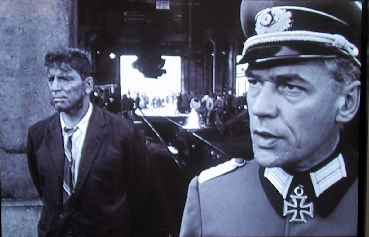
"Just another episode of this whole snuff soap opera we're all in."
Background
After 'Convoy', Peckinpah spent five years in the wilderness. It had been the same with 'Major Dundee'. Then, Daniel Melnick's offer of 'Noon Wine' for TV proved the life-raft that led to an initially productive relationship with Phil Feldman and Peckinpah's masterpiece, 'The Wild Bunch'. This time, though, the comeback wouldn't be quite as spectacular.
Don Siegel had given Peckinpah his first gig on a movie set back in 1954. Now at the end of his own career, the director of 'Dirty Harry' and 'Escape from Alcatraz' - the man who had done arguably as much as Sergio Leone in making Clint Eastwood an icon - was reduced to calling the shots on a half-assed Bette Midler vehicle called 'Jinxed'. Hollywood might have written Peckinpah off, but Siegel had no hesitation in hiring him as second unit director to shoot an elaborate action sequence. Peckinpah got his drinking and predilection for thin white lines under control, turned up on set and demonstrated rigid professionalism.
It was his ticket back to directing. Sadly, he'd only get a shot at one last film. Most of the offers that came in were uber-low budget and held no interest. Still, it was important to get back behind the camera so he picked the best of a bad lot and accepted producers Peter Davies and William Panzer's offer to direct 'The Osterman Weekend'.
 Synopsis
CIA bigwig Maxwell Danforth (Burt Lancaster) encourages zealous agent Lawrence Fassett (John Hurt) to pursue Russian spy ring Omega. Fassett is traumatised from his wife's murder, but throws himself into the assignment. He identifies TV writer Bernard Osterman (Craig T. Nelson), financier Joseph Cardone (Chris Sarandon) and plastic surgeon Richard Tremayne (Dennis Hopper) as members of Omega who might be "turned". He posits to Danforth that their friendship, dating back to college, with political pundit John Tanner (Rutger Hauer) could provide the wedge to get at them. Danforth gives him the go ahead. Fassett presents Tanner with evidence against his friends. Tanner is distraught, but sees an opportunity he can exploit: long critical of Danforth's machiavellian counter-intelligence techniques, Tanner agrees to assist Fassett on the condition that Danforth consent to be interviewed on Tanner's high-rating and controversial current affairs TV show 'Face to Face'. Danforth assents. Fassett kits out Tanner's home with a panoply of surveillance equipment in advance of Osterman, Cardone and Tremayne arriving at Tanner's home for their annual reunion (events known as "Osterman weekends" in honour of Bernard Osterman, who instigated the tradition). Before the guests have even arrived, Tanner gets cold feet at his wife Ali (Meg Foster) and son Steve's involvement and against Fassett's wishes, drives them to the airport. A kidnap attempt en route is foiled by Fassett's men at the last moment and Tanner reluctantly decides to do things Fassett's way. The guests arrive, but it isn't long before tensions run high. Fassett's supposedly "invisible" presence is belied by a series of manipulations, and when Tanner finally discovers the truth about his friends' conspiratorial behaviour he realises things aren't as Fassett would have had him believe. The agent has a quite different agenda ...
 Analysis
Having come that far with the synopsis, allow me to tip things into PLOT SPOILER territory and let the cat out of the bag. 'The Osterman Weekend' - once you've got the first 80 minutes (which are pure misdirection) out of the way - is about how Fassett, who has discovered that Danforth ordered his wife's murder, coerces Tanner into staging the promised TV interview with Danforth as a j'accuse, Fassett using the medium to publically charge Danforth with her murder. A quixotic exchange between Danforth and one of his aides casts doubt on whether Omega even exists ("Omega is as real as we need it to be," Danforth declares).Because 'The Osterman Weekend' is so ludicrously overplotted (it borders on narrative incoherence), and because it's easy to just give up on trying to follow the plot and just kick back and wait for the action scenes instead, the twist almost convinces on first viewing. Subsequent viewings throw up a raft of inconsistencies. Put bluntly, this movie's got more holes than a lump of Swiss cheese. For example:
Why does Danforth order the hit on Fassett's wife? (A throwaway line makes reference to her being employed at the Polish Embassy. Not even the Russian Embassy, for fuck's sake! And if Danforth, as Fassett's boss, was worried about his employee possibly being compromised, wouldn't it be less troublesome to bump Fassett's security clearance down a few notches rather than having his missus whacked?)
How does Fassett find out that Danforth ordered the hit? And if he's convincingly created a non-existent spy ring and manipulated evidence to implicate Osterman, Cardone and Tremayne, why doesn't he just implicate Danforth and destroy his career that way?
If Omega doesn't exist and Osterman, Cardone and Tremayne aren't members of a Russian spy ring (all they're conspiring in is a tax dodge), why do they freak out when Fassett flashes up the Omega symbol while they're watching a home video at Tanner's house? (Granted, the implication exists that Omega is the Swiss bank in which they're squirreling away their retirement fund.)
Who's behind the kidnap attempt on Ali and Steve? Can't be Omega since they either don't exist or they're a bank. It's suggested that Fassett masterminds it, the better to get Ali and Steve back to the house (their absence would be suspicious), but Tanner tells Fassett of his plans literally seconds before he bundles Ali and Steve into the car and drives off. The staged kidnapping is flamboyantly elaborate, utilising cars, helicopters, industrial machinery, a dozen or so men and the apparent gunning down of an "enemy" agent - surely something that even a man of Fassett's calibre would be hard pressed to organise at a moment's notice.
Why, during a shoot-out at Tanner's pool house between Tanner (now aided by Osterman) and Fassett's men, does Fassett give the order to take them both out? The object of the exercise is to secure Tanner's co-operation in using 'Face to Face' as a platform against Danforth. With Tanner dead he'd be back to square one.
There are more narrative problems than these - many more - but why dwell on the aspects of the film that don't work? Blame can easily be apportioned and none of it is Peckinpah's. Robert Ludlum's novel - though the mechanics of structure and narrative are worked out differently - doesn't make a whole lot of sense, either. The screenplay - by Alan Sharp (from a separately credited adaptation by Ian Masters) - fails to establish a clear narrative through-line and only succeeds in confusing things.
So what does work about 'The Osterman Weekend'? Peckinpah himself certainly didn't claim credit for very much. He notoriously remarked, having finished work on it, that he'd just made his first exploitation movie. You can see his point. The violence is apropos of nothing. The expression of that violence - hand-to-hand, whatever's-to-hand, artillery, crossbows - comes across as the product of a checklist rather than the organic development and visceral resolution of psychologically established conflicts a la much of Peckinpah's other work. The nudity is half-hearted, curious sexless and seems to be fulfilling a quota. In many respects, 'The Osterman Weekend' is determinedly formulaic.
But, while it's budgetary restrictions are as painfully evident as the fact that the espionage genre was singularly not its director's metier, 'The Osterman Weekend' boasts some sneakily subversive moments where Peckinpah dodges the shortcomings of the material (and even arguably exploits them) to create something that is clearly his own. Peckinpah's key theme - alongside considerations of honour and loyalty and a keenly observed depiction of how men interact - was always the intrusion of technology. Technology as a destructive force. When 'The Osterman Weekend' was made, home video was presenting cinema with its greatest threat since the television set became omnipresent in American homes in the 1950s. There were now greater opportunities for producers to make low-budget fare, usually bracketed firmly in the exploitation category, and release them direct to video. Indeed, 'The Osterman Weekend' found its audience on VHS. Ironic, since the film functions best as a deconstruction of audience addiction to the small screen and the manipulation of the moving image.
The opening sequence shows Fassett and his wife making love (she is murdered shortly afterwards); the footage is revealed as a surveillance tape Danforth and his aide are reviewing. And yet the multiplicity of camera angles and sophistication of editing far remove it from CCTV or security footage; it has, instead, the feeling of a "mini-movie". Thus Peckinpah sets out his stall: he is concerned less with Ludlum's tricksy, convoluted plotting than the nature of perception and the audience's complicity in the images they view. Tanner has made his living from TV. His house and lifestyle are testament to the financial rewards he has gleaned from his TV show; a show in which he puts his guests on the spot, his editors cutting to unflattering close-ups while these unfortunates squirm under difficult questions, while presenting Tanner himself as righteous and unflappable. There's a small pleasure to be had - one laced with schadenfreude - in watching Fassett turn the medium against Tanner. In this respect, there's a slender case to be made for 'The Osterman Weekend' as a 'Peeping Tom' for the VCR generation. "Just another episode of this whole snuff soap opera we're all in," is how Fassett puts it. Tanner, although ostensibly triumphant, is nonetheless forced to re-evaluate his life and work in the closing frames, "Television programmes are just a filler between attempts to steal your life," he muses. "So if you want to save some, switch off. It's simple. It's done with the hand and what's left of your own free will."

The last shot is of two cameras pointing at an empty chair. There's something desperately valedictory about that image.