Tampilkan postingan dengan label Steve McQueen. Tampilkan semua postingan

Rabu, 10 Februari 2010

Steve McQueen blog-a-thon at The Cooler next month

Jason Bellamy at The Cooler is hosting a Steve McQueen blog-a-thon between 24-27 March.

McQueen is one of the genuine icons of American cinema, his minimalist acting style comparable to Clint Eastwood’s. McQueen’s characters probably emerge with a little more careworn humanity than Eastwood’s, though.

I’ve not decided which of McQueen’s films I’ll be looking at yet (I’ve already explored his two-film relationship with Sam Peckinpah in last year’s Peckinpah tribute), but there’s enough stone-cold classics on his CV to go at.

Head over to Jason’s blog if you want to sign up for the blog-a-thon; you’ll be in good company.

Kamis, 17 Desember 2009

The Getaway

“That’s the problem with this goddamn world, ain’t no morals.”


Background
With 'Junior Bonner' dying a death at the box office, Peckinpah was in need of a hit. He wasn't the only one. Steve McQueen hadn't starred in a substantial box office hit since 'Bullitt' in 1968. His production company, Solar, was in trouble. Peckinpah knuckled down, kept his drinking under control, and committed himself to delivering a professionally crafted, taut and exciting commercial product. It wouldn't be the last time he'd make a deliberate sop to the box office, but never again would he do so in such good faith. He would respond to 'The Killer Elite' with contempt, 'Convoy' with oblivion, and refer to 'The Osterman Weekend' as his first exploitation movie. 'The Getaway' was the most successful Peckinpah film thus far, even though reviews were generally lukewarm.


Synopsis
Professional thief Doc McCoy (McQueen) is doing hard time and not handling it well. He instructs his wife Carol (Ali MacGraw) to plead his case to Benyon (Ben Johnson), a corrupt official with the right connections to influence Doc's parole hearing. On his release, he undertakes a bank heist, roping in Carol along with hot-headed youngster Frank Jackson (Bo Hopkins) and unpredictable tough guy Rudy Butler (Al Lettieri). The robbery is executed efficiently, but Rudy proves a little too trigger happy. Rendezvousing to divide the takings, Rudy shoots Frank en route and intends to do the same for Doc. But Doc pre-empts him and leaves him for dead. Doc and Carol deliver Benyon's cut to his ranch. Benyon taunts Doc with the revelation that Carol secured his release through sexual favours, then instructs Carol to shoot Doc. Carol blows Benyon away instead. Doc and Carol, their relationship strained by the thankless slapping around that Doc doles out to her (never mind that he'd still be in clink otherwise), go on the lam. Meanwhile, an injured but vengeful Rudy forces henpecked vet Harold (Jack Dodson) and his free-spirited wife Fran (Sally Struthers) first to treat him and then to drive him to Mexico and a return engagement with Doc and Carol. Benyon's bereaved and brooding brother has the same idea and despatches a bunch of guys to go after Doc. All parties converge on the Loughlin Hotel on the outskirts of Mexico and gunplay ensues.


Analysis
There's a prevalent critical attitude that because Peckinpah approached 'The Getaway' as a solidly crafted slice of commercial entertainment, it is a lesser movie and can therefore be dismissed. And while there's no doubt it's a lesser piece of work than, say, 'Ride the High Country', 'The Wild Bunch', 'Straw Dogs' or 'Pat Garrett and Billy the Kid', it's facile to dismiss it on such tenuous grounds. True, Peckinpah made it because both he and McQueen needed a hit. True, he made it knowing full well it wasn't as thematically and aesthetically dense as much of his other work. True, he approached it as a craftsman rather than an artist. But it's still one hell of a damned good film. And it's not the only movie made with an agenda that has still managed to triumph over its less than artistic genesis: the Wachowski brothers made 'Bound' purely as a "proving" exercise to secure studio backing for 'The Matrix' - and for my money, 'Bound' remains the best thing they've done.

Although 'The Getaway' isn't amongst the best of Sam Peckinpah's work, it's still the best of the triumvirate of thrillers - the other two being 'The Killer Elite' and 'The Osterman Weekend' - which he made largely on the basis of commercial considerations (ie. make money for the studio = being allowed to make another film). It's worth noting that 'The Getaway' and 'The Killer Elite' followed productions which flopped (respectively, 'Junior Bonner' and 'Bring Me the Head of Alfredo Garcia') while 'The Osterman Weekend' came after five years out of work post-'Convoy' (but that's another story).

'The Getaway' stands head and shoulders above Peckinpah's handful of other done-for-the-money projects. There are two reasons for this. One: Peckinpah's productive working relationship with McQueen meant he approached the material with some degree of enthusiasm. Two: 'The Getaway' is a western at heart. Beyond the obvious imagery - Benyon and his gang, the thief on the train and the old timer who helps Doc and Carol cross into Mexico all wear cowboy hats; Benyon's office walls are bedecked with bull horns - there are narrative parallels to 'The Wild Bunch'. Doc is released from prison by a corrupt official with his own agenda (cf. Deke Thornton and Harrigan). He masterminds a professionally executed robbery (cf. Pike Bishop). He makes a crossing into Mexico (cf. the Bunch). The only difference is that Doc's "bunch" fragment immediately after the robbery, distrust and betrayal prevalent instead of loyalty and honour. But it's only to be expected really; Pike and co. reach their Calvary in the America of 1913, having already outlived their times. Doc is imprisoned (even after Benyon's sprung him from his literal incarceration) in the America of 1972 - and that's one hell of a lot more soulless and mechanized a place than evening the gotterdammerung of the Old West described in 'The Wild Bunch'. In this respect, it's apposite that Doc is played by the same actor who portrayed Junior Bonner - although the hardened professional criminal and the saddle-sore rodeo rider are nothing alike in many respects, one thing can be said of them that denotes an essentially Peckinpahesque kinship: both had outlived their times while their grandfathers were still in the womb!


The America that Doc moves through - indeed, flees from - is ridden with things that threaten to incarcerate, betray or destroy him. And they're all mechanical or technological. The idea of technology as a malign influence permeates every frame of the movie. It starts with the incredibly well-crafted and viscerally realised eight-minute opening sequence depicting Doc's crack-up in prison. Huge steel bolts slam into place at the touch of a button, securing an entire row of cell doors. Machinery in the prison workshop clatters away interminably. Doc works a textile machine, yanking back the lever regulating the speed of the machine, then slamming it home; yanking it back and slamming it home. The machinery clatters and clanks away. Doc sits in his cell, painstakingly building a matchstick model of a bridge. He works the machine, yanking the lever back, slamming it home. He showers, eyes averted from the naked flesh of his fellow prisoners. He remembers making love with Carol. He tries to shake the memories from his mind. The machinery clatters away. He participates in a work gang, mounted guards cradling shotguns. He works the machine. The walls of the prison, the routines, the grey walls, the guards, the tight perameters of his cell, all press in on him. He works the machine that clatters and clanks away. Memories crowd him. His hands tighten around the model bridge, crushing it, pulping it back into the matchwood it was constructed from. Peckinpah's use of montage and editing are peerless. The psychological portrait he effects of Doc as a man almost destroyed by institutionalisation is immediate, shattering and unforgettable.

Even when Doc is released from prison, a bank of security monitors are framed mounted high on a wall behind him. They seem to peer over his shoulder, as if to remind him that he'll never be free. Later still, after Carol has shot Benyon and the couple go on the run, Doc fiddles with the car radio as they hightail across country. He wants to know if Benyon's made the news yet; do they have a head start or is the law already after them? The radio malfunctions. Technology, when it isn't busy imprisoning Doc, fails him when he needs it. Even later still, in an electrical goods store where he tries to buy a new radio, technology betrays him: a display model television suddenly flashes up his picture on a news bulletin. Doc snaps it off, but the shop assistant has already recognised him.

More so arguably than any of the westerns, 'The Getaway' emerges as an exegesis on technophobia. Steve Judd, Pike Bishop and Cable Hogue kick against the first appearances of technology; Doc is up against it at every twist and turn. Indeed, 'The Getaway' would perhaps emerge as a quintessential Peckinpah film but for two considerations: firstly, virtually everything that preceded it was a more definitive statement of Peckinpah the artist; and secondly, Walter Hill's screenplay (although a gritty enough bit of film writing considered on its own merits) constitutes a considerable watering down of the source material. Jim Thompson's novel is dark, cynical, embittered and basically fucking nasty bit of fiction. The Doc and Carol of the novel suffer the claustrophobic interment of a coffin-sized cave in which they have to wait out a manhunt for two days (claustrophobia is one of my bugbears and it took me three evenings to read this relatively short chapter), which leaves Carol close to losing her mind; later they are hidden by a farmer in crawlspace disguised as a dungheap; and finally they make it into Mexico and spend most of their take from the robbery buying sanctuary at El Rey where, as their funds run low and their relationship fragments, they start wondering how best to bump each other off.

Hill's script imposes a happy ending, which is entirely understandable. Filming Thompson's ending as written would have resulted in a film so bleak it would have made Bergman's 'The Silence' look like a Mel Brooks production. Unfortunately, Hill's Doc-and-Carol-cross-into-Mexico-and-they're-still-in-love-awww-bless ending comes across as even more of a sop to audience expectations in the light of the relationship that developed between McQueen and MacGraw. Film critic Kim Newman expresses it perceptively: "the romantic teaming is so potent that Hill has to omit the novel's cynical last chapter, in which the characters are trapped in a Mexican hell-hole that swallows their personalities, although 'Alfredo Garcia' might be seen as a feature length elaboration of the Thompson sketch".


Newman's observation is freighted with implication. 'The Getaway' is an energetic and exciting slice of intelligently put-together mainstream entertainment; it's the last of an already small coterie of Peckinpah films to have a truly upbeat ending; and yet it points to the darker, blackly comic territory Peckinpah would explore, just two years later, with Warren Oates, Isela Vega and a fly-blown sack containing a severed head.

Selasa, 15 Desember 2009

Junior Bonner

"Some kinda motel cowboy."
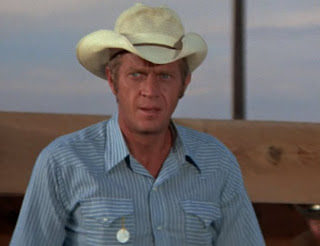


Background
Peckinpah went straight from 'Straw Dogs' to 'Junior Bonner', marking the first and only time in his career he directed two films in the same year. Steve McQueen was already attached to star. The shoot was untroubled and Peckinpah's drinking - which had precipitated his hospitalisation during 'Straw Dogs' - was under control for the duration of the production. Although Peckinpah only went a day overschedule, he exceeded the $2.5 million budget by an extra $1 million. Ignorning both Peckinpah and McQueen's assertion that the film should open small, generate reviews and word of mouth and gradually find its audience, the studio gave it the kind of "opening weekend" release better suited to one of McQueen's action pictures. Despite some very good notices, it flopped. Nonetheless, the relationship between Peckinpah and McQueen remained strong and it was on the basis of 'Junior Bonner' that the actor offered Peckinpah directorial duties on 'The Getaway'.


Synopsis
Rodeo cowboy Junior Bonner (Steve McQueen) nurses a grudge and hell of a lot of bruises from an encounter with a Brahma bull of intemperate disposition named Sunshine. Returning to his home town of Prescott for a return engagement with said bovine, Junior is just in time to witness the house he grew up in demolished by bulldozers to make way for a new real estate development. The realtor: Junior's corpulent and money-obsessed brother Curly (Joe Don Baker). Curly tries to inveigle Junior into acting as a spokesman for his business, taunting him about how little he makes on the rodeo circuit. Junior also discovers Curly's condescending treatment of their father Ace (Robert Preston), struggles to reconcile his affection for the old man with his awkward and stilted relationship with his pragmatic mother (Ida Lupino), and ignores the taunts of his rodeo rival Red Terwilliger (Bill McKinney). There's a few things on Junior's mind, then, as the rodeo gets underway, a carnival atmosphere grips Prescott and Ace tries to talk Junior around to his latest hare-brained scheme: a new life on a ranch in Australia.


Analysis
It was usually the case that Peckinpah responded to screenplays for their potential; he would then develop that potential, often by laborious re-writing or re-imagining. Often Peckinpah is credited as co-author and even in the cases of 'Ride the High Country' and 'The Ballad of Cable Hogue', where the original writers retain full credit, Peckinpah rewrote entire sections of dialogue, infusing these films with saddle-creased poetry. With Rosebrook's screenplay for 'Junior Bonner', however, nothing needed to be done. Peckinpah signed to direct after reading it once: it was a jewel of a script, in tune with the key themes and concerns that define Peckinpah’s work.

We have a hero schooled in the old way of doing things who resents the changing times: Junior's life is the road and the rodeo, he’s more at home outdoors or on horseback than anywhere else, he has a frontiersman’s tough but laconic attitude, and he balks at his brother’s entrepreneurial mindset. Same goes for Ace: he's a drifter and a dreamer, a man whose natural habitants are the saddle and barstool, and he has arguably less place in the modern world than his son.


We have technology as a destructive force: large machines destroy a homestead to make way for a land/property deal driven by a businessman's greed for profits – a nakedly Peckinpahesque subtext that, as we shall see, recurs explicitly in 'Pat Garrett and Billy the Kid'. When Junior sees the bulldozers ramming through the walls of his childhood home, Peckinpah intercuts the scene with shots of the house while it was still standing and close ups of its interior, harshly contrasting the warm, homely details (including, poignantly, a yellowing newspaper cutting about one of Junior's earlier rodeo successes) with scenes of impersonal destruction. Junior drives over, but he's prevented from getting any closer by a 'dozer driver who threatens to dump a load of gravel into Junior's open-top car if he doesn't back up and depart.

This is where the aesthetic of 'Junior Bonner' differs from any other Peckinpah film: where Steve Judd or Gil Westrum, Pike Bishop or Dutch Engstrom, Pat Garrett or Billy - hell, even Cable Hogue - would have filled their hand at that point and done something about it, Junior just sticks it in reverse, goes on his way and has to live with it.

There isn't a single shot fired in 'Junior Bonner', which makes it unique in Peckinpah's filmography. Even 'The Ballad of Cable Hogue' - which is essentially about love and redemption - has its hero blow a couple of recidivists away. It is completely non-violent: a bar-room brawl that breaks out towards the end is played for laughs, while the inevitable dust-up between Junior and Curly consists of exactly two punches being thrown. Junior hits Curly. Half an hour passes. Curly hits him back. End of.

Nor is the rivalry between Junior and Terwilliger in the same league as the compromised relationships between Pike Bishop and Deke Thornton or Pat and Billy. Indeed, Junior's chatting up of Red's girlfriend (apropos of which the brawl erupts; ironically, Junior ducks any involvement and uses the melee to cover his absconsion with the girl) is the only real dramatic development that this subplot engenders.

It never ceases to amaze me just how genial, laconic and unhurried 'Junior Bonner' is. But for the excitingly shot and edited rodeo sequences (DoP: the incomparable Lucien Ballad; editors: Frank Santillo and Robert Wolfe) and the colourful pangeant scenes, there would be no pace to the film at all. And yet it's as watchable and engaged as anything Peckinpah did. Why? Because the man was an actor's director and for an actor's director the character study is as dynamic and dramatic a thing to direct as the most full-on, visceral, cathartic scene. McQueen, who took the role in an attempt to move away from the action hero roles that define his screen persona, achieves in 'Junior Bonner' an acting style as minimalist and unfussy as that of Clint Eastwood. It's such a different side to McQueen and so refreshing to watch.


The rest of the cast do stellar work: Robert Preston is rogueish and irrepressible as Ace; he gives a performance that outshines anything else on his CV. Ida Lupino, no stranger to giving beautifully nuanced performances, brings a spiky vulnerability. Her scenes with Preston zing with acerbic wit. Peckinpah Irregulars Ben Johnson and Dub Taylor make every second of their supporting roles count. And Joe Don Baker, a scene-stealer in everything from 'Charley Varrick' to a couple of the Brosnan Bond movies, justifies every scene he steals by fleshing out Curly and making him more than just the profit-obsessed villain-by-default businessman. When he asks Junior to work for him, he makes no bones about being able to exploit his rodeo reputation to generate business ("big cowboy like you, sincere, genuine as a sunrise"); and yet the offer's motivated by a genuine desire to see Junior better himself, even if Curly's way of expressing it is misguided. "I'm working on my first million," he tells his brother. "You're still working on eight seconds."

It's Junior who gets there first, though. And what he does with the prize-money provides the most affirmative finale in Peckinpah's ouevre.