Rabu, 30 April 2008

Elizabethtown

Pray indulge me in a couple of paragraphs of name-dropping, tenuous connections and simpering fanboy subjectivity. Still with me? Good. Here goes:

I share a birthday - today - with Kirsten Dunst. I also share said birthday with Willie Nelson, Burt Young and the King of Sweden, but while Mr Nelson has cut some damn good records, Burt Young has fetched up in a Peckinpah movie ('The Killer Elite') and the King of Sweden is ... well ... the main royal dude in Volvo-Land, it's Ms Dunst I'm turning my attention to because, quickly frankly, she wins out in the cuteness and likeability stakes.

Now, in the interests of fairness, it has to be said I've never met Kirsten Dunst (nor have I ever met Messrs Nelson, Young or K of S), so it's an open field as to whom might prove the better drinking buddy or make that decisive shot in a game of doubles round the pool table. I'm basing my bias solely on the impression I get from Kirsten Dunst's onscreen persona. And - I say it again - it's purely subjective. A personal predilection. But when I watch Ms Dunst - in any movie (and how many actresses would I have sat through 'Bring It On' for?) - I get the same feeling, the same borderline adoration that, say, Audrey Tatou inspires in 'Amelie', or Amy Adams in 'Enchanted'.

This is something that my partner is likely to read, so I'd best curtail these musings before I'm summarily evicted to the doghouse, birthday or no birthday, and get to the business at hand:

'Elizabethtown'. Which is, in my humble opinion, Cameron Crowe's best film. At this point, I'm guessing the average response is going to be: Yeah whatever, you're only saying that because you fancy the leading lady. Take a cold shower, say five Hail Marys and watch 'Almost Famous' again. Good call. 'Almost Famous' is arguably Crowe's purest film: like 'Elizabethtown', it is free of the metaphysical pretensions of 'Vanilla Sky' and unburdened with the histrionics that marred 'Jerry Maguire' (even now, just thinking about Cuba Gooding Jnr jumping up and down bawling "Show me the money" makes me want to punch him).

'Elizabethtown', though ... the first time I saw it, it reminded me why I love movies.

The opening sees shoe designer Drew Baylor (Orlando Bloom) summarily dismissed after his bold new design for a sports shoe spectacularly fails, costing the company millions. $974 million, to be exact. "You can kind of round it off to a billion," CEO Phil DeVoss (Alec Baldwin) wryly opines. Depressed, dumped by trophy girlfriend Ellen (Jessica Biel), Drew is in a 'goodnight Vienna' kind of mood. In a sequence that's funnier that it has any right to be, he rigs up his exercise machine with a non-manufacturer-approved attachment: a gleaming, wickedly sharp kitchen knife. Only for the duct tape to give out and the knife fall off at the point of impact.

This is when Drew gets a phone call from his sister Heather (Judy Greer) informing him that their father has just died. Highly-strung Heather is freaking out and demands that Drew drop everything and come home to take charge of the arrangements ("you're the responsible one"). Drew takes a long-haul red-eye flight to Louisville, where his father was visiting family in the town of his birth. Drew's hyperactive mother (Susan Sarandon, in her best performance in years) gives him strict instructions to represent her side of the family and organise the cremation. She is also scathingly critical of the paternal side of the family.

So it is that Drew heads to Elizabethtown, not knowing what to expect. What he finds is a simpler way of life, a genuine sense of community and fraternity; what he learns is the true meaning of family.

On the flight, he meets quirky flight attendant Claire (Dunst at her most radiant). An unlikely friendship develops, then deepens, and Drew eventually realises that his life, far from being over, is just beginning. Their courtship is gently and lovingly sketched: the pivotal telephone conversation, played out against a backdrop of rowdy revellers who overrun the hotel Drew checks into; the drive through the night, just to meet for a few moments ("we peaked on the phone"); Claire accompanying Drew to choose his father's urn; that kiss.

'Elizabethtown' is film of many levels and many emotions: black comedy segues into Capraesque magical realism, family drama rubs shoulders with feel good romance, and the final act evolves into a freewheeling road movie.

Perhaps the most memorable set piece involves a performance of Lynyrd Skynyrd's 'Free Bird' and gives a whole new meaning to the phrase "and the band played on". Music, of course, has always been a hallmark of Crowe's film-making, and 'Elizabethtown' boasts the kind of soundtrack you'd expect. First time I saw the film, at Nottingham's Cineworld multiplex, I headed straight for Virgin afterwards and bought the CD. It's massaged the ears on many a car journey since.

Granted, 'Elizabethtown' slips into sentimentality on more than one occasion, and Crowe pulls a final reel steal from 'Amelie' that shouldn't have been necessary for a director of his calibre, but - ultimately - who cares? 'Elizabethtown' is a beautiful, life-affirming film, best seen with someone you care about.

Selasa, 29 April 2008

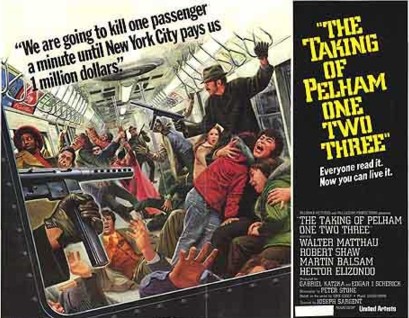
PERSONAL FAVES: The Taking of Pelham One Two Three

A comparison:

Tony Scott has made a lot of highly successful, glossy, superficial films ... and some notable ones, such as the sensuous and glossy vampire drama 'The Hunger', the energetic and profane (but still glossy) Tarantino-scripted 'True Romance', and the claustrophobically tense 'Crimson Tide', which isn't really glossy at all because it's set on a submarine and even Tony Scott would be hard pressed to make a submarine look glossy.

Joseph Sargent has made a bunch of stuff, predominantly for TV, that you've probably never heard of ... and 'The Taking of Pelham One Two Three'.
I mention this because Tony "more gloss than Dulux" Scott is currently remaking 'The Taking of Pelham One Two Three'*, a thriller about the hijacking of a New York subway train and the holding to ransom of its passengers. A few guesses about the remake:

It won't open with transit cop Zachery Garber grouchily escorting a group of Japanese visitors around the control centre, using their assumed lack of facility in the English language to be as sarcastic about his co-workers ("this is Lieutenant Petrone, on weekends he works for the Mafia") as he is about them ("this way, you monkeys"). This not being PC, like.

The hostages will actually have names, and not be bluntly referred to (and then only in the closing credits) as, variously, The Mother, The Hooker, The Pimp, The Old Man, The Alcoholic and The Homosexual. This not being PC, either.

The hijackers' ransom will be adjusted for inflation from the cool million demanded in the original.

The hijackers won't use colour-coded pseudonyms - Mr Blue, Mr Green, Mr Grey, Mr Brown - since this conceit is so ineffably associated in the popular movie-going consciousness with Tarantino's 'Reservoir Dogs', never mind that 'Pelham One Two Three' did it first.

I'll give Tony Scott the benefit of the doubt - the gloss of sarcasm earlier in this post notwithstanding - and wait till his 'Pelham' comes out (it's due next year) before I pontificate any further. For now, let's consider Joseph Sargent's 1974 original, adapted from the novel by John Godey - a film which has never quite achieved the status of classic, but which I think it richly deserves.

Opening with David Shire's poundingly unsubtle score - my partner, watching the film for the first time, wondered aloud whether she was in for a straight thriller or a spoof - Sargent wastes no time introducing his villains and establishing a milieu. This is New York in the 70s, as edgy and grimy as only American cinema of that decade could ever capture it. The subway is an unfriendly, offputting place; the people who travel it, a bustling amorphous mass. Into this environment - dressed similarly in long coats, hats, glasses and moustaches, carrying bulky parcels - come Mr Blue (Robert Shaw), Mr Green (Martin Balsam), Mr Grey (Hector Elizondo) and Mr Brown (Earl Hindman); the packages are opened; semi-automatic weapons appear; a pistol is pointed at the driver. Pelham One Two Three is taken.

Garber (Walter Matthau)'s comedy of embarrassments with the Japanese is soon eschewed in favour of incrementally ratched-up tension as Garber finds himself forced to liaise between the hijackers and the NYPD, themselves frantically awaiting approval from the Mayor's office to deliver the ransom. Mr Blue, coldly mercenary, stipulates an hour for delivery of the million, after which he promises to shoot one hostage per minute until his demands are met.

With the clock ticking and the Mayor (Lee Wallace) a bumbling incompetent, 'Pelham One Two Three' segues from hostage drama to race-against-time thriller. (This is one of the reasons I love the movie: it deftly avoids the inert, static nature of the hostage genre.) With approval - reluctantly - from City Hall to pay the ransom, Sargent then concentrates on the logistics of assembling one million dollars in used, non-sequentially numbered bank notes (as per Mr Blue's instructions) and the NYPD's attempt to transport it across town during wall-to-wall traffic. His attention to detail is as acute during these scenes as it was during the build-up to the hijack. Likewise the minutiae of the hijackers' plan to escape with the moolah.

And yet Sargent's attention to detail is never overly technical, nor does it slow things down. 'Pelham One Two Three' is a superbly paced film. Never mind that there aren't that many action scenes, the sheer sense of urgency propels the narrative. Performance-wise, an offbeat cast gels perfectly. Matthau brings just enough baggage from his more famous funnyman roles to make Garber a rumpled, sardonic, likeable character. Shaw is terse and no-nonsense as Blue. Balsam brings a nervous immediacy to the role of a former subway driver brought in by the hijackers for his technical knowledge. Elizondo commendably plays down what could have been an exercise in cliche as the almost obligatory loose cannon. Jerry Stiller (Ben's dad) is great value as the laconic Petrone.

Ultimately, there's just so much to like about 'Pelham One Two Three', not least the delightfully ironic coda wherein Garber and Petrone track down the remaining gang member. The final shot is priceless, and "Gesundheit" belongs in the pantheon of great last lines.


*Although I understand from IMDB that the title of Scott's version has been rendered 'The Taking of Pelham 123'. See what he did there?

Jumat, 25 April 2008

In Bruges

"Two manky hookers and a racist midget. I'm outta here," opines Ken (Brendan Gleeson). "I'm coming with you," his friend and fellow hitman Ray (Colin Farrell) replies mournfully, their evening's misadventures yet another blow to Ray's already jaded opinion of Bruges.


It's to this history-heavy and nightlife-light Belgian town that Ken and Ray have been sent by their boss Harry (Ralph Fiennes) after a bungled job. Ray, all bored sighs and mumbled disenchantment, is like a moody teenager. "If I'd grown up on a farm and was retarded, Bruges might impress me," he grumbles upon arrival, having barely seen anything of the place, "but I didn't, so it doesn't." He only brightens up when they come across a film crew shooting a pretentious dream sequence for an art-house movie. "They're filming midgets!" he exclaims delightedly, rushing off to watch.


Said midget, Jimmy (Jordan Prentice), prefers the epithet dwarf. Ray, however, isn't above demeaningly calling him Shorty when his coke-addled rant turns to the race question. Not that Ray isn't a walking xenophobe himself. He heaps abuse on Belgium in general and Bruges in particular, gleefully gets into a fight with an American (he twats the fellow with an almost cheery "that's for John Lennon, you fucking Yank cunt") and is visibly deflated when he discovers later that his antagonist is actually Canadian.


Or how about this exchange between Ken and Jimmy:


Ken: Are you American?
Jimmy: Yes, but please don't hold it against me.
Ken: I won't. Just try not say anything too loud or crass.


Martin McDonagh's debut film 'In Bruges' is essentially a two-hander for its first half, a post-Tarantino 'Odd Couple' with its contract killer heroes (I use the word 'heroes' loosely) bonding, bickering and bantering against a picture postcard backdrop, while Jimmy and on-set drug pusher Chloe (Clemence Poesy) weave in and out of their interactions. And it's very funny. McDonagh's script zings with hilarious and quotable lines, even if you wouldn't drop any of them in front of your mother. I can't remember a film since 'Sexy Beast' with so many instances of the 'c'-word.


Take the following conversation, the film having veered into darker territory with revelations about the nature of the bungled job and Harry's arrival in Bruges to take matters in hand. Ken stands up to his boss and offers him a few home truths:


Ken: Let's face it, Harry - you're a cunt. You've always been a cunt. The only thing that's gonna change is that you'll become an even bigger cunt. Maybe have some more cunt kids.
Harry: You retract that bit about my cunt fucking kids.
Ken: I retract that bit about your cunt fucking kids.
Harry: Insulting my fucking kids! That's going overboard, mate.
Ken: I retracted it, didn't I?


The 'Sexy Beast' comparison is apt, not just for the language but in the usually suave Fiennes's full-throttle performance as a dangerous mob boss, a la Ben Kingsley's in Jonathan Glazer's film. But whereas 'Sexy Beast' lost the plot after a rivetting first half, 'In Bruges' doesn't put a foot wrong, ramping up the tension and sense of danger once Harry puts in an appearance, but without sacrificing the surreal humour or losing sight of its characters' humanity.


This last is the ace up McDonagh's sleeve. You shouldn't really give a damn about any of these characters: Ken, Ray and Harry are killers by profession (Ray's blunder, revealed at a key moment, weighs heavily against him), Jimmy is a coked-up self-important bit part actor who parties with - well, Ken put it best - manky hookers, and Chloe deals drugs and wastes herself on a thuggish skinhead boyfriend. Shit, just typing that sentence is enough to make me appreciate just how heavy-handed and grim 'In Bruges' could have been in lesser hands.


However, Martin McDonagh, an acclaimed playwright set to garner the same kind of encomium in the film world, brings enough insight, intelligence and lightness of touch to the proceedings to make you care about the characters (even Harry is a man of principles who takes care not to endanger a pregnant woman), and - Peckinpah-esque ending notwithstanding - to make you laugh out loud. The performances are uniformly excellent, with Farrell proving a revelation.


'In Bruges' doesn't necessarily want to make me go to Bruges (at a guess, it wasn't endorsed by the Belgian Tourist Board) but I do want to go back to my local multiplex and see it again.

Kamis, 24 April 2008

The Host

‘The Host’ opens with a US military type browbeating a Korean serviceman into illegally dumping some chemicals into the Han River in Seoul. Cut to: two fisherman noticing a mutated aquatic life form. Cut to: someone committing suicide off a bridge over the Han, a hulking shape awaiting him under the churning surface of the dark water.

That’s all there is by way of prologue or provenance. Five minutes later, the beastie is on the rampage. Wonderfully-named director Joon-ho Bong pitches his first big set-piece in a fractured filmic middle ground between comedy and terror. The monster is part laughable, part grotesque. But it moves. Thundering out of the water, it charges along the riverbank; chaos ensues. When it dives back in, it takes with it a young girl. Her divided, dysfunctional family spend the rest of the film trying to get her back.

Sounds formulaic enough, but Bong takes the material, by degrees, into less expected territory. Farcical family squabbles are played out against a backdrop of military intervention, the monster’s “infected” victims herded brutally into quarantine. The government – its strings pulled by the US military – turn out to be as monstrous, and as threatening to the protagonists’ survival, as the beast itself. Perhaps more so.

The final stand-off against the monster comes after two hours of governmental deception, media hysteria and social betrayals on every level. The beast has become a metaphor for la bete humaine – the beast in man. The creature feature has become political.

Small quibbles: the film is a tad overlong; the effects in the explosive finale could have benefited from better CGI. But these are minor matters. Ultimately, ‘The Host’ is a damn good movie, playing fast and loose with genre conventions, pulling the rug gleefully out from under the audience as the broad humour of the first half morphs into political satire of the sharpest and darkest hue.

Selasa, 22 April 2008

Bang! short film festival this weekend

This Saturday and Sunday, the Broadway Cinema in Nottingham is hosting a Bang!, a weekend-long festival of short films.

The event kicks off at 3pm on the 26th with the Young Filmmakers Matinee. The Broadway are trumpeting the inclusion of Cheryl Marshall’s Bafta-winner ‘United Polar Showtime Dancers’, but Tony Passarelli’s ‘Kid’s Talk’ could easily prove the star of the show.

Tickets are £2.50 from the Broadway box office. Here’s the link.

Minggu, 20 April 2008

PERSONAL FAVES: The Good, the Bad and the Ugly

Clint Eastwood's role as Rowdy Yates on the long-running western series 'Rawhide' made him a TV star.

It was Sergio Leone's 'Dollars' trilogy that made him a movie star.

'A Fistful of Dollars' established Eastwood's laconic, minimalistic big-screen persona ("get three coffins ready") and, building on his 'Rawhide' fanbase, inextricably linked him with the western. 'For a Few Dollars More' sealed the deal.

Then Leone made 'The Good, the Bad and the Ugly'. Now don't get me wrong: Clint Eastwood is cool in 'The Good, the Bad and the Ugly' (or 'Il Buono, Il Bruto, Il Cattivo' to quote its indigenous title). Let's go even further: Clint Eastwood is fucking iconic. Clint Eastwood has always been one of my favourite actors, and his career behind the camera has been equally impressive.

I just wanted to make that clear. I don't want any misunderstandings. The next paragraph should in no way be interpreted as dissing Clint Eastwood. Okay? Right; here goes:

Eli Wallach owns 'The Good, the Bad and the Ugly'. He rules it. He defines it. Eli Wallach as Tuco, the splendidly amoral Mexican bandido, acts as a perfect foil to both Eastwood's Man With No Name* and Lee Van Cleef's Angel Eyes and steals the film from both of them. He also gets all the best dialogue**, as well as providing a masterclass on how to turn profanity into high art. For instance:

To No Name, riding him into town trussed to a saddle, to collect $2,000 in reward money: "You'll pay for this. I hope you end up in the graveyard, with the cholera and the rabies and the plague ... You filthy bastard. I hope your mother ends up in a two-dollar whorehouse."

On No Name entering the sheriff's office only to be replaced in Tuco's line of sight by the sheriff himself: "Who the hell is this? One bastard go in and another one come out."

To No Name, as he collects the reward money: "You know what you are? You're the son of a thousand fathers, every one of them a bastard like you. And your mother, it is better that we do not speak of her."

To a particularly locquacious would-be assassion: "If you need to shoot, shoot - don't talk."

Wallach's performance is bigger than life - in a good way. He attacks the role with relish, tearing into it, a whirling dervish on the screen, full-blooded and going for it big style. It's a performance completely suited to Leone's style of film-making. At his best (and 'The Good, the Bad and the Ugly' is Leone's best, with 'Once Upon a Time in the West' coming a close second), Leone's filmic landscapes, his characters, their dialogue and conflicts are bigger than life. But never exaggerated. Hyper-real would be a better description.

The Man With No Name isn't just a gunslinger: he's the gunslinger - he draws so fast it's a blur; the shots from his pistol seem louder than explosions; every bullet finds its target. Angel Eyes isn't just a mercenary killer: he's demonically driven, knocking around women and shooting men and children in pursuit of the information that will take him closer to the location of a horde of buried loot.

And Tuco isn't just a bandido: he's a one-man testament to amorality - listen out for his list of crimes the first time No Name saves him from the hangman's noose. Or how about his self-justification during a debate with his brother, a man who turned to the church: "You think you're better than me. I tell you something: where we came from, if one did not want to die of poverty, one became a priest or a bandit. You chose your way, I chose mine. Mine was harder ... You became a priest because you are too much of a coward to do what I do."

'The Good, the Bad and the Ugly' - a film where the Ugly grungily fits the description, the Bad is even badder than bad, and the Good is only the good because (a) he's marginally less of a bastard than the other two, and (b) Clint Eastwood's playing him - is a melting pot of amorality, antagonism and naked greed. It's for no small reason that one of the highlights of Ennio Morricone's score (surely the most instantly recognisable soundtrack in cinema history) is titled 'The Ecstacy of Gold'. With all of which played out against a backdrop of the civil war, Leone fashioned a film that, despite its violence and cynicism, is perversely beautiful. The script is dime-store poetry not just writ large, but writ to fill cinemascope! The visuals go from extreme close-ups to panoramic vistas within the blink of an eye. The whole thing is, to quote Quentin Tarantino, "cinematically perfect".

Films of this genre helmed by Italian directors were often cheap knock-offs of popular American titles, and were generally referred to, part-affectionately part-mockingly, as spaghetti westerns or horse operas. Leone bucked the trend and fashioned both a film and a unique directorial style that would inspire generations of film-makers down the decades, and remains just as influential today. But maybe those terms aren't necessarily derogatory. Let's reclaim them. 'The Good, the Bad and the Ugly' is a spaghetti western in that it's as rich and filling and spicy as the best Italian meal you've ever eaten; a horse opera in that its director was the Giuseppe Verdi of cinema, bold and brilliant and dramatic, the pistol shots of his final showdown ringing out like the Anvil Chorus.


*A bit of a misnomer: in the credits to 'A Fistful of Dollars' he's called Joe, in 'For a Few Dollars More' he's called Monco, while Tuco in 'The Good, the Bad and the Ugly' gives him the nickname Blondie.

**Same deal with 'The Magnificent Seven', in which Wallach again plays a bandit - best line (justifying his wholesale theft and terrorisation of the peasant villagers) "If God had not meant them to be sheared, he would not have made them sheep." Ouch!

Jumat, 18 April 2008

Thank You For Smoking

“Michael Jordan plays ball, Charles Manson kills people, I talk.”

This is how ‘Thank You For Smoking’ protagonist Nick Naylor (Aaron Eckhart) rationalises his job. The points of reference are telling: like Jordan he’s a consummate professional, at the top of his game. Like Manson, he ‘enjoys’ a reputation as a mass-murderer – at least with the anti-smoking league who howl in protest at his lobbying tactics on behalf of the big tobacco companies. The self-deprecation of the “I talk” part of the statement emphasises the wry humour and affability that help get his less-than-socially-acceptable message across.

Naylor’s moral flexibility goes without saying. He socialises with similarly-employed spokespeople for alcohol and firearms – the MOD Squad, they call themselves (MOD an acronym for Merchants Of Death). When his ex-wife’s surgeon boyfriend castigates Naylor for not raising his son in a smoke-free environment, Naylor responds “I’m his father; you’re just fucking his mother.”

Does this make Naylor sound despicable? A callous cynic? Not so. He’s actually a pretty decent guy. Does the best job he can for his paymasters. Proves a good father to his son, despite his ex’s efforts to the contrary – the scenes between them are poignant and beautifully played. Written and directed by Jason Reitman, from Christopher Buckley’s novel, ‘Thank You For Smoking’ centres around a likeable man doing an ultimately risible job, that of presenting a negative message in a positive light. Even then, said message is more about freedom of choice than endorsement of product.

If all this sounds heavy and portentous, fear not. It’s funny as hell, sharply satirical, stylishly directed and brimming with whip-smart dialogue. The ensemble cast is to die for: Maria Bello as one of Naylor’s fellow lobbyists (her biggest coup: getting the Pope to endorse red wine), J.K. Simmonds as Naylor’s cut-throat boss, Rob Lowe as the most glib Hollywood executive this side of ‘The Player’, Robert Duvall as a Machiavellian tobacco baron, William H Macy as a bumbling senator and Katie Holmes as a scheming reporter out to expose our hero.

In the midst of this talent, Eckhart stands head and shoulders, delivering a career best performance. The phrase ‘lights up the screen’ would be a cheap gag in context of the film – except that it happens to be true.