Tampilkan postingan dengan label personal faves. Tampilkan semua postingan

Jumat, 26 Februari 2010

WORK SUCKS: Fight Club

“Advertising has us chasing cars and clothes, working jobs we hate so we can buy shit we don’t need. We’re the middle children of history, men: no purpose or place. We have no great war, no great depression. Our great war is a spiritual war. Our great depression is our lives.”

Thus spake Tyler Durden (Brad Pitt). Tyler Durden is the –

No, wait, back up. Bob. Bob had bitch tits –

No, wait, back up a bit further. There’s this guy, Cornelius (Edward Norton), assumed name, but what the hell, he’s the guy telling the story so let’s just call him The Narrator. Corporate guy, suit, briefcase, flight coupons, condo full of designer furniture, by his own admission “a slave to the Ikea nesting instinct”. He works for a car manufacturer, our boy, and his job involves travelling the length and breadth of the States examining car wrecks to determine if the number of similar models in the field times the possibility of the fault recurring times the average out-of-court settlement is less than the cost of a recall; if so, no recall.

The Narrator, uh, narrates this job spec to a fellow passenger during a domestic flight. She looks alarmed. Our boy, in the meantime, banks on the plane banking as a prelude to a mid-air collision. And why not? “Life insurance pays out triple if you die on a business trip.” Fortunately (or otherwise) our boy doesn’t cark it during a routine flight. Instead, he meets pragmatist, soap manufacturer and wannabe pugilist Tyler Durden.

After a conflagrant misadventure afflicts his Ikea-lined condo, our boy moves in with Durden. Chez Durden is a des res for people who deem “shithole” more important in estate agent (ie. realtor) terms than “no upward chain”. This is immaterial. The terms and conditions of relocation to said locale is that our boy hit Tyler as hard as he can. Our boy’s hesitant. Tyler’s insistent. The rationale? What do you know about yourself if you’ve never been in a fight.

They trade blows in a pub car park. This leads to mass brawling in said pub car park. The whole scene goes underground (literally) in the basement of said pub. The landlord, Lou, objects … briefly. Next thing you know, everyone who’s working a shit job and getting no satisfaction out of life is turning up, losing the tie, adhering to the no shirts/no shoes rule, and finding more than a soupçon of validation in beating the ever-loving shit out of each other.

“No fear. No distractions. The ability to let that which does not matter truly slide.”

Next thing you know, there’s homework assignments and priests are being provoked into exchanging blows, corporate art is desecrated, computer shops blown up, tower blocks with smiley faces daubed on their glass-fronted façade belch flames, hoardings are appropriated for public (mis)information sloganeering, and roof-top pigeons are overfed so that the BMW dealership below is beset with guano all over its top of the range models.

‘Fight Club’ is a hyper-stylized, brilliantly constructed, funny as fuck howl against the general piss-awfulness of modern life. It is agit-prop and protest art. It is the big fungoo administered to the false gods of contemporary culture, a corrective to the slavering press panting over celebrity scandal and the profusion of reality TV non-entities. Put the latest ‘X Factor’ media whores up against Norton and Pitt and I guarantee a no-contest smackdown.

“You’re not your job, you’re not how much money you have in the bank, you’re not the car you drive, not the contents of your wallet, you’re not your fucking cactus. You are the all-dancing, all-singing crap of the world.”

For me, the film turns (in the sense of switching from I-hate-my-job wish-fulfilment to something more meaningful; the switch from audience perception to late-in-the-day revelation comes significantly later) when Durden bursts into a convenience store and bustles the clerk out back at gunpoint. He demands the poor unfortunate’s name and wallet. Both are given over post haste. Durden queries the clerk over an out-of-date student card; turns out the lad wanted to be a vet but dropped out because the course required too much studying. “I’m gonna check in on you,” Durden informs him; “if you’re not on your way to being a vet in six weeks, you’re dead.” It’s a pivotal scene both in terms of how the narrative develops (it gets progressively darker) and in gauging audience complicity. Your appreciation of ‘Fight Club’ depends on your response to this scene: do you wince at the Tyler Durden’s treatment of the poor, gibbering unfortunate? Or do you applaud that Tyler Durden has rescued him from a life of subservient drudgery; has in fact liberated him

I fall into the latter category. This may have something to do with having watched the film last night, a good few drinks under my belt, after a shit day at work that included a royal shafting courtesy of the management. Hence the wish-fulfilment aspect of ‘Fight Club’. The scene where The Narrator beats himself up during a one-to-one with his prissy company-man boss is at once the greatest scene of physical comedy this side of a Charlie Chaplin movie and perversely inspiring. Indeed, the whole of ‘Fight Club’ is perversely inspiring. Even when some of The Narrator’s sloganeering is quite obviously that – sloganeering (and whiny with it) – it touches enough of a nerve that you can understand exactly where Pitt and Norton and David Fincher and Chuck Palahniuk (whose debut novel it is based on) are coming from.

I have read reviews by intelligent commentators on film, many of whose opinions I wholeheartedly agree with, who find ‘Fight Club’ juvenile, facile, puerile and emotionally and intellectually hollow. I’m guessing they’ve never wanted to take a swing at their boss, trash their office and shrug off the responsibilities that keep the majority of us tied to our desks and our cubicles and our contracts of employment. I have – on more than one occasion. But because of those aforementioned responsibilities, I’ve kept myself in check.

Thoreau once said “the mass of men lead lives of quiet desperation”. ‘Fight Club’ is the movie that recognises every one of Thoreau’s faceless, nameless, disaffected masses. ‘Fight Club’ speaks out for them, flips off authority on their behalf, and offers catharsis without the detrimental side effects of getting sacked or spending a night in the cells.

(Having said that, I reserve the right to turn up to a Senior Management Team meeting one of these days in a state of bruised dishevelment and bare bloodied teeth in a horrible gargling hiss at some cornflower-blue-tie wearing dweeb of a boss.)

Kamis, 11 Februari 2010

PERSONAL FAVES: An Inconvenient Truth

Posted as part of Operation 101010
Category: documentaries / In category: 2 of 10 / Overall: 10 of 100


FULL DISCLOSURE: before I saw ‘An Inconvenient Truth’ at the cinema in September 2006, I was a sceptic. I gave little thought to environmental concerns and was of the opinion that global warming was just another media scare story. Davis Guggenheim’s documentary swung a wrecking ball against my apathy and non-understanding and my attitude to the media now is that they don’t talk about environmentalism enough.

Full disclosure, too, on the provenance of this post. The eight paragraphs that follow are simply a copy and paste of the review I wrote for my erstwhile blog MovieBuff three and a half years ago. When I selected ‘An Inconvenient Truth’ for the Personal Faves project – and when I hit upon documentaries as one of the Operation 101010 genres – it was my intention to reappraise the film and write an entirely new piece. Looking back at that original write-up, though, I realised that what I wouldn’t be able to capture in a new article was that sense of the scales falling from my eyes; of how much of a wake-up call the film was to me on personal level. So please excuse the slightly breathless prose style, the contextual references to the Bush administration (the Demon Dubya was still in power at the time), and the stupidly obvious mistake in the first paragraph (it’s a Keynote presentation, not PowerPoint – d’uh!); what follows is how I felt in September 2006, just a couple of hours after seeing the film:

On paper, it doesn’t sound like much of an evening at the flicks: 97 minutes of a US politician giving a PowerPoint presentation about global warming, with a few bits of newsreel footage spliced in. But don’t be put off.

‘An Inconvenient Truth’ is a gripping and thought-provoking documentary about Al Gore’s campaign – although a better word would be crusade; the man is passionate and dedicated – to promote understanding of the global climate crisis. Tirelessly travelling from city to city, state to state, his goal is to raise public awareness, eradicate the myths surrounding global warming that have been propagated in the popular press, and – crucially – to encourage his audience that the solution can be social, not political.

Gore’s lack of faith in the Bush administration isn’t just sour grapes at his defeat in Florida, but based on hard-won personal experience of the political process. America has still not ratified the Kyoto Treaty – the only major country (apart from Australia) not to do so. Oil and big business hold sway over policy-making. Gore relates the story of Phillip Cooney, a lobbyist for American Petroleum who was appointed as Bush’s environmental advisor … a conflict of interests by any standards! Cooney’s White House career came to an end after a whistleblower leaked documents that proved he had censored reports warning of the growing climate crisis. The day after Cooney resigned, he went to work for Exxon Mobil.

But of course, the basic facts of global warming are the very things big business doesn’t want to face up to (the ‘inconvenient truth’ of the title): energy consumption and fossil fuels contribute to the huge quantities of CO2 in the atmosphere. Gore charts a direct correlation between CO2 levels and temperature increase. Melting icecaps and glaciers are only part of the problem; extreme weather conditions such as hurricanes and typhoons have also increased dramatically in the last decade, culminating in last year’s Hurricane Katrina.

The evidence is incontrovertible: a simple graph shows how drastically levels have risen since the 1970s. A projection, based on current increase, demonstrates that within 45 years, the effect on Earth’s atmosphere will be one of irreversible ecological damage. Gore’s message is clear: we have a decade in which we can do something; counter the problem; pulls ourselves back from the brink. It sounds bleak, but Gore remains confident that changes can be made.

This is what it will take: as many people as possible taking personal responsibility in a matter of global morality. Will it happen? I can only offer my response to the film:

‘An Inconvenient Truth’ has changed the way I think about certain issues. It has corrected my misunderstanding, based on erroneous and scaremongering reports in the media, of the causes and results of global warming. It has shown me that, on a personal basis, I can make a change.

We all can. Go and see the film, buy the book that accompanies it – and you’ll already have made a start.

Senin, 01 Februari 2010

PERSONAL FAVES: Amarcord

Posted as part of Operation 101010
Category: Eurovisions (Italy) / In category: 1 of 10 / Overall: 6 of 100


A heady blend of ribald humour and arthouse aestheticism, Fellini’s ‘Amarcord’ is an evocation of small town life in 1930s Italy where a mischievous troupe of schoolboys lust after a buxom tobacconist (and I’m talking the kind of figure that makes Pamela Anderson look anorexic); where same recalcitrants interrupt a maths class by threading an expanding tube of paper from the back of the classroom, under row upon row of desks, until it’s just short of the blackboard at which the teacher is labouring, whereupon one of their number micturates through it, the tube swiftly retracted upon completion; where Volpina (Josiane Tanzilli), the good-natured but insatiable town hooker, goes touting for business at a building site only to be moved along by a foreman who prefers his labours to compose poetry than chase after women; where a man let out of an insane asylum for a day trip takes to the top branches of a tree, repelling all who attempt to approach him with stones, and proves himself of the same mindset as the builders, demanding of the fields, barns and farmhouses that stretch off into the distance, “I want a woman!”; where local femme fatale Gradisca (Magali Noël) turns heads as she shimmies through the town square, a vision in red, en route to the cinema to sigh over Gary Cooper; where the quiet streets can at any moment erupt into boisterous activity as a political rally ends in gunfire and arrests or a motor race detours through the town; where the townsfolk en masse board pleasure cruisers and paddleboats and spend a long evening edging into night bobbing on the choppy waters just to watch a liner from America steam past; and where the shadow of fascism darkly encroaches and one poor unfortunate finds himself interrogated and forced to consume castor oil following an ill-advised political remark.


‘Amarcord’ (which means “I remember”) contains all of life and absolutely no plot. Its depiction of those small and quirky moments that invariably form themselves into the clearest of memories is deeply nostalgic, and ‘Amarcord’ rings as true to someone who grew up in England in the 1970s as it must do to anyone who came of age in the time and place Fellini focuses on. And yet it is completely unrealistic, as obviously a movie movie as anything by Tarantino, with a bicycle-wheeling lawyer blithely breaking the fourth wall everytime he wanders into shot, tipping a wink to the audience and proffering another avuncular anecdote.

Indeed, ‘Amarcord’ is the cinematic equivalent of a raconteur propping up the bar and leading his audience through an interlinked sequence of tall tales, none of which have any real point or meaning but are delivered with such panache and sly wit that their very telling is the raison d’etre. It takes a special talent to achieve this verbally, a rare one to do so in writing and the requirement that one is an honest-to-God genius in the medium of cinema. ‘Amarcord’ is directed by Fellini. I rest my case.

Rabu, 20 Januari 2010

PERSONAL FAVES: Little Dieter Needs to Fly

Posted as part of Operation 101010
Category: Werner Herzog / In category: 1 of 10 / Overall: 1 of 100


As a documentarist, Werner Herzog has produced a body of work as striking, challenging and original as any of his feature films. This is the man who used cinema (a visual and aural medium) to explore the world of a blind and deaf woman in 'Land of Silence and Darkness'; who, in 'Grizzly Man', crafted the found footage of an egomaniacal narcissist into something powerful, profound and unsentimental; who made the eccentric, quietly subversive 'Encounters at the End of the World' on the Discovery Channel's dime.

Approaching a Werner Herzog documentary, it's a good idea to put aside any preconceptions of what a documentary is ... or should be. "Cinema verite," Herzog famously declared, "is the truth of accountants." Simply recording events as they happen in front of the camera gives you about as much chance of getting at the truth of something as the doomed penguin in 'Encounters at the End of the World' has of flying to the moon. Although if that penguin did fly to the moon, you can bet Herzog would already be there, as philosophical and unruffled in a space suit as he is mired in the jungle or being shot at during an interview, ready to capture the moment.

Herzog's approach to the documentary form - indeed, to film in general - is to find what he calls "ecstatic truth". There's an example of this not five minutes into 'Little Dieter Needs to Fly', arguably one of Herzog's most compelling documentaries. His subject is German-born American fighter pilot Dieter Dengler. A boy in post-war Germany, haunted and inspired in equal measure by a memory from the war years of an American plane passing so close to his house that for a split second he locked eyes with the man in the cockpit, Dengler emigrated to the US, gained citizenship, joined the air force and was deployed to Vietnam. He had no concept of the geography or the politics of the conflict. He knew nothing - would only realise after harsh circumstances gave him a brutally different perspective - of the sufferings and hostility that were cloaked by the foliage of the jungle.


Dengler's participation in the war lasted for all of one mission. Shot down over Laos, he was captured by the VC. A forced march through the jungle brought him to a prison camp. He slept with his feet locked in place between blocks of wood, his hands shackled to those of the POWs to either side of him. Use of the latrine was a once-a-day luxury. Beaten, emaciated, stricken with dyssentry, men endured their own filth. Their captors evinced ferality but demonstrated an instinctive understanding of how to psychologically demoralise prisoners; break them down; rob them of hope. Dengler, a man for whom the wellspring of optimism evidently never even threatened to run dry, determined to escape. But I'm getting ahead of myself ...


Herzog begins the documentary with the Dieter Dengler of 1997, a Dieter Dengler in late middle age: expressive, affable, a genial host (he opens his doors to Herzog and his crew as if they were old friends) and an interviewer's dream in his candidness and eloquence. Herzog films him driving along an isolated stretch of road in a beautifully preserved 1960s roadster. Dengler pulls up outside of his house, hops out of the car and closes, opens and closes the driver's side door. He does the same thing with the front door to his house. "This may be strange to some people," he says, almost sheepishly, "but to me it's very important, this freedom to be able to open or close a door."

This is the moment of ecstatic truth. As Herzog freely admits in conversation with Paul Cronin, editor of the inspirational Faber film book 'Herzog on Herzog', this was "a scene I created from what he had casually mentioned to me, that after his experiences in the jungle he truly appreciated being able to open a door whenever he wanted to."

And this is where critics of Herzog (yes, such people exist; yes, they're irredeemably lacking in poetry, imagination and a soul) pounce, declaring, "Ah! So he staged that scene. He scripted and directed it. Therefore he is not a documentarist and 'Little Dieter Needs to Fly' is compromised and at least in part a work of fiction."

To such people, I would recommend (a) the immediate acquisition of a life; and (b) the relinquishing of cinema in favour of an interest more suited to their mindset. Trainspotting, maybe. Yes, the door-shutting bit in 'Little Dieter Needs to Fly' isn't a bona fide, documented, totally and utterly unscripted piece of footage. Yes, it was staged. But check out the next scene: Dengler shows Herzog and the camera crew around his house. Every available square inch of wall space is occupied by a painting or a framed photograph. The paintings have a common theme: each of them depict an open door. This bit isn't scripted or staged. See what Herzog's doing? That's right: he's getting to the truth of the matter.

Here's another way he gets at the truth of the matter. He takes Dengler back to Laos.

How many documentaries have you seen where the main participant appears purely as a talking head? Andrew McDonald's 'Touching the Void' springs to mind. The location footage and re-enactments are breathtaking, but ultimately the film is about mountaineer Joe Simpson and the hard decision he had to make regarding his climbing partner, yet we only ever see Simpson against a black background. The distance between Simpson, narrating his recollections in a studio, and the re-enactment cast and crew braving the elements and getting the shots that make the project viably cinematic is all too pronounced.


At the other end of the scale, how many documentaries have you seen where the subject revisits the scene of an emotional or traumatic event, where the camera keeps rolling as said poor unfortunate, emotionally devasted by the renewed cascade of memories, gets all choked up and turns away as the words fail them and the tears start? It's an easy result, a cheap shortcut to the emotional engagement of the audience.

Herzog doesn't do either of these things. He stops short or goes further, depending on your personal reaction to the film.

For all that Dengler is obviously a raconteur, a man who can effortlessly turn a phrase and bring a description to life - for all that the story he's telling is so dramatic that if the film consisted of Dengler facing the camera for two hours and talking without a single edit or bit of archive footage you'd still listen reverently until he'd got through recounting every last detail - Herzog doesn't desist from really getting to grips with the story; really finding his way into the time and the place and the savagery of it.

Herzog not only has Dengler go back to Laos, he has him -

Shit! I can't discuss why 'Little Dieter Needs to Fly' is so maverick a documentary and yet so perfectly Herzog without getting into explicit detail. And if anyone's reading this who hasn't seen 'Little Dieter Needs to Fly', I'd like to think you might want to track down a copy of the film and discover it for yourself without yours truly blurting out the very details that make it so special. Let me just say that Dieter Dengler is the perfect subject for Werner Herzog: he is equally a pragmatist, a poet, a realist and a romantic icon. When he talks about his buddies and his memories, or - in the final sequence - reunites with the pilot who spotted his distress signal and rescued him from VC country, the effect is devastating.

Herzog's documentary has nothing to do with war, troop deployment or US foreign policy. It has to do with the individual. It is essential viewing.

Sabtu, 19 Desember 2009

PERSONAL FAVES: Pat Garrett and Billy the Kid

"It feels like times have changed."


Background
Everything augered well: a director coming fresh from his biggest commercial success to date, returning to the western genre of his first five movies; a script by a young but brilliant writer (Rudy Wurlitzer) seemingly attuned to the zeitgeist; a story based around one of the best known and most mythical histories of the Old West; a cast of genre stalwarts including Chill Wills, Slim Pickens, L.Q. Jones, R.G. Armstrong and Jason Robards, headed up by screen legend James Coburn and folk hero Kris Kristofferson; and a soundtrack by heir apparent to Kristofferson Bob Dylan, the singer-songwriter debuting in a supporting role. What could go wrong?

James Aubrey, that's what. Aubrey was the president of MGM and a hatchet man. He culled, curtailed and compromised MGM's film production, slashing budgets and fucking over filmmakers, and funnelled the money into the corporation's hotel/casino interests. Of all the producers Peckinpah battled with over the years, it is Aubrey who can properly be reckoned his nemesis. Their antagony was evident from the outset. Budget and shooting schedule were set way under what Peckinpah deemed necessary. The services of an engineer Peckinpah wanted on location (to ensure the cameras didn't suffer from the inclement weather conditions in Mexico) was denied. Consquently a damaged flange went undetected, rendering a week's worth of footage out of focus. Aubrey forbade reshoots. Peckinpah re-shot every bit of compromised footage on the QT.

Essentially, 'Pat Garrett and Billy the Kid' played out the way 'Major Dundee' had: Peckinpah rebelled against the studio while on location, going overbudget (by more than $1.5 million) and overschedule, only for the suits to take their revenge when he returned from location shooting. Every one of Peckinpah's films (except for 'Bring Me the Head of Alfredo Garcia') suffered from post-production interference, but this usually happened once he'd turned in his preferred cut. 'Pat Garrett and Billy the Kid' arguably has the distinction of being the one Peckinpah film for which a director's cut never really existed in the first place. With Aubrey dead set on muscling Peckinpah out and stripping 'Pat Garrett' down to an hour and a half of shoot outs and fuck anything resembling character development or narrative coherence, Peckinpah found himself bartering scenes while editing was still in progress, offering to make cuts here and there in order to safeguard, for example, the raft sequence.

A fine cut was produced for which two preview screenings were permitted. Since Peckinpah was not present at its erstwhile screening for the suits, and since so many compromises had been made already, it's dubious as to whether this can be considered Peckinpah's final cut. Aubrey wanted the length reducing and shanghaied the editing team into working to this end behind Peckinpah's back, threatening that non-compliance would result in his turning it over to less experienced editors whose only remit would be to hack it down to 90 minutes. What happened next is the stuff of legend. Remembering that a work print had been left in a screening room, Garth Craven and Sergio Ortega, assisted by Peckinpah's driver Chalo Gonzalez, gained entrance to said location under the cover of night, Mysteriously, the print wasn't there next morning. It was soon realised the print didn't have any sound. Funnily enough, another disappearance occurred.

The Aubrey-approved cut-to-ribbons 96 minute cut of 'Pat Garrett and Billy the Kid' was released in July 1973 to muted reviews and average box office. In October of the same year, MGM ceased film distribution and sold its entire back catalogue to United Artists, an event which precipitated Aubrey's resignation. "Mr Aubrey is no longer employed," Peckinpah mused shortly afterwards; "so maybe I have done something good for the world." A pyrrhic victory, maybe, but the fact still remains: James Aubrey was unemployed and Sam Peckinpah went on to make another five films.


Synopsis
Las Cruces, New Mexico, 1909. Ageing Sheriff Pat Garrett (James Coburn) is in dispute with landowner John Poe (John Beck) over a lease agreement. Garrett and Beck's association goes back to 1881 when Garrett tracked down his former friend and partner in crime Billy the Kid (Kris Kristofferson), but they've come to a parting of the ways. With Garrett old and embittered and publically critical of the Santa Fe Ring, Beck and his business partners consider him a liability - an embarrassing throwback to the old days - and are planning to assassinate him. In his last few moments alive, Garrett relives those infamous days and the terrible denouement that made him a sheriff and the Kid a legend.


Analysis
I've kept the synopsis short for two reasons: (i) 'Pat Garrett and Billy the Kid' is a simple story in the way that 'The Wild Bunch' is simple, ie. narratively (Peckinpah collaborator Gordon Carroll summarised the plot as "a man who doesn't want to run ... pursued by a man who doesn't want to catch him"); and (ii) this article's waltzing towards the 1,000 word mark and I haven't even started analysing the film yet.

There's probably another 1,000 words that can be written about the opening credits sequence. Events in Las Cruces, 1909 (Poe's betrayal of Garrett) and Fort Sumner, 1881 (Garrett's reunion with the Kid a week before he takes the post of sheriff, ie. just prior to his betrayal of Billy) are intercut. When Garrett rides into Fort Sumner, he finds the Kid and his minions amusing themselves shooting the heads off a bunch of chickens buried up to their necks in the dirt. At Las Cruces, Poe's henchman mumbles something about checking a harness, instead pulling a rifle from a saddle roll; another gunman crawls through the sagebrush, ready to take up his position. The shots that follow cut between target practice and cold-blooded murder. Billy's men blast the heads of chickens; Poe's open fire on Garrett. Timeframes overlap. So does the soundtrack. "Damn near perfect," one of Billy's acolytes declares, apropos of a summarily despatched chicken ... but the words echo as Garrett takes a shot and slumps to the ground. Peckinpah's use of editing ramps up the emotional impact of the sequence: a potshot Billy takes at a chicken seems to travel through time and strike Garrett; purposefully aimed coups de grace by Poe's men result in the heads being blasted off helpless fowl.

Peckinpah's signature freeze frames are used as bluntly and brilliant as in 'The Wild Bunch'. As Garrett struggles to rise from the dusty ground only to sink back defeatedly, Peckinpah isolates the moment. He uses this image to accompany the film's title. He arrives at his "directed by" credit in equally iconoclastic fashion. The 1909 prologue documenting Garrett's death throes gives out the 1881 Fort Sumner sequence, and a very much alive - and younger (though still notably middle-aged) Garrett comes riding into town. Billy the gang don't notice him, so busy are they decimating the local feathered populace. Hopping off his horse, he hefts his rifle and, while Billy's still aiming, sights on a chicken and blows its head off. Billy's boys go diving for cover, panic written on their faces. Billy turns round, slowly and wryly, and greets his old friend with a grin. Some spiky banter ensues (it's clear some of the Kid's hangers-on aren't too happy to see Garrett), then the two of them head off to the bar for a couple of shots of whisky and the business at hand:

Garrett: Times are changin', Billy. You want it straight?
Billy: If that's what you're here for.
Garrett: The electorate want you gone. Out of the country.
Billy: Well, are they tellin' me or are they askin' me?.
Garrett: I'm askin' you. But in five days I'm makin' you, when I take over as sheriff of the county.

Peckinpah's directed by credit appears at this point, in a freeze frame that enforces the pause between "I'm makin' you" and "when I take over as sheriff". It might not be as quotable as "if they move, kill 'em" in 'The Wild Bunch', but by God it gives the line some weight!

The dynamic has thus been established: Garrett and the Kid are equally protagonist and antagonist. Neither are exactly heroes, though Peckinpah both empathisizes with the weight of world-weary experience that seems to be etched into every line on Garrett's face, and appreciates the self-aggrandizing behaviour of Billy (particularly in his escape from the Lincoln County jail). Neither are entirely villains, either, even though Billy is a notorious outlaw who refuses to change his ways, and Garrett is a former outlaw who commits the greater sin (certainly in the grand scheme of Peckinpah's aesthetics) of not remaining true to himself and trying to change with the times.


Oh yes, Garrett is the first (and last) of Peckinpah's western protagonists to break with the tradition of Steve Judd, Pike Bishop and co. and Cable Hogue. This is perhaps the most significant element of the dynamic/antagonism between Garrett and Billy - it's summed up during their conversation just after the opening credits:

Billy: Sheriff Pat Garrett. Sold out to the Santa Fe Ring. How does it feel.
Garrett: It feels like times have changed.
Billy: Times maybe, but not me.

Which makes it pretty clear that, since neither Garrett or the Kid are entirely good guy or bad guy, the real villain of the piece is the changing times. Or rather the men who are responsible for changing them. The men responsible for political corruption, financial chicanery, corporate conspiracy and the fencing off of frontier territory, the free and open spaces partitioned, owned, leased and jealously guarded. Men like high-living politico Governor Wallace (Jason Robards), eminence grices Holland and Norris (the power behind Wallace's throne), grasping landowner John Chisum (Barry Sullivan) and toadying parvenu on the make Poe. If 'The Wild Bunch' and 'The Ballad of Cable Hogue' depict technology as the instrument of change, then 'Pat Garrett and Billy the Kid' looks back to 'Ride the High Country' ("the days of the forty-niners are past and the days of the steady businessman have arrived") - only here the steady businessman has been replaced by the rapacious businessman, the dollar-obsessed businessman, the businessman who rapes the land and values human life lower than his profit margin. Corruption and bribery are rife. At an interview with Wallace, the Governor offers Garrett an incentive towards Billy's expedited apprehension:

Wallace: We're offering a reward of one thousand dollars for the Kid's capture. You can have five hundred now.
Garrett: Well, I aim to bring the Kid in. But until I do, you'd better take your five hundred dollars and shove it up your ass and set fire to it.

One of the most curious aspects of 'Pat Garrett and Billy the Kid' - and I'm damned if I can work out whether it's a flaw or a masterstroke - is how determinedly Peckinpah keeps the Chisum/Wallace/Poe conspiracy offscreen. True, all three of them get at least one significant scene (Garrett's encounter with Wallace is thorny; with Chisum, cautious), but they remain backgrounded, shadows that creep around the edges of Garrett's pursuit of Billy. The depiction of Chisum in particular is borderline bland. It's as if Peckinpah is saying "yup, these are the villains, these are the guys hellbent on destroying the old ways, these are guys without souls who answer only to money and power and influence, but by Christ they're nobodies - they ain't really men".

Peckinpah has more time for Deputies Bell (Matt Clark) and Ollinger (R.G. Armstrong), the latter completing the triumvirate of fanatical religious types the actor specialised in (following on from Knudsen in 'Ride the High Country' and Dahlstrom in 'Major Dundee'. Both are in the way when Billy liberates himself from Lincoln Country jail. Kristofferson's characterisation of Billy melds ruefulness and cold determination when he comes up against Bell. It's a different story with Ollinger. The two men have already entered into a spirited disagreement over spiritual matters, Ollinger committed to making sure Billy "gets with god" ("I'll take you for a walk across Hell on a spiderweb") and Billy responding to Ollinger's pious "On your knees" with a pithy "Kiss my ass". Billy's summary dispatching of Ollinger burns with the visceral and iconic intensity that fuelled Peckinpah's reputation as "Bloody Sam".

Peckinpah has more time for Sheriff Baker (Slim Pickens) and Black Harris (L.Q. Jones), whose exchange of fire after Garrett co-opts the former to help in smoking out the latter results in Baker's agonisingly slow passing, stumbling down to the river, gut-shot, and sitting by the slowly flowing waters, the silvery play of light on the surface, as his breathing grows shallower and the life ebbs out of him. At the same time terrible and utterly beautiful, it's one of the greatest scenes Peckinpah ever shot. Likewise the narratively pointless but poetically eloquent scene where Garrett, in a playful throwback to the outshooting-Billy-at-Fort-Sumner scene, accidentally provokes an exchange of fire with a passing raftsman, only for both men to pause, reflect and lower their guns at the critical moment. Both of these scenes are redolent of Peckinpah the humanitarian, Peckinpah the poet, Peckinpah the wounded romantic, desperately aching for a time that's changed and bitterly regretful of the forces that changed it. They give the lie to the cliche of Peckinpah as a purveyor of violence for its own sake.


Peckinpah has more time for a coffin-maker named Will ... of whom more tomorrow. I've expended about 2,500 words already and I think that one short scene between Garrett and Will (who serves, variously, as conscience, ghost and alter ego) deserves an article of its own. For now, I'll just say that 'Pat Garrett and Billy the Kid' - given its troubled production, its director's tendency to drinking to insensation on set, the disservices done to it in editing, and its rejection of propulsive/exciting/urgent pacing typical of a chase narrative - ought to be a complete mess. And certainly there's a wonky, woozy, slightly off-kilter feel to the film. Watching it is like being punch-drunk. But it's also multi-layered, a film that repays repeated viewings. A film that worms its way under your skin and disseminates its genius slowly and subconsciously.

Rabu, 09 Desember 2009

PERSONAL FAVES: The Wild Bunch

"When you side with a man, you stay with him - and if you can't do that, you're like some animal. You're finished. We're finished!"


Background
The slow road out of his years in the wilderness following the 'Major Dundee' catastrophe and his firing from 'The Cincinnati Kid' began with his adaptation of 'Noon Wine' for the TV drama show 'ABC Stage 67'. Netting him Writers' Guild and Directors' Guild nominations and his best notices since 'Ride the High Country', he found himself in demand again. Head of production at Seven Arts, Kenneth Hyman was on a roll after the staggering success of 'The Dirty Dozen' and was looking to develop another action movie vehicle for Lee Marvin under the auspices of Warner Brothers. The project he had in mind was called 'The Diamond Story' and Peckinpah didn't think much of the script. Nonetheless, Hyman appointed producer Phil Feldman to work with Peckinpah. Neither of them cared much for 'The Diamond Story' and their attention was soon drawn to a couple of other scripts: 'The Wild Bunch' and 'The Ballad of Cable Hogue'.


It's entirely possible that Hyman would have called time on their extracurricular activities and ordered Peckinpah to knuckle down to 'The Diamond Story' but for one factor. 20th Century Fox had just paid half a million (an unprecedented amount for a script at that time) to William Goldman for 'Butch Cassidy and the Sundance Kid' and handed the reins to George Roy Hill. Industry buzz was high. There was probably no better time to make a western. Feldman saw 'The Wild Bunch' as a challenge to 'Butch and Sundance' at the box office. He was convinced it had blockbuster written all over it. 'The Diamond Story' was summarily abandoned and Feldman and Peckinpah threw themselves into 'The Wild Bunch'.


The production was suitably epic. Peckinpah, predictably, went overbudget. He exposed 330,000 feet of film, printing most of it so that he'd have an amorphous mass of material from which to work in the editing room. There were over 1,200 camera set-ups. Feldman didn't question any of Peckinpah's techniques. Their relationship was so good that their next project, 'The Ballad of the Cable Hogue', went into pre-production while editing work was still being completed on 'The Wild Bunch'. Things very quickly and irreversibly soured between them. While Peckinpah was scouting locations for 'Hogue', Feldman - pressured by the studio to bring 'The Wild Bunch' down to a two hour cut - caved in and, behind Peckinpah's back, snipped twenty minutes out. This was the last straw for Peckinpah - who already considered the 140 minute cut a compromise from his original three and a half hour version - and, true to form, kicked off very publically against Feldman and Warner Brothers, ending his association with both.


Synopsis
Grizzled outlaws Pike Bishop (William Holden), Dutch Engstrom (Ernest Borgnine) and the bunch ride into the town of Starbuck. Disguised as US army personnel, they storm into a railroad office and steal the payroll at gunpoint. Outside, under the nominal command of Pike's former partner Deke Thornton (Robert Ryan), a posse of bounty hunters are lying in wait for them. Deke entered into a bargain with railroad boss Harrigan (Albert Dekker) whereby he's bought his way out of jail in return for hunting down the bunch. A vicious shoot-out occurs and some of the bunch are killed. The surviving members head back to their rendezvous with Sykes (Edmond O'Brien) and divide the loot - only to realise they've been had. The money bags they risked their lives for are filled with washers. With Deke and the bounty hunters on their trail, they cross into Mexico where they stay briefly at youngest gang member Angel (Jaime Sanchez)'s village. The place is decimated; Angel's father has been killed by despotic Mexican general Mapache (Emilio Fernandez) while his girlfriend has gone off and whored herself at Mapache's hacienda. The bunch fetch up at Agua Verde where a rash decision on Angel's part precipitates an uneasy alliance with Mapache, who is being advised by a high ranking officer of the Imperial German army. The bunch are soon contracted by Mapache to rob a munitions train. The robbery is well-planned and executed, but they still have to face Mapache's treachery, the pursuing bounty hunters and the realisation of their own failings.


Analysis
Broadly speaking, the key themes of Peckinpah's work are:

1) Times change, yet Peckinpah's heroes - men of a certain era, men of a certain mindset - would rather die than change with them.
2) Technology encroaches, its results only ever destructive.
3) Loyalty, honour and codes of conduct are thrown into harsh relief - and tested sorely - by the inherently compromised morality of his protagonists.
4) How men behave, interact, are defined by their actions and - sometimes - redeem themselves.

Just as broadly speaking, the most recurrent visual motifs in his films are: mirrors (as early as the 'The Deadly Companions' there's a shot of a gunslinger pumping a bullet into his own reflection, an image revisited with shattering clarity of purpose in 'Pat Garrett and Billy the Kid'), children bearing witness to or emulating the worst of adult behaviour (in almost every film: here it's a bunch of giggling children watching red ants swarm over a scorpion before heaping kindling over insects and arachnid alike and burning the lot), and automobiles as avatars for the death of the Old West (first glimpsed almost running Steve Judd over in 'Ride the High Country' and later a threat to Cable Hogue's business in Peckinpah's 'Wild Bunch' follow-up).

Not only are all of these present in 'The Wild Bunch' - along with his stylistic trademarks of slo-mo and freeze frames - but they synthesize perfectly into a vital, intense and immediate statement of who Peckinpah was as an artist, as a filmmaker and as a man. Re-reading these last few paragraphs, I've used the word "men" a lot, and probably opened myself up to the kind of criticism that dogged Peckinpah throughout his life and is still applied by commentators unable (or unwilling) to look into his films with the depth they demand. It's such an easy thing to do to label Peckinpah "macho", to say that he made films about men that were shot through (pardon the pun) with an aesthetic of violence. It's easy to say that because - on an incredibly superficial level - it's true. But Peckinpah, for all the gunfire and the blood squibs, was a director of anti-violence. What gives his films their psychological complexity - and what continues to render his work difficult for some people - is that he incorporated the anti-violence, the bloody and infinitely painful messiness of it, into a powerfully realised iconography that challenged the audiences' reactions. Michael Haneke works towards a similar end - but without the acutely observed degree of characterisation that makes even the most minor characters in a Peckinpah movie spring to life, and with a coolly cerebral European approach that establishes an intellectual distance between the screen and the audience - and scoops critical plaudits.

Peckinpah made films about men, but he wasn't afraid to show their failings. Pike fucks up: it's his complacency which leads to Deke's arrest which in turn leads to his deal with Harrigan; backstory reveals that it was his complacency in his affair with a married woman that got her killed; and it's his complacency in dealing with the handover of munitions to Mapache following the train robbery that sees Angel - already antagonistic towards Mapache - sent with Dutch to trade the last batch of rifles. Mapache accuses Angel of stealing a case of rifles and takes him prisoner. A grim, guilt-ridden Dutch rides out of Agua Verde alone, leaving Angel to his rival's brutal ministrations. At least two of these mistakes lead to a testing of the friendship between Pike and Dutch. Take their altercation after Deke's men open fire on a defenceless Sykes:

Dutch: Damn that Deke Thornton to hell!
Pike: What would you do in his place? He gave his word.
Dutch: Gave his word to a railroad!
Pike: It's his word!
Dutch: That ain't what counts - it's who you give it to!

This mirrors an earlier contretemps between a disgusted Thornton, surveying the aftermath of the protracted gunfight in Starbuck, and a brutally pragmatic Harrigan:

Thornton: Tell me, Mr Harrigan, how does it feel gettin' paid for it? Gettin' paid to sit back and hire your killings with the law's arms around you? How does it feel to be so goddamn right?
Harrigan: Good.
Thornton: You dirty son of a bitch!


Peckinpah said of 'The Wild Bunch': "I wasn't trying to make an epic, I was trying to tell a simple story about bad men in changing times. 'The Wild Bunch' is simply about what happens when killers go to Mexico. The strange thing is that you feel a great sense of loss when these killers reach the end of the line." When Peckinpah says "simple story", he means simple in terms of its plot. Psychologically and subtextually, it's fucking complex. He's right: his characters are killers; remorseless ones and not scared of death themselves. Suspecting that Mapache's second-in-command Herrara (Alfonso Arau) will attempt to shanghai the munitions from them off the robbery, they rig up the wagon with dynamite and call Herrara's bluff by light the fuse. He backs down, but the scene is played out with such steely resolve that there's no doubt Pike and co. would rather blow themselves to hell than back down. When they reach the end of the line, it's not just because Thornton's men have kept them trapped in Agua Verde. When they - SPOILER ALERT - go out in a hail of bullets after a protracted gun battle against vastly stronger numbers, it's not just because of what happened to Angel. They have reached the end of the line in that they have outlived their times; the world has moved on and there is no place for them in the new scheme of things. 'The Wild Bunch' is Peckinpah's first western to be set in the twentieth century, not the 1860s. 'The Ballad of Cable Hogue', set in the early 1900s, continued the theme while the prologue to 'Pat Garrett and Billy the Kid' sees Garrett as a bitter old man in 1909 before flashing back to the main body of the action in 1881. 'The Wild Bunch', though, is Peckinpah's most explicit j' accuse of the social, political and technological upheavals that destroyed the Old West and buried the frontier spirit. 'The Wild Bunch' takes place in 1913.


"These days are closing fast," Pike muses, early on, "we gotta start thinking beyond our guns." The point is rammed home when the Bunch encounter Mapache's automobile. They summarily label it an "ugly damned thing", only for Sykes (ironically the oldest of the group) to prove the most cognizant of changing technology: "I hear they got one of those things up north that can fly." Tector Gorch (Ben Johnson) mocks him: "You damned old fool, that's a balloon." Pike sets the record straight: "No, the old man's right. They've got motors, wings, go sixty miles in less than an hour. Gonna use them in the war, they say." One year before the Great War, the atrocity that - to quote Wilfred Owen - "slew ... half the seed of Europe one by one." Pike Bishop and the Bunch in this world? Hell no, they'd rather die first, a decision borne out when the one remaining survivor of the Bunch, Sykes, throws in his lot with the men from Angel's village. "Ain't the way it used to be," he muses, in a line which pretty much sums up Peckinpah's worldview and his directorial ethos, "but it'll do." But - and this is the masterstroke - before these kiilers, these bad men, reach the end of the line, Peckinpah gives them their humanity. The sojourn in Angel's village allows us to see them variously relaxing, larking about and reminiscing. When Pike, midway through a reflective conversation with the village elder, breaks off to watch the Tector and Lyle (Warren Oates) playing a game of cat's cradle with one of the village girls, laughing innocently and exhibiting none of their usual lasciviousness towards anyone female, he remarks "Now that I find hard to believe." In a line that is key to any heartfelt appreciation of the film, the elder replies: "Not so hard. We all dream of being a child again, even the worst of us. Perhaps the worst most of all."


We all dream of being a child again, even the worst of us. Perhaps the worst most of all. I'll put that line up against all the criticism that's ever been levelled at Peckinpah that he was nothing but a director of violence. Paul Seydor states in his magnificent book 'The Westerner Films - A Reconsideration' that is "impossible not to recognize in [Peckinpah] the wounded romantic, the tragic idealist, the agonizer believer". And it is impossible, in my opinion, to watch 'The Wild Bunch' and not be utterly convinced that, in his finest moments as a filmmaker, Sam Peckinpah entered his house justified.

Kamis, 26 November 2009

PERSONAL FAVES: The Dam Busters


In his sixty year career as director, Michael Anderson has chalked up over 40 features for cinema and television. He has a proven track record as a director of war films, sci-fi and espionage. His filmography includes 'Operation Crossbow', 'The Quiller Memorandum', 'Logan's Run' - commercially successful in their day and, to a greater or lesser degree, still reasonably popular. On the flip side, we have 'Doc Savage: Man of Steel' and 'Orca: Killer Whale' (succinctly: semi-colons in the title = avoid).

A decade into his career he made his one bona fide classic, a strong contender for the title of finest British war movie ever made: 'The Dam Busters'.

So how come 'The Dam Busters' is so good when the rest of his work runs from the acceptably entertaining to the ploddingly routine by way of the completely forgettable ('Second Time Lucky', anyone)?

Three reasons, I think:

1) A thoughtful and clear-sighted screenplay by R.C. Sherriff, drawing on Paul Brickhill's eponymous book and Guy Gibson's memoir 'Enemy Coast Ahead', which follows the story from development and trialling of Barnes Wallis's revolutionary bouncing bomb through the formation of 617 Squadron and their legendary bombing run - incurring heavy casualties - on the Ruhr dams.

2) Eric Coates' timeless 'Dam Busters March' - a work not actually written for the film (Coates was no aficionado of composing for the cinema and generally turned down commissions for film work) but, by coincidence, completed as an exercise in an Elgarian march and given its title just days before the film's producers prevailed upon him to contribute to the score.

3) The story has everything that even the most over-heated script writer's imagination could dream of - a new, unorthodox weapon; a visionary scientist up against committees and bureaucrats; an elite unit put together for the purpose of a top secret mission; a desparate bombing run involving low-level night flying, heavily fortified enemy targets and an objective that could shorten the war - with the added benefit that it happens to be true*.


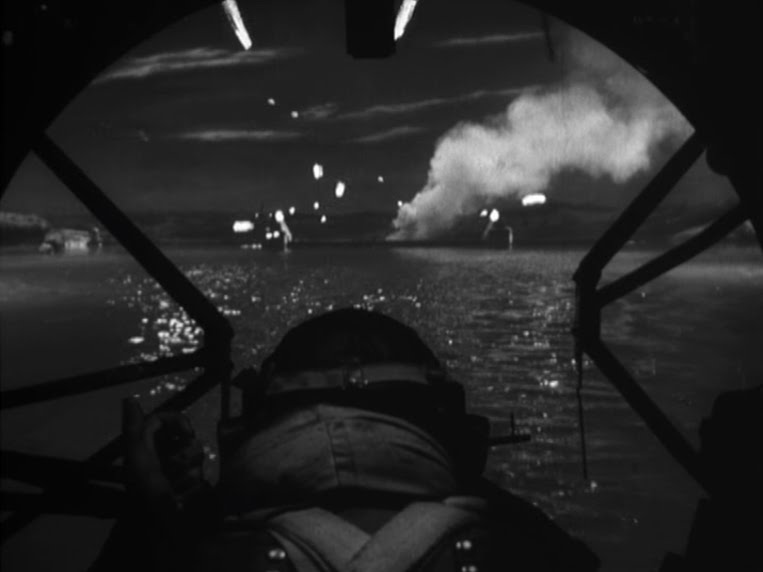
Or rather, the curious synergy of these three elements. Curious because the Boy's Own thrilleramics that even a cursory checklist of the film's narrative components (point 3) seems to promise is held firmly in check throughout - and often entirely negated by - the refusal of Marshall's script to indulge in obvious melodrama or gung-ho tub-thumping (point 1) and the emotive admixture of resilience and melancholy that imbues Coates's music (point 2). To describe 'The Dam Busters' in terms of the stiff-upper-lip Britishness specific to that time (a film from the mid-50s looking back to events of the mid-40s) would be a little too obvious, as well as verging on cliche. And yet there is about it a quietness, a calmness - even (especially) in the scenes of the Lancaster bombers holding steady at just 60 feet above the surface of the dams, flak peppering the sky around them, the bomber aimer's voice intoning "Steady ... steady" with almost preternatural detachment - that for all its understatement is redolent with the courage, the spirit, the heroism of the men it portrays.


'The Dam Busters' shares with 'Appointment in London' the depiction of flyers for whom hazardous missions, anti-aircraft fire and the prospect, every time they took off, that this mission could be their last were quite simply the accepted facets of a night's work. These were men for whom the extremes of aerial warfare were just a job. The last scene, between Gibson (Kenneth More), just back from the mission, and Wallis (Michael Redgrave), distraught at the squadron's losses, is a perfect example. When Wallis opines that if he knew how many men would be lost he would never have "started this", the pragmatic Gibson recommends that he see the base's medic for a sleeping pill and try to get some rest. Wallis enquires if Gibson is going to call it a day. A shake of the head, despite the long night and devastating mission he has just endured. "I've got some letters to write," Gibson says. More's delivery nails the pragmatism, the normality of it. No big emotional speech, no watery eyes or wavering voice. Instead, a realistic acceptance underpinned by a steely resolve that the job has to be done.


Or, to put it more succinctly, 'The Dam Busters' is refreshingly free of heroics while remaining, indubitably, a film about heroes.


*The film takes commendably few liberties with historical fact, and those it does are mainly in regard to Wallis's struggles to convince the top brass of the practicality of the bouncing bomb.

Sabtu, 19 September 2009

PERSONAL FAVES: Django

Challenge ten people at random to write a synopsis of their favourite western, and I'm betting at least eight out of the ten would start "Deke/Zeke/Jake [delete as applicable] rides into town and ..."

In Sergio Corbucci's 'Django', the eponymous anti-hero walks into town and ...


Whoa. Let's back up a moment. Django (Franco Nero) doesn't even get into town before his misadventures start. Dragging a coffin behind him, Django arrives at a rope-bridge on the outskirts of town where he witnesses a group of Mexicans flogging a woman, Maria (Loredana Nusciak). Before he can intervene, the Mexicans are gunned down by a bunch of Yankees. Rather than rescuing Maria, however, it's their intent to tie her to a cross and burn her. This time Django does intervene.

So: body count already in double figures, a heroine who's earned the disapprobation of rival factions, and an enigmatic outsider about to play those selfsame antagonists off against each other. And we're only five minutes into the movie. Our boy hasn't even opened that coffin yet ...

Once in town, Django encounters the sadistic and xenophobic Major Jackson (Eduardo Fajardo), a man who gets his kicks forcing Mexican peasants to run for their life then shooting them in the back. He commands a private army (their uniform: KKK-style face masks, only red instead of white) as well as holding a post at a nearby US cavalry fort. A bar-room altercation sees Jackson's henchmen dead. Django casually enquires how many men he's got left. Forty-eight, Jackson replies. Django casually invites him to come back with all of them. Jackson obliges.

This is where our boy opens the coffin.

So: body count now pushing three figures courtesy of an off-the-wall shoot-out that most films would have saved for the denouement, and we've still got the little matter of Mexican revolutionary General Hugo Rodriguez (Jose Bodalo), his relationship with Django, their collaboration on a daring robbery at the very same US fort Major Jackson's affiliated with, and acts of betrayal and counter-betrayal that set up a truly excruciating finale where Django, his hands broken in a retributive beating, has to go up against his erstwhile antagonist while he can't even hold a gun, let alone pull the trigger.

Made in 1966, 'Django' was a cheaply and quickly produced spaghetti western, badly dubbed and aimed squarely at the American market. It became a phenomenon, spawning at least thirty sequels (only one of which, the slightly disappointing 'Django Strikes Again', was an official, linear follow-up with Nero reprising the title role). Countless other spaghetti westerns were quickly retitled to include the name Django, even though the character makes no appearance. Takeshi Miike's recent 'Sukiyaki Western Django' sets itself up as a bizarro prequel.

It also established Corbucci as the most popular and influential director of spaghetti westerns after Sergio Leone. Both were admirers of Kurosawa and saw 'Yojimbo' at impressionable stages in their careers. It's no coincidence that their breakthrough films - 'Django' for Corbucci, 'A Fistful of Dollars' for Leone - display similarities to Kurosawa's samurai classic.

'Django', though, ups the ante on even Leone's amoral reworking of 'Yojimbo'. Django is one of the genre's most inscrutable protagonists: he announces himself as Django, but refers to what's in the coffin as Django. He even refers to wanting to bury Django. Of course it's a fucking big gun in the coffin, not a person, so is Django admitting that he's lived by the gun for so long that he's lost his humanity to it, that the gun itself is Django and he's simply the mode of transport that hauls from one town to the next, one killing to the next? He has a grudge against Major Jackson over the killing of a former girlfriend, but the backstory is never revealed. Django saves Maria, but seems to abandon her to Rodriguez later on. The only other woman he takes an interest in, he uses to stage a diversion so he can steal off with a consignment of gold.

But he's angel compared to Jackson and Rodriguez. These two set the standard for corruption. Everyone's dirty. Even the town itself is a feculent mud-hole.

Corbucci ups the ante on the violence, too. There are fist fights, whippings, emasculation, death by pick-axe, a pre-'Reservoir Dogs' bit of ear-slicing and whole swathes of extras mown down when Django cuts loose with the Gatling gun.

And yet it's more than just a cheapie exploitationer. Enzo Barboni's cinematography is exceptional, Corbucci's direction is assured (in addition to the prerequisite shoot-outs and bar-room brawls, he pulls off an extended scene of Hitchcockian tension as Django attempts to abscond with the gold), and the film is rich in ambiguous imagery. Particularly religious imagery. Crosses are everywhere, from the marquetry on the top of Django's coffin, to the burning crosses Jackson's men carry, to the headstones in the cemetery where Django's final confrontation with Jackson occurs.


There's even a striking scene of Django, broken and remorseful, kneeling before a cross.

Umm. No. Wait. He's using it to aim his gun.

Rabu, 09 September 2009

PERSONAL FAVES: Leningrad Cowboys Go America

The Leningrad Cowboys are a Ukranian ensemble with a heavy balalaika influence to their repertoire. Their manager Vladimir (Matti Pellonpaa) - a man who gives orders in brusque fashion and wears a fur coat so big it looks like the fucking Yeti gave its life for it - gets them an audience with a producer. The verdict: the Leningrad Cowboys suck. So much, in fact, that the producer's best advice is that they go to America. He puts Vladimir in touch with his cousin who, in turn, books the band to play a wedding gig.


With their deceased bass-player as part of their luggage and their one fan (a demented individual who stalks them even though they beat him off with sticks) in tow, they set out for the US of A. What follows is a freewheeling, eccentric road movie. Think 'The Straight Story' with a stretch limo instead of a ride-on lawn mower and a selection of dodgy cover versions instead of Angelo Badalamenti's haunting score.


The songs range from "That's All Right, Mama" in a redneck bar to "Born to be Wild" in a bikers' bar by way of their one bit of original material, "Ballad of the Leningrad Cowboys"* in a C&W joint called the Club Zhivago - an ideal venue, one would think, for a Ukranian band. Unfortunately, it goes out of business after the Cowboys headline there for a week. Coincidence? Comment on American economics? Satirical rejection of the concept of America as the promised land? You decide.


Likewise, with the quality of the music. A celebration of the rough 'n' ready ethos of rock 'n' roll, in which anyone can pick up a guitar, hammer out a few chords, bawl the lyrics into a microphone and find a valid mode of self-expression? A bunch of random but instantly recognisable tunes given a distinctly Eastern European flavour? An hilariously tuneless and inept showcase for the most deliberately awful phoney band since Cliff Richard and the Shadows in 'Summer Holiday' Spinal Tap in 'This is Spinal Tap'? You decide.


What's for sure is that Aki Kaurismaki's deadpan classic is one-of-a-kind. And when I say deadpan, I mean it. The dialogue is deadpan. The music is performed deadpan. Even the cinematography is deadpan. But of course, it has to be. 'Leningrad Cowboys Go America' is too absurd to be played any other way than dead straight. After all, this is a film whose heroes are nigh on identical, big quiffed and monosyllabic; whose nominal villain (Vladimir) keeps the supply of beer he refuses to share with anyone in the ice-packed coffin of the departed bass player; whose comic foil (the demented fan/village idiot) has the most poignant scene, bonding with a barber over a love of Hank Williams songs; whose wedding gig denouement involves the resurrection of the bass player, the village idiot's induction into the band and a cactus plant rigged up with a tap so that peyote is quite literally on draught!


'Leningrad Cowboys' is the kind of delirious, undefinable and just plain bonkers kind of movie that made me fall in love with movies in the first place. "Film is not analysis, it is the agitation of the mind." Here it's the agitation of the funny bone and the eardrums, as well.


*Chorus: I'm a Leningrad Cowboy / Raising cattle on the Steppes / So pour me another wodka / 'Cause I'm drinking to forget.

Minggu, 30 Agustus 2009

PERSONAL FAVES: Spirited Away

Winner of the Academy Award for Best Animated Film in 2003, 'Spirited Away' was my introduction to Miyazaki. I saw it on the big screen in a subtitled print (Miyazaki's subsequent films 'Howl's Moving Castle' and the forthcoming 'Ponyo' were dubbed for theatrical release) and it was one of those rare and delightful occasions where I fell in love with a film immediately and wholeheartedly; loved every frame of it; floated out of the cinema high on the pure joy of spending two hours under the spell of a genuinely feel-good film made with love and intelligence and attention to detail.


The plot - or at least the mechanics that set the plot in motion - could be straight out of a horror film. 10-year-old Chihiro's parents make a wrong turn en route to their new home and end up in a strange deserted township. Victims of their own greed, a curse befalls her parents. Then darkness falls and insubstantial, ghost-like shapes appear in the streets. Chihiro flees. Sseeking refuge at a huge old bathhouse, she discovers that yet more spirits, some benign and some quite definitely malevolent, are waiting ... and that her destiny is inextricably bound up with theirs.


The visual style is that of an opulent fantasy, sometimes creepy, sometimes delightful.


The film itself is quite simply a love story. In the most explicit (and superficial) sense, it's a love story between Chihiro (or Sen as she becomes known, having been tricked into forfeiting her name) and Haku, half youth half dragon, the unwitting apprentice to despicable witch Yubaba. Like Sen/Chihiro, his true name has also been stolen.


It's a love story about the cameraderie of friendship. Chihiro's parents are self-centred and foolish. Nonetheless, her adventures in the spirit world are motivated by a desire to free them from Yubaba's curse; and during these adventures she benefits from the support of a makeshift family of friends: a multi-limbed old man in charge of heating the bathhouse who commands a fur-ball army of sprites lathered in coal dust to keep the furnace stoked; an older girl slaving away as a cleaner who takes her under her wing; a river god bloated with a human waste pumped into his realm whom Sen cleanses; and a mysterious spirit called No Face whose personality reconfigures according to the characters he meets. Faced with the greedier denizens of the bathhouse, No Face becomes ravenous, rapacious and repellent. In Sen/Chihiro's company, he is calm and accommodating.


Most of all, though, 'Spirited Away' is a love story about the power of imagination. Chihiro's parents are scornful of the world they find themselves in, take advantage of what's on offer, and pay the price. Chihiro, though initially scared, integrates with her new surroundings and finally, as Sen, embraces them, particularly in her alliance with Yubaba's considerably more humane sister Zeniba.


Miyazaki's realisation of the spirit world, of its infrastructure, of the trompe-l'oeil architecture of the bathhouse, is breathtaking. He creates a world as believable as it is fantastical, a world his characters live in, rather than just a backdrop against which a story takes place. A world with structure and protocols and systems of transport.

It's a world I've lived in every time I've watched the film and been reluctant, when normality is restored at the end, to leave.