 With Daniel Craig established as a Bond to rival Sean Connery courtesy of 'Casino Royale', the only certainty nowadays in any poll is who would come bottom of the list: George Lazenby.
In all fairness, it's hardly his fault. A former male model, whose only previous acting experience had been a small role in the low budget spy spoof 'Espionage in Tangiers' - that the producers plucked him from nowhere and expected him to fill Connery's shoes was a spectacular bit of bad judgement, one compounded by further hamstringing him with a script as wet as an out-of-season weekend in Bognor Regis and pitifully lacking in the ruthless do-or-die ethos that characterises the best instalments of the franchise.
But I digress.
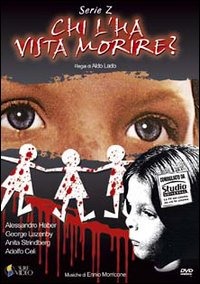
I have little interest in writing about 'On Her Majesty's Secret Service'; what is worth mentioning, however, is what George did next. He followed his solo Bond appearance with a lead role in Cy Endfield's largely forgotten mercenary drama 'Universal Soldier' (nothing to do with the Dolph Lundgren/Jean-Claude van Damme flick), after which he found himself negotiating the dank, dangerous, non-tourist-promoted backwaters of Venice in Aldo Lado's dark and compelling giallo 'Who Saw Her Die?'
Lazenby plays Franco Serpieri, a sculptor living in Venice whose desultory affair with a local woman barely masks with pain of his estrangement from his wife Elizabeth (Anita Strindberg). Dishevelled, gaunt (Lazenby lost weight for the role), at odds with the cliquey society of art dealers and collectors, personified by his patron Serafian (Adolfo Celli - star of an earlier Bond film, 'Thunderball'), upon whom his livelihood depends, Serpieri's malaise is temporarily relieved by a visit from his vivacious young daughter Roberta (Nicoletta Elmi).
Temporarily, because red-headed Roberta falls foul of a black-gloved murderer a third of the way into the film and Serpieri, reconciled with Elizabeth through the harshest of tragedies, becomes obsessed with finding her killer.
At which point I need to stop talking about Lazenby. His physical transformation for the role is remarkable - coming a scant three years after 'OHMSS', he's almost unrecognisable: gone, the chiselled good looks that secured his erstwhile modelling profession, gone the coiffured, clean-shaven image; the Lazenby of 'Who Saw Her Die?' is an emaciated scruff of the first order - but his range as an actor is limited. Which is more than can be said for Strindberg. Often cast in gialli purely for her striking, high-cheek-boned looks, she has seldom been saddled with a more useless eye-candy/set-dressing/"woman in peril" role than here. (You can imagine Lado's direction: "Anita, look glacial ... Anita, look scared ... Anita, scream like you've never screamed before.")
I should mention instead Celli's effortless portrayal of Serafian as a sybarite/sensualist/degenerate (delete according to personal aesthetics), fine work from a wonderfully expressive actor who, in this film particularly, comes across as a Peter Ustinov gone bad. He's great; his scenes bootstrap the film up to a higher level.
But there's two people who really turn 'Who Saw Her Die?' into, if not a top-flight, then certainly an inspired giallo.
One is director Aldo Lado. Not just the only director, to the best of my knowledge, who first name and surname are an anagram of each other, he also worked as assistant director to Bertolucci on 'The Conformist'. Unjustly overlooked, Lado's contributions to the giallo are the equal of anything Bava achieved, and his capacity for spatial dislocation/disorientation and sustained setpieces (notably a tense cat-and-mouse sequence which takes in a fog-wreathed harbour and an abandoned factory) come close to the prowling, subjective camerawork of Argento at his best.
And speaking of those two maestros: remember Nicoletta Elmi, the creepy kid in Bava's 'A Bay of Blood' and the even creepier kid in Argento's 'Deep Red'? Here she plays a decidedly non-creepy kid. An actually quite adorable kid. Just eight years old when she starred in 'Who Saw Her Die?', Elmi acts everyone offscreen. The first act of the film, in which the killer makes two failed attempts at abducting Roberta before finally - fatally - succeeding, rises above the genre checklist it could easily have become. It's the doomed Roberta you remember more than the driven Serpieri. It's her terrible vulnerability, her achingly poignant innocence, than define the film, long after the shoal of red herrings have been forgotten and the almost awkwardly abrupt ending has ceased to bother the casual viewer.
Nicoletta Elmi has acted in only a handful of films and TV shows.An early, very small role, was in Visconti's masterpiece 'Death in Venice'; a decade and a half later, she proved the only good thing in Lamberto Bava's so-bad-it-was-almost-good-but-ultimately-was-just-plain-bloody-awful 'Demons'. In her mid-twenties, she turned her back on acting and studied medicine. A loss to cinema, but I applaud her humanity.