Tampilkan postingan dengan label Quentin Tarantino. Tampilkan semua postingan

Minggu, 23 Agustus 2009

Inglourious Basterds (a review in five chapters)

Chapter one:
Once upon a time ... in the New York Times

There's a review of 'Inglourious Basterds' in the New York Times - an organ normally dependable for its film criticism - which not only misses the point by a country mile, but in its last line writes off the very concept of the anti-hero as a valid fictive creation. This is what reviewer Manohla Dargis has to say:

"The film's most egregrious failure [is] its giddy, at times gleeful embrace and narrative elevation of the seductive Nazi villain ... Unlike those in 'Schindler's List', Mr Tarantino's Nazis exist in an insistently fictional cinematic space where heroes and villains converge amid a welter of movie allusions ... 'Inglourious Basterds' is simply another testament to his movie love. The problem is that by making the star attraction of his latest film a most delightful Nazi, one whose smooth talk is presented as lovingly as his murderous violence, Mr Tarantino has polluted that love."

Firstly, 'Schindler's List' exists in a cinematic space every bit as "insistently fictional" as that of 'Inglourious Basterds' - it's in black and white; much of its visual style is non-naturalistic; ash from crematorium chimneys falls as gently and lovingly as snow - so the comparison doesn't hold water. Secondly, Dargis argues that Christoph Waltz's SS Colonel Hans Landa is the best thing about the film simply because he gives the best performance. Ralph Fiennes's is similarly the best performance in 'Schindler's List'; Dargis's argument is further weakened. Thirdly, why does a "gleeful embrace and narrative elevation" of a Nazi character perforce constitute a flaw in a film's aesthetic? I've always found Paul Scofield's erudite von Waldheim far more appealing than Burt Lancaster's monosyllabic Labiche in John Frankenheimer's 'The Train' - and this dynamic, if anything, makes the film even more interesting. (See also: 'Cross of Iron': German protagonist, excellent film. And where does Dargis's argument leave the "good German" in, say, Powell and Pressburger's '49th Parallel' or 'The Life and Death of Colonel Blimp'?) Fourthly, criticising Tarantino for creating his vision of cinema within a deliberately fictive space is as facile as slating a Bollywood film for being three hours long and containing a bunch of song and dance numbers. It's little more than an admission that Dargis doesn't like a certain style of film-making, only dressed up in the kind of cheap point-scoring that there should be no place for in the New York Times.

Also, Dargis seems to imply that premeditated empathy with a villainous character - ie. the writer and/or director specifically setting out to make an anti-hero not only palatable but laudable to the audience - is reprehensible. Excuse me? Some of the greatest characters in both classical literature and pop culture and at all points inbetween are anti-heroes. From Hamlet to Hannibal Lecter, from King Lear to Freddy Krueger. Everyone loves an anti-hero. It's the thrill of a character doing and saying the things we could never do or say - things, frankly, that we wouldn't want to do or say. It's the delightful frisson of a character whose moral disconnect imbues them with a fascinating unpredictability; a character who could quite literally do anything.


Chapter two:
Glorious basterds

And while I'm kicking against mainstream film critics, can I just say that I don't understand why so many critics still carp about violence in Tarantino's work. Sure, everything he's done contains scenes of violence, but I'd argue no more so than most tentpole summer blockbusters. While, say, your average Michael Bay film doesn't feature scalpings (how would Transformers scalp each other? "each one of you Autobots owes me one hundred Decepticon pistons ... and I want my pistons!") it buys wholly into an aesthetic of violence - explosions, shoot outs, cars flipping over and smashing into other cars at high speeds - which leaves you in no doubt that sheer, unmitigated destruction is Bay's raison d'etre. Tarantino, however, is more interested in the build up, the tension, the dialogue and character dynamics.

When action or violence happens in a Tarantino movie, it erupts suddenly and is over quickly. There is, per capita, very little onscreen violence in his work. The first chapter of 'Inglourious Basterds' is a clammily tense interrogation by Landa of a French farmer harbouring a Jewish family. It quickly becomes apparent that Landa knows full well the family are there and where they are hidden; he's simply toying with the man. The scene is intense and gripping, punctuated by an inspired mine's-bigger-than-yours visual joke, and what makes it work is not the thirty seconds of gunfire it culminates in but the twenty minutes of dialogue that build up to it. Landa arranging his pen and pot of ink on a table carries far more weight than the machine guns slung over his men's shoulders.

It follows, then, that any director who places more importance on words than action - and how refreshing is that in contemporary American cinema? - must needs be an actor's director. And this is where I still don't think Tarantino gets his dues. Love or loathe the deliberate movieness of his movies, the man gets fucking great performances from his actors. 'Pulp Fiction' made Samuel L Jackson and resurrected John Travolta. Pam Grier and Robert Forster in 'Jackie Brown' - we're talking about finest hours. Uma Thurman's never been as good outside Tarantino's cinema. And now in 'Inglourious Basterds' we have a bravura, multi-faceted performance from Christoph Waltz, vacillating between charm, cruelty and - daringly in the finale - a touch of high camp. It's full-throttle and hugely memorable. But so is Diane Kruger's irresistible diva-like turn as Brigitte von Hammersmarck, the dahling of the German film industry.


Melanie Laurent's character Shoshanna (the only survivor of Landa's first chapter massacre) is almost overwhelmed by Waltz and Kruger, but she's never less than the true main character of the film, and evinces a quiet determination underscored by a melancholic sense of vulnerability. That she understates just emphasises the importance of her character. Michael Fassbender comes within a plummy vowel of stealing the show as Lt Archie Hickox, a British officer despatched to assist the Basterds and make contact with Brigitte (a double agent) in a mission to assassinate the Nazi chiefs of staff. Bouncing off an audaciously cast Mike Myers (as fellow Brit, General Ed Fenech), Fassbender takes up the mantle of George Sanders and gives us a smooth, unpeturbable Brit (his staring-death-in-the-face speech about there being "a special place in hell reserved for people who waste good Scotch whisky" is priceless).

Elsewhere, as the Basterds, Brad Pitt is a scream as hillbilly platoon leader Lt Aldo Raine, drawling his cod-philosophical down-home dialogue with relish; Til Schweiger as the only German member of the outfit, officer-hating Hugo Stiglitz, gives a breakout performance comparable to Waltz's; B.J. Novak makes the most of a bit of comic relief when Landa taunts him that his nickname amongst German soldiers is "the Little Man"; and only Eli Roth seems ill-at-ease as baseball bat wielding Sgt Donowitz.


Chapter three:
European night in Tarantino-land


Because Tarantino's movies are movie movies, references to other films come thick and fast. Since the 'Kill Bill' opuses, his soundtracks have been culled from existing movie music. Character names reference favourite actors (Aldo Raine is a nod to Aldo Ray; Hugo Stiglitz to ... well, Hugo Stiglitz). Movie posters, characters talking about movies, and clips from movies are part of the fabric of a Tarantino film. Prior to 'Inglourious Basterds', he revealed a very '70s aesthetic, culminating in his and Robert Rodriguez's homage to the era of exploitation movie drive-in double bills, 'Grindhouse'.

'Inglourious Basterds' throws open the doors of Tarantino's movie love wider than ever before - and none of it, as Manohla Dargis would have you believe, is polluted. Tarantino - knowledgably and contextually - incorporates the work of Leni Riefenstahl, G.W. Pabst and Paul Martin. The latter's 'Gluckskinder', a loose 1936 remake of 'It Happened One Night', is referenced during the first meeting between Shoshanna, now running a cinema under an assumed identity, and Frederick Zoller (Daniel Bruhl), a Nazi sniper heralded as a hero of the nation. Smitten by Shoshanna, he wants her cinema to host the premiere of a propagandist film based on his exploits in which he plays himself.

Zoller proves one of the most slippery characters in the film, charming to the point of being self-effacing, almost sickened by the cinematic representation of his prowess as a marksman, yet still capable of ruthlessness and a threat to Shoshanna despite his feelings for her. Bruhl, impressive in everything I've seen him in since 'Good Bye Lenin!', does more good work here.

An interview with Tarantino at Sunset Gun goes into fascinating detail on the power Goebbels wielded in German film production during the Third Reich. Tarantino pertinently makes the point that many of the propaganda films produced (a staggering 800 titles during Goebbels' tenure) were comedies or historical epics. Parallels can be made, messages got across, without hammering the audience over the head in a blunt and obvious fashion. America and Britain made their fair share of propaganda films, too, many of them - including Powell and Pressburger's first eight collaborations - emerging as bona fide works of art.


Chapter four:
Operation cinephile

'Inglourious Basterds' confounds expectations from the off. Hell, it confounds them from its very title. A dictionary-defying variant on Enzo G. Castellari's 'The Inglorious Bastards', it sets up an expectation of a death-or-glory men-on-a-mission balls-to-the-wall actioner in the vein of 'The Dirty Dozen' or 'Where Eagles Dare'. But 'Inglourious Basterds' doesn't focus solely on the unit put together to undertake one of these missions, nor does it wind up at vertiginous clifftop stronghold or a chateau deep behind enemy lines.

Its denouement takes place at a cinema. Its heroine runs the cinema. Her would-be suitor Zoller plays himself in a film that makes hagiography of atrocity. Landa is put in charge of security at the cinema by Goebbels, who has overseen production on the Zoller film. Lt Hickox is handpicked for his mission because he was a film critic specialising in UFA during peacetime. Even Lt Raine is moved to inform a captured Nazi soldier who refuses to co-operate that he's glad of the man's refusal because "watching Lt Donowitz here beat Nazis to death is about as close as me and the boys get to going to the movies". The climax takes place during a film screening.

The film-within-a-film, 'Nations Pride', was directed by Eli Roth and constitutes a frenzied gun battle between sniper Zoller and hundreds of enemy troops; a shot of a man targetted by Zoller falling into a decorative pool apes a similar shot in 'Scarface'. It's both a nifty in-joke and a provocative anachronism, emphasising (as the title of chapter one - "once upon a time ... in Nazi-occupied France" - suggests) that 'Inglourious Basterds' is a WWII movie only in that it embraces some conventional war movie themes and imagery. Otherwise, it plays by its own rules and doesn't apologise for doing so!

Aldo Raine is as nominally the hero of the piece as Landa is the villain. The real hero of 'Inglourious Basterds' is cinema itself. When Shoshanna plans her revenge, its not explosives she uses to incinerate her enemies but reels and reels of nitrate film. There's something indescribably creepy about that pile of film reels lurking behind the cinema screen - particularly when you're watching 'Inglourious Basterds' on the big screen - and it's an image Tarantino plays on effectively.


Chapter five:
Revenge of the giant controversy

When 'Inglourious Basterds' screened at Cannes, opinion was divided. This is nothing new for Tarantino; there were boo's as well as cheers when he took the Palme d'Or for 'Pulp Fiction'. Debate will doubtless rage on the internet in the coming months, opinion chasmically divided. I'm confident that 'Inglourious Basterds' will prove the love-it-or-loathe-it audience divider of Tarantino's career.

Personally, as you might have gathered from the couple of thousand words I've waxed lyrical on it so far, I love 'Inglourious Basterds'; I still need to watch it a few more times, but I have an inkling it might end up, if not my favourite Tarantino film, then certainly joint first with 'Pulp Fiction'. It has no regard for history, it is supremely self-indulgent (Tarantino is perhaps the only film-maker I can think of for whom self-indulgence is a positive trait), and it continually defies audience expectation. It's a film only Quentin Tarantino could have made, and I can't foist upon it any higher a recommendation than that.

Jumat, 21 Agustus 2009

Inglourious Basterds (first thoughts)

It's me and Paula's first wedding anniversary today, and what more romantic a way to mark the occasion that an afternoon showing of 'Inglourious Basterds', Quentin Tarantino's alternative, subversive, brutal and often funny as fuck war movie?

(We're out for a meal shortly, so I've only got a few minutes to blog a quick hit-and-run immediate thoughts type review. Expect a more considered article in the next few days. Oh, and I know I said August was foreign movies month on The Agitation of the Mind, but half of 'Inglourious Basterds' is in French or German and subtitled, so it kind of counts.)

Immediate thoughts, then:

Everything you've heard is true: Tarantino happily rewrites history, sticks David Bowie on the soundtrack of a movie set (mostly) set in 1944, and confounds any and every expectation you go into the cinema with. This isn't so much a war movie as a western (the opening chapter is chock full of iconography that wouldn't be out of place in a Sergio Leone opus, right down to the chapter title "once upon a time ... in Nazi-occupied France") which segues into a men-on-a-mission caper (only without anything as pifflingly audience-pandering as an actual mission*) which then takes time out to spoof the stiff-upper-lip ethos of '50s British war films (the nonsensical verbiage between Mike Myers and Michael Fassbender is a scream) before wandering into a basement bar to revisit the Mexican stand-offs so brilliantly realised in 'Reservoir Dogs' and 'Pulp Fiction' (only with SS officers, undercover operatives and a glamorous double agent thrown in for good measure), with all of the plot strands resolving at an art deco cinema where 'Inglourious Basterds' stops being anything even genre related and reveals itself as a bullet-riddled, explosive and endearingly self-indulgent love letter to cinema itself.

Maybe I'm throwing this out a little too early (I'll certainly be seeing the film again on the big screen - and soon - so I'll save my more considered write-up till after this second viewing), but 'Inglourious Basterds' is the Tarantino film I've had most fun watching since 'Pulp Fiction'.

"This might well be my masterpiece," Lt Aldo Raine (Brad Pitt) declares in the film's last line (apropos of what is something I'll leave you to find out for yourself), and it's impossible not to take it as self-acclamation on Tarantino's part. Thing his, he could - could - be right.


*Broadly speaking, "I need me eight men ... we're gonna kill Nazis" doesn't really constitute a mission. It's more like, you know, a mission statement.

Sabtu, 21 Maret 2009

PERSONAL FAVES: From Dusk Till Dawn

There’s a scene in Alfonso Cuaròn’s ‘Y Tu Mamá También’ – a masterly paeon to homo-eroticism, political incorrectness and the older woman – in which the horny teenage protagonists, left to their own devices after their girlfriends jet off on an exchange holiday, pass the time by engaging in some wholesome outdoor activity. Such as lying on the diving boards of a deserted country club swimming pool, eyes closed, hands in their trousers, vigorously polishing the lighthouse as they fantasise about their favourite actresses. One of them invokes the name of that Mexican goddess in human form, Salma Hayek, and both are spurred on to greater feats of onanism.

I’m willing to bet the gentlemen in question were thinking of the snake dance scene in ‘From Dusk Till Dawn’.

Directed by Robert Rodriguez from a script by Quentin Tarantino blah blah crims on the run blah blah kidnap a family and cross the border in their RV blah blah Titty Twister blah blah Cheech Marin’s hilarious and definitely NSFW “pussy” speech blah blah wait for their contact blah blah packed with bikers and mariachi musicians blah blah sudden lurch into horror film territory blah blah small group of survivors blah blah and did I mention that there’s this showstopping scene where Salma Hayek does a snake dance?

Sorry. I was eager to cut to the chase there. I’ll try to make amends by at least pretending to write a proper, considered article on the film. The key scene in ‘From Dusk Till Dawn’ occurs exactly at the halfway mark. Thus far, script and direction have kept audience sensibilities firmly within an immediately recognisable genre – the crime thriller. There has been shooting, explosions, hostage taking, kidnapping, the evasion of authorities and a tense border crossing. Then the protagonists – brothers in crime Seth and Ritchie (George Clooney and Quentin Tarantino), and hostage family Jacob (Harvey Keitel), Kate (Juliette Lewis) and Scott (Ernest Liu) – make an ill-advised stop at a lawless roadhouse.

It’s here that a Tex-Mex band are laying down some sleazy tunes while topless go-go dancers gyrate. (Last night I was writing about ‘The Insider’ and musing that “Mann conjures images that are haunting, sometimes surreal … and effortlessly poetic”; twenty-four hours down the line as it’s topless go-go dancers gyrating. God, I love blogging!) The lights go down, a hush falls over the rough-neck crowd. The leader of the mariachis announces the next act: the cryptically named Santanico Pandemonium. It’s Salma time!

Oh shit, I was trying to keep this reasonably intelligent. I was going to compare the scene to Rita Hayworth’s vampish burlesque number in ‘Gilda’ and Michelle Pfeiffer’s seductive rendition of “Makin’ Whoopee” in ‘The Fabulous Baker Boys’. I was going to highlight how the narrative is put on hold so the female protagonist can (literally) take centre stage, the piffling concerns of plot and dialogue held in stasis; subjugated to the heroine’s sensual self-expression. I was going to expand on this point and write about the destructive force of the uninhibited sexuality on display – how both ‘Gilda’ and ‘The Fabulous Baker Boys’ progress from these sequences into examinations of jealousy and fractured relationships. I was going to wind up this scholarly digression by demonstrating how ‘From Dusk Till Dawn’ takes things one step further: not only does the smouldering sexuality of Santanico’s dance herald destruction and filial separation (I was going to slip in a clever little parenthetical reference to the Baker boys being brothers as well), it also sends the film spinning off into a completely different narrative and a completely different genre as Santanico morphs into a vampire and one of the sexiest women ever to grace the big screen suddenly turns into something very fucking freaky.

But then I thought, why bother? Film is not analysis it is the agitation of the mind. And ‘From Dusk Till Dawn’ doesn’t invite analysis; it invites some mates round and lays on a pizza and a six-pack. It’s a B-movie to the nines and that’s how it should be enjoyed. It’s got gorgeous George being a badass. It’s got Harvey Keitel as a preacher who turns into a vampire-killing “mean mmmm-mmmm servant of God”. It’s got FX meister Tom Savini as a character called Sex Machine who’s got a six-shooter in a codpiece! It’s got Fred Williamson growling “I was in ’Nam.” It’s one hundred minutes of balls to the wall sick twisted fun, all wrapped up in a kick-ass soundtrack.

And it’s got Salma Hayek. Doing a snake dance.


(I may be sleeping on the couch tonight.)

Minggu, 04 Januari 2009

THE FINAL GIRL FILM CLUB: Grindhouse

Do you know how excited I was about ‘Grindhouse’? Imagine the adrenalin levels of a kid on Christmas Day, a fat kid in a sweetshop lockdown and no adults around to tell him not to, a pyromaniac in a fireworks factory, a dipsomaniac left in charge of a distillery, a voyeur given carte blanche to roam around the Playboy Mansion, and a member of the NRA at an arms bazaar. Now combine all those adrenalin levels, throw a few tequila slammers into the mix and shoot the whole thing full of heroin.

That’s how excited I was.

Tim at Antagony & Ecstacy reviewed it under the pullquote ‘The Movie I Was Put on This Earth to See’, and I was almost wetting myself.

And. Then. Something. Happened.

‘Grindhouse’ underperformed at the American box office. I started hearing dispiriting rumours: the film was being split in two for its European release; ‘Death Proof’ would come out first; there was no confirmed UK release date for ‘Planet Terror’. There was a big question mark over whether the spoof trailers would be released theatrically.

I. Was. Not. Happy.


I’ll admit it here and now: I was looking forward more to ‘Planet Terror’ than ‘Death Proof’, having been monstrously underwhelmed by ‘Kill Bill Vol. II’ (another Tarantino opus that got released in two parts, with a six month wait after the blistering first instalment with its iconic “House of Blue Leaves” set-piece).

Sure enough, the handful of lobby posters I’d seen for ‘Grindhouse’ quietly disappeared, to be replaced by ‘Death Proof’ posters. Frequent IMDb visits seemed to confirm that there was still no release date for ‘Planet Terror’. In the meantime, I’d tracked down the spoof trailers online and bookmarked them.

A week before ‘Death Proof’ opened, I got hold of ‘Planet Terror’ on Region 1 DVD, featuring the ‘Machete’ trailer (my personal favourite of the four spoofs). Me and Paula decided to have our own, cobbled together ‘Grindhouse’ experience: we watched ‘Planet Terror’ on DVD in the morning (including ‘Machete’), fired up the computer and watched the ‘Don’t’, ‘Thanksgiving’ and ‘Werewolf Women of the SS’ trailers, then went to the cinema and watched ‘Death Proof’ on the big screen in the afternoon.

It doesn’t quite equate to taking your seat in the cinema, watching two 90-minuters (each complete with ‘missing reel’) back to back, interspersed with the spoof trailers – ie. three and a half hours of moviegoing designed as an affectionate, often ironic but ultimately down and dirty throwback to the grubby joys of the exploitation B-movie double bill.

The point of those 70s double-bills was that you saw them in a cinema. Usually a dingy fleapit where the seats were dimpled with cigarette burns, smoke was still hanging in the air courtesy of the audience at the earlier screening, your shoes adhered to the floor thanks to a combination of melted ice cream, popcorn and spilled Ki-ora, and the films were interrupted at least a couple of times during the screening due to technical problems with the projector.

In order to recreate the experience, ‘Planet Terror’ and ‘Death Proof’ – the former more authentically – are scratched and distressed and jump about a lot, simulating hamfisted splicing, and in the case of ‘Planet Terror’ the film seems to bubble up and burn into white nothingness.

Seen on DVD, you think “hmmm, that’s quite a convincing effect”. Seen on a computer, the spoof trailers are quite obviously that: spoofs. You find yourself picking hairs. Both ‘Thanksgiving’ and ‘Werewolf Women of the SS’, as sleazily inspired as they are, are billed as “a film by Eli Roth” and “a film by Rob Zombie” respectively, the latter trumpeting a big star name (Nicolas Cage) – but no zero-budgeted exploitation flick would be thus advertised. Edgar Wright’s ‘Don’t’ hits the mark as acutely as ‘Machete’, though, delivering a minute’s worth of stalk ‘n’ slash highlights while the voiceover drones monotonously “Don’t … don’t … don’t … don’t.”

Still, all of these component parts were meant to be taken together, as a three and a half hour whole … and were meant to be seen at the cinema. Instead, we got expanded cuts of ‘Planet Terror’ and ‘Death Proof’, the former now clocking in 1 hour 45 minutes, and Tarantino’s opus pushing the two hour mark, again pushing the films another step away from their original aesthetic.


The damage done to both films is that you view them as separate entities, which leads to pointless exercises in critical approach whereby you try to reconcile the more authentic ‘look’ of ‘Planet Terror’ with the post-modern ironic playfulness of ‘Death Proof’ instead of thinking “zombie movie – cool; car chase movie – cool”. Or ruminating on the promise of the erotic given the plethora of eye candy (two quartets of heroines in ‘Death Proof’; cleavages a-go-go courtesy of Rose McGowan, Marley Shelton and Stacy Ferguson in ‘Planet Terror') and the non-inclusion of actual nudity (want topless women? the ‘Machete’ trailer’s the only place you’ll find ’em) and coming to the conclusion that an implied salaciousness : disappointment ratio is par for the course in exploitation movies and Rodriguez and Tarantino have played on this most effectively … when you should, of course, be thinking “wow, hot chicks”.

Tim comments, in his brilliantly written review, “the structural vulernability of Grindhouse makes it the same as those things it mimics, even while the very soul of Grindhouse is that, as a mimic, it is not the same thing. Therefore, the film becomes both thesis and antithesis”, and he’s absolutely right. To discuss structure is perhaps the most intelligent way to approach ‘Grindhouse’ critically. Otherwise, as just as valid, you can simply kick back with a big tub of popcorn, turn off your critical faculties and let your mind go “zombies, cool … wow, Rose McGowan’s a fox … machine gun leg … shoot-outs, cool … stuff blowing up … fast cars, cool … wow, Vanessa Ferlito’s a fox … Kurt Russell being a badass, cool … wow, how long’s this car chase gone on for? …” and so on and so forth.

They’ve been constructed deliberately – and a lot more cleverly than a first viewing might lead you to believe – but the component parts of ‘Grindhouse’ are quite simply a hymn to the gleeful pleasures of moviegoing in an age where hot chicks, fast cars, cheesy special effects and 90-minutes of low-budget mayhem were their own raison d’etre.

Comparing and contrasting the films is a redundant exercise. The distributors, by splitting ‘Grindhouse’ in two, have left the likes of your humble blogger here with no choice other than to do just that. I was even tempted to use this post as a prologue to articles on ‘Planet Terror’ and ‘Death Proof’ over the next two evenings.

But I won’t because I’m convinced that if I ever get to see ‘Grindhouse’ in the format Messrs Rodriguez and Tarantino intended me to, then I’ll have seen a masterpiece of post-modern throwback indulgent irony. Yup, I know those last four words seem like a quadrille of contradiction but I reckon the movie that underperformed in America and never made it to the UK has what it takes to synthesise them; and until ‘Grindhouse’ gets released in this country in its original format (preferably in a theatrical run), or until I can get my hands on a Region 1 DVD, it will have to remain the best movie I’ve almost seen.

Selasa, 29 April 2008

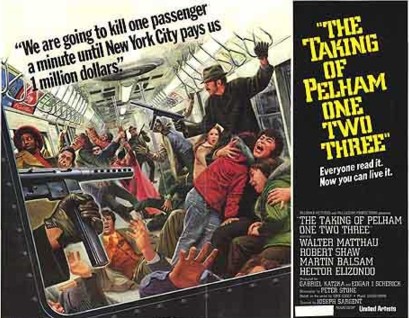
PERSONAL FAVES: The Taking of Pelham One Two Three

A comparison:

Tony Scott has made a lot of highly successful, glossy, superficial films ... and some notable ones, such as the sensuous and glossy vampire drama 'The Hunger', the energetic and profane (but still glossy) Tarantino-scripted 'True Romance', and the claustrophobically tense 'Crimson Tide', which isn't really glossy at all because it's set on a submarine and even Tony Scott would be hard pressed to make a submarine look glossy.

Joseph Sargent has made a bunch of stuff, predominantly for TV, that you've probably never heard of ... and 'The Taking of Pelham One Two Three'.
I mention this because Tony "more gloss than Dulux" Scott is currently remaking 'The Taking of Pelham One Two Three'*, a thriller about the hijacking of a New York subway train and the holding to ransom of its passengers. A few guesses about the remake:

It won't open with transit cop Zachery Garber grouchily escorting a group of Japanese visitors around the control centre, using their assumed lack of facility in the English language to be as sarcastic about his co-workers ("this is Lieutenant Petrone, on weekends he works for the Mafia") as he is about them ("this way, you monkeys"). This not being PC, like.

The hostages will actually have names, and not be bluntly referred to (and then only in the closing credits) as, variously, The Mother, The Hooker, The Pimp, The Old Man, The Alcoholic and The Homosexual. This not being PC, either.

The hijackers' ransom will be adjusted for inflation from the cool million demanded in the original.

The hijackers won't use colour-coded pseudonyms - Mr Blue, Mr Green, Mr Grey, Mr Brown - since this conceit is so ineffably associated in the popular movie-going consciousness with Tarantino's 'Reservoir Dogs', never mind that 'Pelham One Two Three' did it first.

I'll give Tony Scott the benefit of the doubt - the gloss of sarcasm earlier in this post notwithstanding - and wait till his 'Pelham' comes out (it's due next year) before I pontificate any further. For now, let's consider Joseph Sargent's 1974 original, adapted from the novel by John Godey - a film which has never quite achieved the status of classic, but which I think it richly deserves.

Opening with David Shire's poundingly unsubtle score - my partner, watching the film for the first time, wondered aloud whether she was in for a straight thriller or a spoof - Sargent wastes no time introducing his villains and establishing a milieu. This is New York in the 70s, as edgy and grimy as only American cinema of that decade could ever capture it. The subway is an unfriendly, offputting place; the people who travel it, a bustling amorphous mass. Into this environment - dressed similarly in long coats, hats, glasses and moustaches, carrying bulky parcels - come Mr Blue (Robert Shaw), Mr Green (Martin Balsam), Mr Grey (Hector Elizondo) and Mr Brown (Earl Hindman); the packages are opened; semi-automatic weapons appear; a pistol is pointed at the driver. Pelham One Two Three is taken.

Garber (Walter Matthau)'s comedy of embarrassments with the Japanese is soon eschewed in favour of incrementally ratched-up tension as Garber finds himself forced to liaise between the hijackers and the NYPD, themselves frantically awaiting approval from the Mayor's office to deliver the ransom. Mr Blue, coldly mercenary, stipulates an hour for delivery of the million, after which he promises to shoot one hostage per minute until his demands are met.

With the clock ticking and the Mayor (Lee Wallace) a bumbling incompetent, 'Pelham One Two Three' segues from hostage drama to race-against-time thriller. (This is one of the reasons I love the movie: it deftly avoids the inert, static nature of the hostage genre.) With approval - reluctantly - from City Hall to pay the ransom, Sargent then concentrates on the logistics of assembling one million dollars in used, non-sequentially numbered bank notes (as per Mr Blue's instructions) and the NYPD's attempt to transport it across town during wall-to-wall traffic. His attention to detail is as acute during these scenes as it was during the build-up to the hijack. Likewise the minutiae of the hijackers' plan to escape with the moolah.

And yet Sargent's attention to detail is never overly technical, nor does it slow things down. 'Pelham One Two Three' is a superbly paced film. Never mind that there aren't that many action scenes, the sheer sense of urgency propels the narrative. Performance-wise, an offbeat cast gels perfectly. Matthau brings just enough baggage from his more famous funnyman roles to make Garber a rumpled, sardonic, likeable character. Shaw is terse and no-nonsense as Blue. Balsam brings a nervous immediacy to the role of a former subway driver brought in by the hijackers for his technical knowledge. Elizondo commendably plays down what could have been an exercise in cliche as the almost obligatory loose cannon. Jerry Stiller (Ben's dad) is great value as the laconic Petrone.

Ultimately, there's just so much to like about 'Pelham One Two Three', not least the delightfully ironic coda wherein Garber and Petrone track down the remaining gang member. The final shot is priceless, and "Gesundheit" belongs in the pantheon of great last lines.


*Although I understand from IMDB that the title of Scott's version has been rendered 'The Taking of Pelham 123'. See what he did there?