Tampilkan postingan dengan label Walter Matthau. Tampilkan semua postingan

Sabtu, 10 Januari 2009

PERSONAL FAVES: Charley Varrick

Don Siegel’s follow up to his nihilistic 1971 classic ‘Dirty Harry’ was a complete change of pace, and perhaps explains why it didn’t find the mainstream success its predecessor (or indeed any of his collaborations with Clint Eastwood) did.

‘Charley Varrick’ is a quirky crime caper which ambiguously trades on its star Walter Matthau’s affable comedic persona, but benefits from him playing straight. Which isn’t to say that it’s not noir to the nines when it wants to be.

Opening with Charley (Matthau) and his three-man crew pulling a slick bank robbery in sleepy Tres Cruces, Mexico, the plan goes awry when a local cop tumbles to the false plates on the station wagon driven by Charley’s wife Nadine (Jacqueline Scott), the gang’s getaway driver. The resulting shoot-out leaves Charley’s crew decimated, and he and headstrong young crim Harman Sullivan (Andy Robinson, best known as the Scorpio Killer in ‘Dirty Harry’) are lucky to get away with the money.

Charley realises his luck might be running out when the haul clocks in a three-quarters of a million, not the $20-$30,000 he was expecting. Quickly realising the bank was laundering Mob funds, he turns his attention to how to stay alive now that the cops are the least of his worries. Things are complicated by the increasingly unpredictable Harman’s intent to start flashing his share around and living the high life.

Ex-stunt pilot Charley leaves Harman holed up in a trailer park and approaches photographer Jewell Everett (Sheree North), who runs a profitable sideline in forged documents, for a couple of passports. Little does he know that bank executive Maynard Boyle (John Vernon), simpatico to the dirty dealings at the Tres Cruces branch, has engaged pipe-smoking and effeminately named hitman Molly (Joe Don Baker) to get the money back.

Nor does he know that Molly and Jewell are known to each other, nor that molly has already tracked Harman down and had a little chat with him. That’s ‘little chat’ as in the kind of little chat Mr Blonde has with Marvin the cop in ‘Reservoir Dogs’.

In fact, a closer point of comparison might be ‘No Country for Old Men’. Molly comes off as a precursor to Javier Bardem’s Anton Chigurh, a man similarly dispatched by underworld to types to recover a certain cache of cash and eliminate anyone who stands in the way. Both stride implacably through their respective films. Both take their work very seriously. Neither appreciative levity or smart comments (“I didn’t drive six hundred miles for the amusement of morons,” Molly growls when a gaggle of hookers find his name funny, the line delivered in the same granite tones as Chigurh’s stone cold “Call it, friendo” to an about-to-die gas station attendant). The only difference is that Molly is ineffably polite to the people he doesn’t have to kill and he smiles a lot more. Even though it’s the smile of a shark or a tiger. Joe Don Baker is on top form in the role; for my money it’s his best work on the big screen.

Matthau is terrific too, making his second appearance on the Personal Faves list in an uncharacteristically straight role (after ‘The Taking of Pelham One Two Three’), even if his rumpled, somewhat shambolic persona makes it a tad unlikely that he’d prove romantically irresistible to Boyle’s uber-prim secretary Sybil Bolt (Felicia Farr) in an extended scene near the end that’s pure plot device.

Still, that’s the only quibble I have against Charley Varrick. Siegel’s direction finds and maintains a spot-on balance of wry humour, pacy narrative and a handful of excellently staged and edited action scenes. Vernon is perfectly cast as the oily executive who gets a nicely ironic comeuppance. Robinson is also good. Scott, North and Farr add a touch of sassy Seventies glamour as well as being appealing in their roles. And Michael Butler’s cinematography is just glorious.

The denouement is highly memorable, all the pieces slyly put in place beforehand, and the switcheroo payoff arrived at via a standout car/biplane chase.

The crime caper was a staple of Seventies cinema – ‘Pelham’ and ‘Thunderbolt and Lightfoot’ are prime examples – and in my book the still underrated ‘Charley Varrick’ is the equal of either of them.

Selasa, 29 April 2008

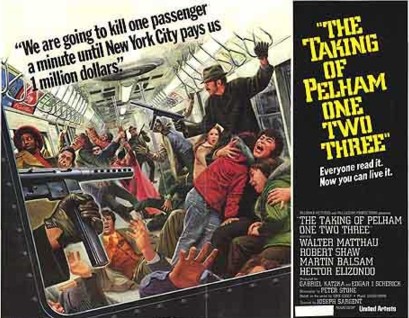
PERSONAL FAVES: The Taking of Pelham One Two Three

A comparison:

Tony Scott has made a lot of highly successful, glossy, superficial films ... and some notable ones, such as the sensuous and glossy vampire drama 'The Hunger', the energetic and profane (but still glossy) Tarantino-scripted 'True Romance', and the claustrophobically tense 'Crimson Tide', which isn't really glossy at all because it's set on a submarine and even Tony Scott would be hard pressed to make a submarine look glossy.

Joseph Sargent has made a bunch of stuff, predominantly for TV, that you've probably never heard of ... and 'The Taking of Pelham One Two Three'.
I mention this because Tony "more gloss than Dulux" Scott is currently remaking 'The Taking of Pelham One Two Three'*, a thriller about the hijacking of a New York subway train and the holding to ransom of its passengers. A few guesses about the remake:

It won't open with transit cop Zachery Garber grouchily escorting a group of Japanese visitors around the control centre, using their assumed lack of facility in the English language to be as sarcastic about his co-workers ("this is Lieutenant Petrone, on weekends he works for the Mafia") as he is about them ("this way, you monkeys"). This not being PC, like.

The hostages will actually have names, and not be bluntly referred to (and then only in the closing credits) as, variously, The Mother, The Hooker, The Pimp, The Old Man, The Alcoholic and The Homosexual. This not being PC, either.

The hijackers' ransom will be adjusted for inflation from the cool million demanded in the original.

The hijackers won't use colour-coded pseudonyms - Mr Blue, Mr Green, Mr Grey, Mr Brown - since this conceit is so ineffably associated in the popular movie-going consciousness with Tarantino's 'Reservoir Dogs', never mind that 'Pelham One Two Three' did it first.

I'll give Tony Scott the benefit of the doubt - the gloss of sarcasm earlier in this post notwithstanding - and wait till his 'Pelham' comes out (it's due next year) before I pontificate any further. For now, let's consider Joseph Sargent's 1974 original, adapted from the novel by John Godey - a film which has never quite achieved the status of classic, but which I think it richly deserves.

Opening with David Shire's poundingly unsubtle score - my partner, watching the film for the first time, wondered aloud whether she was in for a straight thriller or a spoof - Sargent wastes no time introducing his villains and establishing a milieu. This is New York in the 70s, as edgy and grimy as only American cinema of that decade could ever capture it. The subway is an unfriendly, offputting place; the people who travel it, a bustling amorphous mass. Into this environment - dressed similarly in long coats, hats, glasses and moustaches, carrying bulky parcels - come Mr Blue (Robert Shaw), Mr Green (Martin Balsam), Mr Grey (Hector Elizondo) and Mr Brown (Earl Hindman); the packages are opened; semi-automatic weapons appear; a pistol is pointed at the driver. Pelham One Two Three is taken.

Garber (Walter Matthau)'s comedy of embarrassments with the Japanese is soon eschewed in favour of incrementally ratched-up tension as Garber finds himself forced to liaise between the hijackers and the NYPD, themselves frantically awaiting approval from the Mayor's office to deliver the ransom. Mr Blue, coldly mercenary, stipulates an hour for delivery of the million, after which he promises to shoot one hostage per minute until his demands are met.

With the clock ticking and the Mayor (Lee Wallace) a bumbling incompetent, 'Pelham One Two Three' segues from hostage drama to race-against-time thriller. (This is one of the reasons I love the movie: it deftly avoids the inert, static nature of the hostage genre.) With approval - reluctantly - from City Hall to pay the ransom, Sargent then concentrates on the logistics of assembling one million dollars in used, non-sequentially numbered bank notes (as per Mr Blue's instructions) and the NYPD's attempt to transport it across town during wall-to-wall traffic. His attention to detail is as acute during these scenes as it was during the build-up to the hijack. Likewise the minutiae of the hijackers' plan to escape with the moolah.

And yet Sargent's attention to detail is never overly technical, nor does it slow things down. 'Pelham One Two Three' is a superbly paced film. Never mind that there aren't that many action scenes, the sheer sense of urgency propels the narrative. Performance-wise, an offbeat cast gels perfectly. Matthau brings just enough baggage from his more famous funnyman roles to make Garber a rumpled, sardonic, likeable character. Shaw is terse and no-nonsense as Blue. Balsam brings a nervous immediacy to the role of a former subway driver brought in by the hijackers for his technical knowledge. Elizondo commendably plays down what could have been an exercise in cliche as the almost obligatory loose cannon. Jerry Stiller (Ben's dad) is great value as the laconic Petrone.

Ultimately, there's just so much to like about 'Pelham One Two Three', not least the delightfully ironic coda wherein Garber and Petrone track down the remaining gang member. The final shot is priceless, and "Gesundheit" belongs in the pantheon of great last lines.


*Although I understand from IMDB that the title of Scott's version has been rendered 'The Taking of Pelham 123'. See what he did there?