Tampilkan postingan dengan label Dario Argento. Tampilkan semua postingan

Kamis, 22 Mei 2008

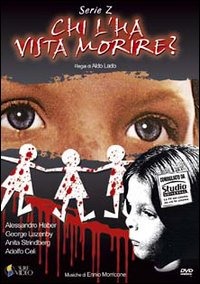
Who Saw Her Die?

With Daniel Craig established as a Bond to rival Sean Connery courtesy of 'Casino Royale', the only certainty nowadays in any poll is who would come bottom of the list: George Lazenby.

In all fairness, it's hardly his fault. A former male model, whose only previous acting experience had been a small role in the low budget spy spoof 'Espionage in Tangiers' - that the producers plucked him from nowhere and expected him to fill Connery's shoes was a spectacular bit of bad judgement, one compounded by further hamstringing him with a script as wet as an out-of-season weekend in Bognor Regis and pitifully lacking in the ruthless do-or-die ethos that characterises the best instalments of the franchise.

But I digress.

I have little interest in writing about 'On Her Majesty's Secret Service'; what is worth mentioning, however, is what George did next. He followed his solo Bond appearance with a lead role in Cy Endfield's largely forgotten mercenary drama 'Universal Soldier' (nothing to do with the Dolph Lundgren/Jean-Claude van Damme flick), after which he found himself negotiating the dank, dangerous, non-tourist-promoted backwaters of Venice in Aldo Lado's dark and compelling giallo 'Who Saw Her Die?'

Lazenby plays Franco Serpieri, a sculptor living in Venice whose desultory affair with a local woman barely masks with pain of his estrangement from his wife Elizabeth (Anita Strindberg). Dishevelled, gaunt (Lazenby lost weight for the role), at odds with the cliquey society of art dealers and collectors, personified by his patron Serafian (Adolfo Celli - star of an earlier Bond film, 'Thunderball'), upon whom his livelihood depends, Serpieri's malaise is temporarily relieved by a visit from his vivacious young daughter Roberta (Nicoletta Elmi).

Temporarily, because red-headed Roberta falls foul of a black-gloved murderer a third of the way into the film and Serpieri, reconciled with Elizabeth through the harshest of tragedies, becomes obsessed with finding her killer.

At which point I need to stop talking about Lazenby. His physical transformation for the role is remarkable - coming a scant three years after 'OHMSS', he's almost unrecognisable: gone, the chiselled good looks that secured his erstwhile modelling profession, gone the coiffured, clean-shaven image; the Lazenby of 'Who Saw Her Die?' is an emaciated scruff of the first order - but his range as an actor is limited. Which is more than can be said for Strindberg. Often cast in gialli purely for her striking, high-cheek-boned looks, she has seldom been saddled with a more useless eye-candy/set-dressing/"woman in peril" role than here. (You can imagine Lado's direction: "Anita, look glacial ... Anita, look scared ... Anita, scream like you've never screamed before.")

I should mention instead Celli's effortless portrayal of Serafian as a sybarite/sensualist/degenerate (delete according to personal aesthetics), fine work from a wonderfully expressive actor who, in this film particularly, comes across as a Peter Ustinov gone bad. He's great; his scenes bootstrap the film up to a higher level.

But there's two people who really turn 'Who Saw Her Die?' into, if not a top-flight, then certainly an inspired giallo.

One is director Aldo Lado. Not just the only director, to the best of my knowledge, who first name and surname are an anagram of each other, he also worked as assistant director to Bertolucci on 'The Conformist'. Unjustly overlooked, Lado's contributions to the giallo are the equal of anything Bava achieved, and his capacity for spatial dislocation/disorientation and sustained setpieces (notably a tense cat-and-mouse sequence which takes in a fog-wreathed harbour and an abandoned factory) come close to the prowling, subjective camerawork of Argento at his best.

And speaking of those two maestros: remember Nicoletta Elmi, the creepy kid in Bava's 'A Bay of Blood' and the even creepier kid in Argento's 'Deep Red'? Here she plays a decidedly non-creepy kid. An actually quite adorable kid. Just eight years old when she starred in 'Who Saw Her Die?', Elmi acts everyone offscreen. The first act of the film, in which the killer makes two failed attempts at abducting Roberta before finally - fatally - succeeding, rises above the genre checklist it could easily have become. It's the doomed Roberta you remember more than the driven Serpieri. It's her terrible vulnerability, her achingly poignant innocence, than define the film, long after the shoal of red herrings have been forgotten and the almost awkwardly abrupt ending has ceased to bother the casual viewer.

Nicoletta Elmi has acted in only a handful of films and TV shows.An early, very small role, was in Visconti's masterpiece 'Death in Venice'; a decade and a half later, she proved the only good thing in Lamberto Bava's so-bad-it-was-almost-good-but-ultimately-was-just-plain-bloody-awful 'Demons'. In her mid-twenties, she turned her back on acting and studied medicine. A loss to cinema, but I applaud her humanity.

Kamis, 17 Januari 2008

Demons / Demons 2

Conversation between self and Paula:

"What are you going to write about now you've finished watching the Dario Argento box set?"

"Well, I thought I'd make a start on the Herzog set you bought me for Christmas. But I've got 'Demons' and 'Demons 2' to review first."

"I thought you said they weren't proper Argento films."

"They're not. He co-wrote and produced them. Lamberto Bava directed."

"So why bother writing about them?"

"I kind of intimated I'd review the entire box set."

"But you didn't like them. How was it you described 'Demons'?"

"Piece of shit."

"And what was your opinion of 'Demons 2'?"

"Piece of shit: the next chapter."

"And why did you start the blog?"

"Well ..."

"To write about the films you're passionate about. So skip the 'Demons' films and write about Herzog."

What's that line in 'Hamlet' - "to whet thy already blunted purpose"? Thanks, Paula. Wise words.
Still, though ...

'Demons' concerns a group of stereotypes (uh, sorry, characters) who are invited to a movie preview at a newly renovated cinema. They include a handful of repulsively clean cut teenagers, a pimp and his two girls (the only pimp in history who takes his bee-hatches to the flicks instead of sending them out on the street to make him some money), a bickering middle-aged couple and a blind man (at a cinema ... you work it out). The film they watch is a violent horror with pretentious overtones (the protagonists discover Nostradamus's tomb and unleash a curse which turns them into demons). The events onscreen start happening to the audience and suddenly the cinema is amok with demons (although, to be honest, they just look like bargain-basement zombies). The survivors try to fend them off. Because all of this occupies less than half of the mercifully short 85-minute running time, Bava then throws in a car full of coke-snorting young thugs with names like Ripper, Hot Dog and Baby Pig; chased by the police, they take refuge in the cinema ... and then it's more of the same for the last half hour.

'Demons' is infuriating not for its sheer ineptitude, its horribly dated 80s soundtrack and music-video stylings, or the fact that four people (including Argento) contributed to the screenplay and the best they came out with was lines like (on entering the projection booth and looking at the machinery), "These are automatic - they run by themselves." Like, duh! 'Demons' is frustrating because occasionally - occasionally - it does something that's almost clever. The opening sequence, squeaky clean American student Cheryl (Natasha Hovey) getting all worried because she's convinced herself she's being stalked, climaxes with a man in a mask stepping out of nowhere to block her exit ... only to hand her a complimentary ticket. Bava subverts audience expectations nicely here - likewise, in the closing credits, he savagely turns the 'final girl' convention on its head. More scenes like this and less of the am-dram acting, over-reliance on gross-out effects and utterly inappropriate music, and 'Demons' could have been ... well, significantly less bad.

What of 'Demons 2'? Less a sequel, despite a tenuous plot device wherein a TV movie about the survivors of the original causes the residents of a tower block to become infected, than an act of recycling. At least two prominent cast members return: Bobby Rhodes follows up his wear-bad-suit-and-shout-a-lot performance as Tony the Pimp in the first film with a wear-bad-track-suit-and-shout-a-lot performance as Hank the Gym Instructor. The demons kill him off pretty easily in both. Pasqualino Salemme follows up his frown-and-scowl-a-lot characterisation as Ripper the Teenage Thug in the erstwhile installment with a frown-and-scowl-a-lot characterisation as The Security Guard ... but, see, in this film he's on the side of the establishment. In the hands of a better director this might have passed for irony. Bava also re-uses the wrongfoot-the-audience opening sequence, this time revealing blobs of red falling onto a knife as the result of an upended jam jar in a baker's kitchen.

Here's an example of the awful cheesiness of 'Demons 2': square-jawed hero and heavily pregnant heroine (they had names, they were played by someone or other ... I honestly can't be bothered to go back on IMDB) flee to the top of the tower block, the demons pursuing them. From somewhere (a mountaineering shop tucked between the service lift and the janitor's closet, perhaps?) they acquire a gapple and a few metres of rope. Hero secures the grapple, glances over the parapet. "Remember those safety courses we took last year?" he asks the heroine. She nods, dewy-eyed. Cut to: heroine clinging tightly to hero as they abseil to safety. Some films fall into the so-bad-it's-good category. 'Demons 2' goes one step further: so-bad-it-was-almost-good-then-it-went-all-out-to-prove-it-was-actually-just-bad-in-the-first-place.

I'm going to take a shower, birch myself, say a couple of hundred Hail Marys and watch some proper films before I next post on this blog. Honest.

Rabu, 16 Januari 2008

Phenomena

Jennifer Corvino (Jennifer Connelly), the daughter of an eternally-absent movie star, is packed off to the prestigious Richard Wagner School for Girls in Switzerland, under the care of the equally musically named Frau Bruckner (Daria Nicolodi). The beheaded corpse of a Dutch tourist, Vera Brandt (Fiore Argento) has just been discovered, another victim in a spate of grisly murders. The school is abuzz with fear and intrigue. The girls are cliquey and snide. Jennifer is scorned for her perceived fame. The prissy headmistress (Dalila di Lazaro) takes against her from the start. She makes just two friends - room-mate Sophie (Federica Mastroianni) and, away from the school, entomologist Dr John MacGregor (Donald Pleasance).

She meets MacGregor after a sleepwalking incident. Lost and confused, miles from the school, she is rescued by MacGregor's assistant, Inga, who takes Jennifer to the wheelchair-bound scientist's home/laboratory. Oh, yeah, Inga's a chimpanzee, by the way. I am not making this up.

Jennifer and MacGregor hit it off immediately, bonding over their mutual love of insects. MacGregor studies them; his field is insect communication - he believes them to be telepaths. Jennifer proves his thesis and then some. Our girl actively empathises with them. A firefly leads her to an important discovery following Sophie's murder. A couple of million flies angrily descend upon the school when Jennifer is tormented by her classmates. The headmistress reveals herself as something of a religious fanatic. "Satan is sometimes referred to as Beelzebub," she muses; "the lord of the flies", and on this basis plans to have Jennifer bundled off to the nearest psychiatric hospital.

In the meantime, MacGregor has been helping Inspector Geiger (Patrick Bauchau) with his enquiries, studying the insects feeding off the recovered remains of Vera to pinpoint her time of death. This, and his burgeoning friendship with Jennifer, bring him to the killer's attention. The inevitable attack on him is witnessed by Inga who, unable to intercede, later finds the killer's discarded straight-razor and goes looking for revenge. Yes, that Inga. You know, the chimp.

Let me say it again: I am not making this up.

As you might have gathered, 'Phenomena' is ever so slightly bonkers. Although many of the director's fans rate it low in his filmography it is, in many ways, archetypally Argento. There's the wonky science from 'The Cat O'Nine Tails' and 'Four Flies on Grey Velvet'. There's the protagonist's visual impairment from 'TCONT': while Arno is blind and witness something only by overhearing it, Jennifer sleepwalks and witnesses a murder while not conscious. There's the telepathy subplot from 'Deep Red' that gets Helga killed in that film and Jennifer's life put at risk in 'Phenomena'. There's a pounding rock score that features compositions by former Goblin frontman Claudio Simonetti, as well as songs by Iron Maiden and Motorhead. There's plenty of prowling camerawork, editing that's as sharp as the aforementioned straight-razor, and a handful of scenes, particularly an extended finale, which are as tense and gloriously grand guignol as anything Argento has committed to film.

So why its reputation as second-rate Argento? The ludicrous plot probably has something to do with it ... but when has Argento ever been beholden to logic, narrative coherence or anything so conventional? Take 'Suspiria': it's an exercise in illogicality, but as a work of film art it's as gorgeous as it is demented.

No, I think 'Phenomena' suffers from the place it occupies in Argento's filmography. From 1975 to 1982, Argento was in his element: 'Deep Red', 'Suspiria', 'Inferno', 'Tenebrae', two deliriously over-the-top horror movies bookended by the two finest examples of the giallo in all of cinema. Compared to these, 'Phenomena' does, unfortunately, seem a little by-the-numbers. It doesn't even feature one of Argento's technical trademarks, like the two-and-a-half minute Louma crane sequence in 'Tenebrae' or the swooping ravens' POV shot in 'Opera', the film that followed 'Phenomena'.

It would be all to easy to make a case for Argento's career as a study in decline since 'Tenebrae'. But 'Phenomena' has its moments - along with a good performance, despite the often awful dialogue she's saddled with, by the young Jennifer Connelly (she was fifteen at the time and her star quality was already in evidence). Donald Pleasance gives sterling support in one of his better post-'Halloween' appearances. Argento's assistant director and protege Michele Soavi pops up in a supporting role as Inspector Geiger's assistant. And on the subject of the good detective, 'Phenomena' is that rarest of gialli: one that features a halfway competent copper, even though his complacency proves his undoing in the final reel.

Finally, 'Phenomena' has the most manic climax of any Argento movie. There's never been a deus ex machina like it!

Selasa, 15 Januari 2008

Deep Red

Whereas 'The Bird with the Crystal Plumage' and 'The Cat O'Nine Tails' are immediate in the instigation of their narratives (Sam Dalmas is walking home when he sees something; Franco Arno is walking home when he overhears something), 'Deep Red' sets out its stall in a more roudabout, even oblique, fashion. The first scene shows very little but is full of significance: we see a table set for dinner, a gramophone stand, a Christmas tree, an expanse of parquet flooring. A child's nursery rhyme plays liltingly on the soundtrack. In shadow, an indeterminate figure knifes another figure in the back. The bloody knife is thrown to the floor, suddenly occupying the screen in grotesque close-up. A pair of legs enter the composition, feet halting before the knife. Small feet. Those of a child.

The lilting song is replaced by Goblin's bass-heavy score ('Deep Red' marks Argento's first collaboration with the band; their music would become a mainstay of his films). The opening credits over, a POV shot takes us into a hall, heavy red curtains drawing back theatrically, where a conference on parapsychology is in progress. Psychiatrist Professor Giordani (Glauco Mauri) is interviewing a famous medium, Helga Ulmann (Macha Meril). Helga demonstrates her powers with a borderline parlour trick (correctly identifying an audience member she's never met) before jolting back in her seat, body wracked as if in agony. "I have contacted a twisted mind," she gasps. "You ... you have killed. And you will kill again." Another POV shot as the still anonymous newcomer to the conference just as quickly withdraws. Helga returns to her hotel room, keen to record her perceptions of this telepathic experience. Her few pages of notes are summarily removed after a shocking attack by a black-clad antagonist wielding a meat cleaver.

It is only now that, in true giallo fashion, our wrong-place-at-the-wrong-time hero happens along and witnesses the murder. Introduced a few minutes earlier rehearsing with his band and berating them for sounding "too clean, too formal ... this kind of jazz was born in brothels", Marc Daly (David Hemmings) is an English musician living in Rome. Walking home, he stops to chat with his friend Carlo (Gabrielle Lavia), a pianist-for-hire at a trendy bar. Marc remonstrates with Carlo about his drink problem and the way he squanders his talent. "You do it for the love of it," Carlo returns; "I do it for the money." This remark suggests that Marc occupies an ivory tower while Carlo lives in the real world. Seconds later, the real world (or at least Argento's hyper-stylised version of it) comes crashing into Marc's life as a scream rings out. Seconds after this, he sees Helga plunged face-first through a plate glass window.

By the time Marc gets to her apartment the killer has fled and it's too late. The police arrive, again adhering to giallo archetype: Superintendent Calcabrini (Eros Pagni) stuffs his face with sandwiches at the crime scene, demonstrates more interest in what instrument Marc plays than in generating lines of enquiry, and basically proves as much use as the proverbial chocolate teapot. Marc, meanwhile, fixates on the surreal paintings that line the walls of the hallway leading to Helga's apartment. Something bothers him; something he can't quite put his finger on.
.
Threatened by the killer, who plays the child's nursery rhyme outside Marc's apartment prior to warning him to leave Rome, Marc joins forces with flamboyant journalist Gianna Brezzi (Daria Nicolodi, making her first appearance in an Argento film) and they begin their own investigation. Marc buys a recording of the nursery rhyme and plays it to Giordani, who suggests it might be linked to a formative and probably traumatic event in the killer's childhood. Marc learns of a book detailing unsolved mysteries in which the nursery rhyme is mentioned. There is an illustration of an old house. Marc tears the illustration out of the book, and sets about tracking down the author, Amanda Righetti (Giuliana Calandra). The killer beats him to it. Frustrated, sickened at the brutality of Amanda's death, Marc overlooks a vital clue. Giordani, who visits the scene later, sees what Marc has missed. He returns to his office, confident that he knows the murderer's identity ...

Marc, meanwhile, locates the old house. He makes a couple of discoveries, but is coshed, left unconscious and wakes to find the place in flames. It seems like the killer has, once again, been one step ahead of him. Then he unearths a final clue which leads him to a confrontation in a deserted school ... but even then, there's something that doesn't add up. And there's one more nasty surprise lying in wait for him.

'Deep Red' meets all the criteria expected of a giallo. So what makes it transcend the sub-genre? Why is it arguably Argento's greatest achievement? Firstly, there's the script, which Argento co-wrote with Bernardino Zapponi (who worked with, among others, Fellini): crafty, clever, intricately structured, it leaves its greatest conceit - the transference of guilt from killer to protagonist - beautifully understated, assuming that the more the viewer thinks about the last-act revelation, and the motivations behind the murder and mayhem, the more apparent the supposed hero's complicity will become. That's all I'm saying on the subject, by the way; if you haven't seen the film yet, I don't want to deprive you of the jaw-dropping confidence which with Argento shows/conceals the murderer's identity quite early on. Structurally, the script offers a number of 'rhymed' scenes: incidental details and bits of throwaway dialogue which presage the mechanics of the various death scenes.

There's also the introduction, for the first time in Argento's filmography, of the supernatural, Helga's telepathy providing the impetus for the first murder. When Giordani introduces Helga, he talks of telepathy in the animal world, how a butterfly, in danger, will mentally communicate with others of its species, a mass of them responding. (This line finds its visual corrolary, only with flies instead of butterflies, in a key scene in 'Phenomena'.) Argento would go on to make two supernatural/horror films: 'Suspiria' and 'Inferno', the first two parts of his only-just-completed Three Mothers trilogy.

'Deep Red' brings the horror ethos to the fore, both in terms of elaborate, blood-soaked set-pieces (the title, 'Profondo Rosso' in its original Italian, is certainly apt) and the dark psychology behind them. I won't dwell on the latter for fear of giving too much away (suffice it to say that key themes here - duality and complicity - are taken to their logical extreme in the later 'Tenebrae'), so let's consider the former. The death scenes are bloodier and more violent than anything Argento had depicted before - something he would raise the bar on with (again) 'Tenebrae'. But there's more going on than just a B-movie guts 'n' gore exploitation workout. Argento raises the bar on tension, as well, particularly in Giordani's death scene, where he is menaced by an unseen assailant only for a rabbit-faced life-size mechanical doll to come hurtling into his office, maniacal giggling filling the soundtrack. Typing a description of this scene, I'm aware that it probably sounds ridiculous. Onscreen - take my word on this - it's fucking terrifying.

Just as creepy are the pre-murder scenes where the camera pans, in fetishistic close-up, across a collection of childhood mementos set against a backdrop of black velvet. Again, a simple description doesn't communicate much; but the combination of image, music and camera movement add up to one of the most effective head-fucks in cinema.

Argento's technical bravura is also evident during the wordless 15-minute sequence where Marc prowls the old house. With Goblin's soundtrack again providing aural assault, Argento's camera gets as much inside his protagonist's head as it does the empty rooms, dusty corridors and flooded basement of the house itself. The full extent of Marc's obsession is documented here.

Hemmings's performance, reminiscent of (as well as slyly satirising) his earlier work on Antonioni's 'Blow-Up', is one of his best. His scenes with Gianna work well, too, her supreme confidence an eternal threat to his painfully thin veneer of masculinity. Marc emerges as an often vulnerable but likeably tenacious character - multi-layered in a way that Sam Dalmas or Carlo Giordano aren't. And yet it's this tenacity that leaves him, in the film's powerful final image, looking back at his own image in a pool of blood, silently reckoning the cost of his obsession.


Minggu, 13 Januari 2008

The Cat O' Nine Tails

If it ain't broke, don't fix it. 'The Cat O'Nine Tails' opens in similar fashion to 'The Bird with the Crystal Plumage': Rome by night, a street scene; a man on his way home is an accidental witness to ...

Actually, no; scratch that. It becomes a very different film quite early on. One of the chief pleasures of 'TCONT' is Argento's first-act manipulation of accepted giallo conventions. To begin with, our protagonist Franco Arno (Karl Malden) doesn't technically witness anything since he's blind. Secondly, what he stumbles on (a few words of overheard conversation) is indicative of blackmail, not murder. Thirdly, he's revealed, a few minutes later, as not even being the protagonist but a supporting character. Here's our hero of the day, another example of Argento's blandly interchangeable leading men: Carlo Giordano (James Franciscus), an investigative journalist hurrying to the scene of a break-in at the Terzi Institute, a renowned genetics research facility. En route, he bumps into Franco (quite literally); the two quickly join forces as blackmail and burglary leads to multiple murder and everyone at the institute seems to have a secret to hide.

There's institute head honcho Professor Terzi (Tino Carraro), whose interest in his adoptive daughter Anna (Catherine Spaak) is rather unwholesome; there's narcissistic German researcher Dr Braun (Horst Frank), leading a double life that leaves him open to personal as well as professional jealousies; there's Dr Calabresi (Carlo Aleghiero), who fatally discovers something about one of his colleagues ... fatally for him, that is; there's Calabresi's lover, Bianca Merusi (Rada Rassimov), who races to find the incriminating evidence before the killer can find her; there's Dr Casoni (Aldo Reggiani), whose work on the XYY project constitutes one discovery too many.

The XYY project, the Macguffin around which the narrative centres, explores the idea that criminal tendencies are genetically pre-programmed. Casoni enthuses that, once the research has been completed, a simple test at birth, followed by immediate incarceration of all carriers, will effectively stamp out crime and violence. It's a startling concept: a future in which the state whisks babies from womb to prison to guard against what they might do later in life. It's also a highly dubious bit of science, which is probably why the script doesn't explore it any further. Although, as with the later 'Deep Red', there's a brutal irony lurking at the end of the film once you think about it a bit.

It's curious that 'TCONT' remains so under-rated. Read the user comments on IMDB and the general concensus seems to be that it's lacking in Argento's trademark bravura visuals and camerawork ... but you could say that of 'TBWTCP'. In fact, Argento's operatic visual excesses didn't fully kick in until 'Deep Red'. True, there's nothing in 'TCONT' quite as striking as Sam Dalmas trapped between the two sets of glass doors at the start of 'TBWTCP', but there are still some great set-pieces: a murder at a railway station, a bunch of paparazzi distracted from the arrival of a pouting starlet as someone is pushed in front of an oncoming train (the face/front of locomotive impact is not so much homaged in Eli Roth's 'Hostel' as shamelessly plagiarised); a Hitchcockian bit of suspense involving a poisoned carton of milk (a sly reworking of a terrific sequence in 'Notorious'); a bit of business in a shadowy crypt that segues from blackly comic to just plain creepy; a roof-top confrontation/chase scene in which Franco proves himself more than capable despite his blindness.

There are also flaws, however: far too many scenes with the typically ineffectual cop, Superintendent Spini (Pier Paolo Capponi); a pointless romantic subplot between Carlo and Anna (Franciscus and Spaak pitch their performances at a narcoleptic level; there is absolutely no chemistry; their love scene is embarrassing); perfunctory and fairly ordinary death sences; way too many red-herrings (granted, a certain amount of misdirection is requisite in the giallo, but here there are too many instances when the actual plot is all but forgotten about); and a title that's as tenuous as the science is shaky. Discussing the various institute staff whose behaviour prompts suspicion, Franco and Carlo come up with nine names. "Like a cat o' nine tails," Carlo exclaims. "Yes, the old navy whip," Franco nods. "If we could just grasp one of them ..." Carlo muses.

And yet 'TCONT' is an intriguing and often entertaining film to watch. It also benefits from arguably the greatest acting performance in any Argento film: that of Karl Malden. I don't think I've ever seen a mainstream actor play a blind man so convincingly, so physically and with such dignity. Forget Al Pacino's inexplicably Oscar-rewarded turn in 'Scent of a Woman', Malden truly integrates with his character.

Jumat, 11 Januari 2008

The Bird with the Crystal Plumage

Expatriate writer Sam Dalmas (Tony Musante), spending his last few days in Rome before he returns to the States, is wandering back to his apartment one evening when his attention is drawn to the brightly-lit facade of an art gallery. The gallery is on two levels, its exhibits mostly sculptures - strange, twisted, threatening objects. On the upper level, a woman dressed in white is struggling with a black-clad figure. Sprinting across the road, Sam tries to gain entry, intent on helping her. A large sliding glass door, locked and immovable, stops him. While he struggles, the black-clad figure leaps down to the lower level, leaving the woman bleeding from a stab wound, and disappears through a rear exit ... though not before triggering a mechanism which closes a second glass door behind Sam. Trapped, and looking like a bizarre live-art addition to the galleries exhibits, Sam is helpless, impotent, unable to do anything but await the police's arrival and hope the woman doesn't expire in the meantime.

Unusually, the police arrive in a timely fashion ... then immediately revert to giallo type as they spectacularly fail to generate any leads. In fact, Inspector Morosini (Enrico Maria Salerno)'s only attempt at pro-active police work is to organise an identity parade for Sam's benefit, rounding up a group of usual suspects ("right, bring in the perverts"). Sam avers that he didn't see the attacker's face. All he can be sure about is that some aspect of what he witnessed doesn't seem right - but he just can't put his finger on it. A foiled attack on him on his way home, followed by threatening phone calls advising him to go back to America, do nothing to quell his curiosity and he begins his own investigation, much to the chagrin of his girlfriend Julia (Suzy Kendall). Sam ties in the attack at the gallery with a recent series of murders of young women which the police - surprise, surprise - have no suspects for.

Sam learns that one of the earlier victims worked at an antique shop. The proprietor tells him that she sold a macabre picture just before she was killed. Sam obtains a catalogue photo of the painting and eventually tracks down the artist, but he proves as unhelpful as he is eccentric and the trail goes cold. Then another clue falls into place and seems to lead Sam back to where he started. But there are still a few surprises in store for him ...

'The Bird with the Crystal Plumage' was Argento's first film and an immediate success. He followed it up very quickly with 'The Cat O'Nine Tails', establishing himself as a master of the giallo and inviting comparions to Hitchcock. Praise indeed! And yet 'TBWTCP' isn't without its flaws: Musante and Kendall turn in wooden performances, an early indicator of Argento's tendency to casting bland actors in lead roles (cf. James Franciscus in 'The Cat O'Nine Tails', Leigh McCluskey in 'Inferno'); the script, while clever in terms of structure and misdirection, is bogged down with clunky exposition; the attempts at comedy (an effeminate antique shop owner, a pimp with a speech impediment) are laboured and unfunny.

So why does Argento owe his career to it? Why is it still considered a classic of its kind? Why is it still being paid homage to (most recently by Quentin Tarantino in 'Death Proof')? The Hitchcock comparison provides an answer: like Argento, Hitch was never a director of actors ("actors are cattle" is one of his most cutting and oft-quoted homilies); his fame derives instead from bold, hugely memorable set-pieces, wrought with tension, which are perfectly geared to the visual potential of the medium. The crop dusting plane and the Mount Rushmore finale in 'North by Northwest', the shower scene in 'Psycho', [insert personal favourite here].

Same deal with Argento. At his best, he's capable of wringing every possible drop of tension from a scene then still making you jump when he delivers the pay-off. Visually, his films are full of striking compositions and often surreal colour schemes (although his recent work has, sadly, demonstrated a curbing of his excesses in this respect). Some stand-outs from 'TBWTCP': the iconic opening scene, the black-clad figure stark against the clinical white of the gallery, Sam trapped between the bright interior and the nocturnal street outside (the now discontinued Killing in Style has a perceptive article on this scene); a claustrophic cat-and-mouse sequence as a gunman stalks Sam through a bus depot, the closely parked buses forming a maze of sorts as Sam tries both to evade his antagonist and find a way out; Julia menaced as she waits for Sam to return from his meeting with the painter, desperately trying to escape the apartment through a back window as the front door begins to splinter under the killer's assault; Sam at a disadvantage, pinned beneath one of the sculptures at the art gallery as he finally realises who's behind it all.

Ultimately, if 'TBWTCP' isn't quite top-flight Argento it still stands as a statement of intent - a clear indication of the idiosyncratic style he would develop as a film-maker.

Kamis, 10 Januari 2008

I am murderously yellow: a guide to recognising the giallo

You can’t really talk about Dario Argento without using the word ‘giallo’, so for the benefit of the non-aficionado, a few words of explanation:

Giallo is Italian for ‘yellow’. Historically, this refers to the distinctive yellow covers of pulp novels published by the Mondadori company in the 1920s and 1930s. These were the equivalent of American hard-boiled fiction (indeed, many were translations of works by the likes of Edgar Wallace), and proved so popular that other publishing houses rushed into print similar titles, retaining the lurid covers. In the 1960s and 1970s directors like Mario Bava, Sergio Martino and our current man of the match Mr Argento crafted cinematic equivalents – some of them adaptations of the original novels.

For an in-depth but always accessible examination of the giallo phenomenon, with plentiful examples under review, check out Giallo Fever.

For my part, perhaps the quickest introduction to the giallo is a simple list of some of its defining characteristics:

1. Black gloves. Along with identity-concealing trenchcoat and fedora, this is the de rigueur fashion accessory for the killer-about-town.

2. An amateur sleuth, in the wrong place at the wrong time, who decides to launch their own investigation after witnessing a murder or attempted murder. There’s usually something about what they saw that bugs them, something they can’t quite put their finger on. And there’s generally a threat to their own safety as a result of launching said investigation. Which they only do because …

3. The police are totally ineffectual. Take ‘The Bird with the Crystal Plumage’ (of which more later): Inspector Morosini (Enrico Maria Salerno), getting nowhere with the official investigation, happily sanctions star witness Sam Dalmas (Tony Musante) to undertake his own enquiries. Saves on police manpower, I guess.

4. Extended, operatic death scenes. Essentially, the giallo is a hybrid of the traditional whodunit and the visceral stalk ‘n’ slash flick. Death scenes are all important – the more tension that can be generated, the more bizarre the mechanics of the murder, and the more bloody the pay-off, the better.

5. Staircases. I don’t know why, but there’s a penchant in these movies for vertiginous shots of (often spiral) staircases. Likewise, killers and victims alike tend to plunge from high places or down elevator shafts.

6. J&B. It’s a bloody awful blend, but the manufacturers must have bunged a fair bit of money towards gialli budgets because it features as product placement in the same way – and just as blatantly – as Aston Martins in Bond movies.

7. Famous mainstream actors at the start or later on in their careers. Jennifer Connelly in ‘Phenomena’, for example, or Karl Malden in ‘The Cat O’Nine Tails’.

8. Gratuitous nudity. Well, black gloves and bottles of J&B can only generate so many ticket sales.

9. Edwige Fenech. See above.

10. Distinctive titles, often featuring an animal (‘Don’t Torture a Duckling’), a colour (‘Deep Red’), a number (‘Five Dolls for an August Moon’), or sometimes a combination of all three (‘Four Flies on Grey Velvet’). Elsewhere, you might find a reference to the murder weapon (‘Hatchet for the Honeymoon’), or the promise of something of something steamy, seamy and downright disreputable (‘Your Vice is a Locked Room and Only I Have the Key’ – see above).

Right, then: ‘The Bird with the Crystal Plumage’. And to quote Inspector Morosini, “Bring in the perverts …”

Rabu, 09 Januari 2008

Dario Argento: the, ahem, Ultimate Collection

I’m currently working my way through Blackhorse Entertainment’s ‘Dario Argento: the Ultimate Collection’. This six-DVD box set is very nicely presented, but nonetheless I have to take umbrage with it.

For starters, only two-thirds of its contents were directed by man himself: ‘Demons’ and ‘Demons 2’ were helmed by Lamberto (son of Mario) Bava, with Argento co-scripting and producing. Yes, I know that Argento therefore influenced the style and content of these films – and that, in the early stages of Bava’s career, Argento was his mentor – but damn it, if a box set advertises itself as the Dario Argento Ultimate Collection, or the Martin Scorsese Ultimate Collection, or even the Brett Eisner Ultimate Collection for Christ’s sake, then surely it’s not unreasonable to expect all of the films contained therein to be directed by said individual. And besides, if you need a couple of Argento-produced fillers to round the set out, then Michele Soavi’s ‘The Church’ and ‘The Sect’ are better choices.

So what are we left with? Well, we have Argento’s first two films, ‘The Bird with the Crystal Plumage’ and ‘The Cat O’Nine Tails’, as well the magnificent ‘Deep Red’ and the preposterous ‘Phenomena’.

Which brings me to my next gripe: if you have the word ‘ultimate’ in the title, make damn sure the content justifies it. ‘Bird’ is a striking debut, ‘Cat’ remains one of Argento’s most under-rated works, and ‘Deep Red’ is a straight-up masterpiece … but where ‘Suspiria’, where ‘Tenebrae’, where ‘Opera’? In another box set, that’s where! And – quelle surprise! – I’m still waiting for Amazon to get it to me. Final gripe: I've not watched every disc yet, but the quality of those I have has been shocking - the sound is crackly; the prints grainy and subject to ghosting. Fair dues, what I paid for the set brings the individual disc price down to a shade under £3.00, but still it comes back to the words on the cover: Ultimate Collection. Put simply: it isn’t.

Nevertheless, the Argento-fest, such as it is, kicks off tomorrow … so don your black gloves, pour yourself a glass of J&B and prepare to stalk the shadowy reels of that most visceral and operatic of sub-genres, the giallo.

Jumat, 28 Desember 2007

Coming attractions

Between my order for the Dario Argento box set finally arriving and my partner buying me the second Werner Herzog box set (featuring 'Even Dwarves Started Small', 'Fata Morgana', 'The Enigma of Kaspar Hauser', 'Heart of Glass' and ' Stroszek'), I've got plenty of films to write about.

But between moving house and an imminent mini-break in Scotland for the New Year (Hogmanay with the Scots - methinks some drinking is going to be done), I've not had the chance to watch them, or to update this blog.

Normal service will be resumed (hopefully) during the second week of January.

In the meantime, here's hoping everyone had a Merry Christmas; and my best wishes for a Happy New Year.