Category: gialli / In category: 1 of 10 / Overall: 4 of 100

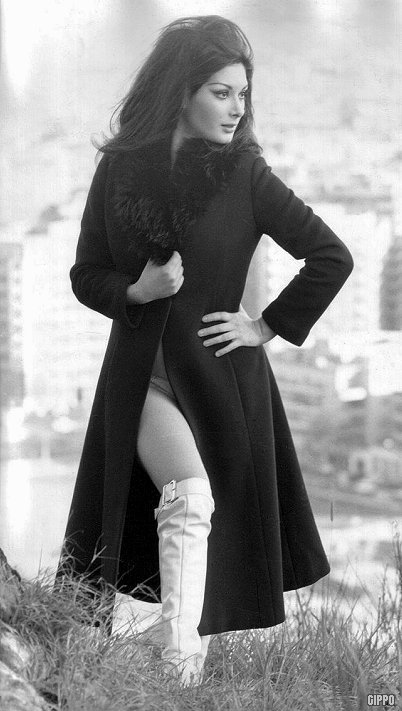
Check out the image above. Off-kilter composition, bottle of J&B, Edwige Fenech. Yup, we’re in giallo territory.
‘All the Colours of the Dark’ is one of five terrific gialli Sergio Martino directed between 1971 and 1973, following on from (and reuniting the stars of) ‘The Strange Vice of Mrs Wardh’ and the magnificently titled ‘Your Vice is a Locked Room and Only I Have the Key’.
Fenech stars as Jane Harrison, the increasingly harassed and distressed partner of London-based pharmaceutical rep Richard Steele (George Hilton). Still plagued with nightmares about the murder of her mother many years previously, Jane is also recovering from the trauma of a car accident (an incident for which it seems Richard is blameworthy) which caused the miscarriage of her baby. Richard favours prescription drugs to treat her nervous condition, while her sister Barbara (Nieves Navarro, appearing under her Susan Scott pseudonym) is keen for Jane to enter therapy with the psychiatrist for whom Barbara works.

To make matters worse, the piercingly blue-eyed killer from her dreams – a man with rather phallic tendencies to knife-wielding – seems to have stepped living and breathing into the real world. Jane’s already fragile condition deteriorates as he begins stalking her, following her on the Underground, keeping sinister vigil outside her apartment building.
Martino establishes a ‘Rosemary’s Baby’-style atmosphere of mounting dread from the outset, probing his heroine’s borderline hysterical mental/emotional state as effectively and unremittingly as Polanski did in his classic of the macabre. The influence of ‘Rosemary’s Baby’ is writ large, but it’s to Martino’s credit that ‘All the Colours of the Dark’ comes across as more than just a knock-off or a cash-in.
Martino gets the ball rolling with a zonked-out dream sequence structured around quasi-Freudian imagery that mirrors Jane’s state of mind. Many more dream/fantasy/paranoia sequences will follow, Martino segueing between Jane’s inner world and the (supposedly) real one with such sneaky aplomb that, for much of the film’s hour and a half running time, he maintains ambiguity as to whether everything we see is simply a product of Jane’s troubled mind. (Lucio Fulci achieved a similar effect, albeit using a different cinematic bag of tricks, in ‘A Lizard in a Woman’s Skin’ made the year before.)
If proof of Jane’s mental turmoil were required, it’s provided by the scene on which the film entire hinges. Panicked after a perhaps-real-perhaps-imagined appearance of the stalker, Jane seeks solace from her alluring but mysterious neighbour Mary Weil (Marina Malfatti).

Jane: I'm sure someone is chasing me, someone coming very deep from my childhood. Do you believe in that sort of thing?
Mary: I believe in a lot more .. I had my problems, too. Not as serious as yours, but I got rid of them.
Jane: How?
Mary: Do you know what a black mass is?
Jane: You're scaring me.
Mary: It makes sense to be afraid sometimes. You have to find it and it'll disappear.
At this point, ‘All the Colours of the Dark’ could easily have lurched into the realms of the risible, the carefully established atmosphere and giallo tropes swamped by this explicitly horror/supernatural-themed narrative development. And, it has to be admitted, Martino’s staging of the black mass/orgy does come close to parody. Bruno Nicolai’s wordless vocal score is unintentionally hilarious while actor Julian Ugarte’s portrayal of the cult leader is less high priest than high camp.
Yet somehow Martino manages to fuse the disparate elements into a decently-paced and never less than entertaining hybrid. He makes good, non-touristy use of the London locations and conjures as many striking compositions and memorable set-pieces as you’d expect from a giallo, culminating in a vertiginous rooftop chase.
Fenech turns in a full-throttle performance as a woman in meltdown. Navarro and Malfatti add to the glamour quotient, even if their performances prove somewhat by-the-numbers. Hilton is dependable, but badly dubbed in the English language version. (Subject of which: the Shriek Show DVD release, while presenting a beautiful anamorphic transfer, suffers from murky sound that renders entire chunks of dialogue nearly indecipherable; fortunately, an Italian language/English subtitles option is available.)
‘All the Colours of the Dark’ arguably stops short of being one of the all-time great gialli, though. It flags a little towards the end. The fantasy vs. reality riff is recycled perhaps once too often. The eleventh hour inclusion of an exposition-spouting police inspector is arbitrary even by giallo standards. A just-as-eleventh-hour subplot involving an unexpected inheritance threatens to steer the mystery from the esoteric to the mundane. More annoyingly, a flashback to a crucial but initially overlooked clue requires a cheat on Martino’s part.
Still, these are relatively minor gripes and gialli often rely on endings that are abrupt, arbitrary or outright baffling (even such richly atmospheric, slow-burn entries as ‘Who Saw Her Die?’ and ‘The House with the Laughing Windows’ register high scores on the WTF-o-meter. ‘All the Colours of the Dark’ sees its prolific and versatile director on good form and gives the achingly gorgeous Fenech one of her best-remembered roles.