Background
The slow road out of his years in the wilderness following the 'Major Dundee' catastrophe and his firing from 'The Cincinnati Kid' began with his adaptation of 'Noon Wine' for the TV drama show 'ABC Stage 67'. Netting him Writers' Guild and Directors' Guild nominations and his best notices since 'Ride the High Country', he found himself in demand again. Head of production at Seven Arts, Kenneth Hyman was on a roll after the staggering success of 'The Dirty Dozen' and was looking to develop another action movie vehicle for Lee Marvin under the auspices of Warner Brothers. The project he had in mind was called 'The Diamond Story' and Peckinpah didn't think much of the script. Nonetheless, Hyman appointed producer Phil Feldman to work with Peckinpah. Neither of them cared much for 'The Diamond Story' and their attention was soon drawn to a couple of other scripts: 'The Wild Bunch' and 'The Ballad of Cable Hogue'.
It's entirely possible that Hyman would have called time on their extracurricular activities and ordered Peckinpah to knuckle down to 'The Diamond Story' but for one factor. 20th Century Fox had just paid half a million (an unprecedented amount for a script at that time) to William Goldman for 'Butch Cassidy and the Sundance Kid' and handed the reins to George Roy Hill. Industry buzz was high. There was probably no better time to make a western. Feldman saw 'The Wild Bunch' as a challenge to 'Butch and Sundance' at the box office. He was convinced it had blockbuster written all over it. 'The Diamond Story' was summarily abandoned and Feldman and Peckinpah threw themselves into 'The Wild Bunch'.
The production was suitably epic. Peckinpah, predictably, went overbudget. He exposed 330,000 feet of film, printing most of it so that he'd have an amorphous mass of material from which to work in the editing room. There were over 1,200 camera set-ups. Feldman didn't question any of Peckinpah's techniques. Their relationship was so good that their next project, 'The Ballad of the Cable Hogue', went into pre-production while editing work was still being completed on 'The Wild Bunch'. Things very quickly and irreversibly soured between them. While Peckinpah was scouting locations for 'Hogue', Feldman - pressured by the studio to bring 'The Wild Bunch' down to a two hour cut - caved in and, behind Peckinpah's back, snipped twenty minutes out. This was the last straw for Peckinpah - who already considered the 140 minute cut a compromise from his original three and a half hour version - and, true to form, kicked off very publically against Feldman and Warner Brothers, ending his association with both.

Synopsis
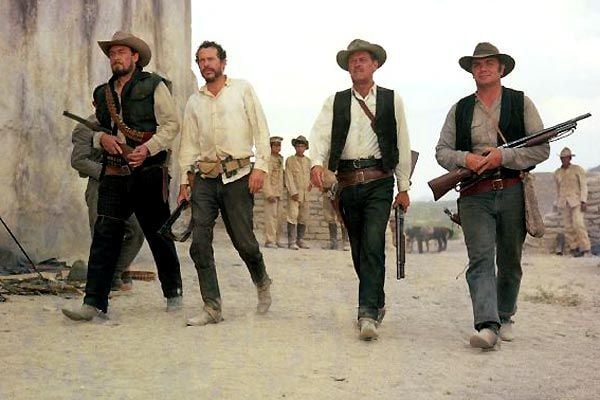
Grizzled outlaws Pike Bishop (William Holden), Dutch Engstrom (Ernest Borgnine) and the bunch ride into the town of Starbuck. Disguised as US army personnel, they storm into a railroad office and steal the payroll at gunpoint. Outside, under the nominal command of Pike's former partner Deke Thornton (Robert Ryan), a posse of bounty hunters are lying in wait for them. Deke entered into a bargain with railroad boss Harrigan (Albert Dekker) whereby he's bought his way out of jail in return for hunting down the bunch. A vicious shoot-out occurs and some of the bunch are killed. The surviving members head back to their rendezvous with Sykes (Edmond O'Brien) and divide the loot - only to realise they've been had. The money bags they risked their lives for are filled with washers. With Deke and the bounty hunters on their trail, they cross into Mexico where they stay briefly at youngest gang member Angel (Jaime Sanchez)'s village. The place is decimated; Angel's father has been killed by despotic Mexican general Mapache (Emilio Fernandez) while his girlfriend has gone off and whored herself at Mapache's hacienda. The bunch fetch up at Agua Verde where a rash decision on Angel's part precipitates an uneasy alliance with Mapache, who is being advised by a high ranking officer of the Imperial German army. The bunch are soon contracted by Mapache to rob a munitions train. The robbery is well-planned and executed, but they still have to face Mapache's treachery, the pursuing bounty hunters and the realisation of their own failings.

Analysis
Broadly speaking, the key themes of Peckinpah's work are:
1) Times change, yet Peckinpah's heroes - men of a certain era, men of a certain mindset - would rather die than change with them.
2) Technology encroaches, its results only ever destructive.
3) Loyalty, honour and codes of conduct are thrown into harsh relief - and tested sorely - by the inherently compromised morality of his protagonists.
3) Loyalty, honour and codes of conduct are thrown into harsh relief - and tested sorely - by the inherently compromised morality of his protagonists.
4) How men behave, interact, are defined by their actions and - sometimes - redeem themselves.
Just as broadly speaking, the most recurrent visual motifs in his films are: mirrors (as early as the 'The Deadly Companions' there's a shot of a gunslinger pumping a bullet into his own reflection, an image revisited with shattering clarity of purpose in 'Pat Garrett and Billy the Kid'), children bearing witness to or emulating the worst of adult behaviour (in almost every film: here it's a bunch of giggling children watching red ants swarm over a scorpion before heaping kindling over insects and arachnid alike and burning the lot), and automobiles as avatars for the death of the Old West (first glimpsed almost running Steve Judd over in 'Ride the High Country' and later a threat to Cable Hogue's business in Peckinpah's 'Wild Bunch' follow-up).
Not only are all of these present in 'The Wild Bunch' - along with his stylistic trademarks of slo-mo and freeze frames - but they synthesize perfectly into a vital, intense and immediate statement of who Peckinpah was as an artist, as a filmmaker and as a man. Re-reading these last few paragraphs, I've used the word "men" a lot, and probably opened myself up to the kind of criticism that dogged Peckinpah throughout his life and is still applied by commentators unable (or unwilling) to look into his films with the depth they demand. It's such an easy thing to do to label Peckinpah "macho", to say that he made films about men that were shot through (pardon the pun) with an aesthetic of violence. It's easy to say that because - on an incredibly superficial level - it's true. But Peckinpah, for all the gunfire and the blood squibs, was a director of anti-violence. What gives his films their psychological complexity - and what continues to render his work difficult for some people - is that he incorporated the anti-violence, the bloody and infinitely painful messiness of it, into a powerfully realised iconography that challenged the audiences' reactions. Michael Haneke works towards a similar end - but without the acutely observed degree of characterisation that makes even the most minor characters in a Peckinpah movie spring to life, and with a coolly cerebral European approach that establishes an intellectual distance between the screen and the audience - and scoops critical plaudits.
Peckinpah made films about men, but he wasn't afraid to show their failings. Pike fucks up: it's his complacency which leads to Deke's arrest which in turn leads to his deal with Harrigan; backstory reveals that it was his complacency in his affair with a married woman that got her killed; and it's his complacency in dealing with the handover of munitions to Mapache following the train robbery that sees Angel - already antagonistic towards Mapache - sent with Dutch to trade the last batch of rifles. Mapache accuses Angel of stealing a case of rifles and takes him prisoner. A grim, guilt-ridden Dutch rides out of Agua Verde alone, leaving Angel to his rival's brutal ministrations. At least two of these mistakes lead to a testing of the friendship between Pike and Dutch. Take their altercation after Deke's men open fire on a defenceless Sykes:
Dutch: Damn that Deke Thornton to hell!
Pike: What would you do in his place? He gave his word.
Dutch: Gave his word to a railroad!
Pike: It's his word!
Dutch: That ain't what counts - it's who you give it to!
This mirrors an earlier contretemps between a disgusted Thornton, surveying the aftermath of the protracted gunfight in Starbuck, and a brutally pragmatic Harrigan:
Thornton: Tell me, Mr Harrigan, how does it feel gettin' paid for it? Gettin' paid to sit back and hire your killings with the law's arms around you? How does it feel to be so goddamn right?
Harrigan: Good.
Thornton: You dirty son of a bitch!

Peckinpah said of 'The Wild Bunch': "I wasn't trying to make an epic, I was trying to tell a simple story about bad men in changing times. 'The Wild Bunch' is simply about what happens when killers go to Mexico. The strange thing is that you feel a great sense of loss when these killers reach the end of the line." When Peckinpah says "simple story", he means simple in terms of its plot. Psychologically and subtextually, it's fucking complex. He's right: his characters are killers; remorseless ones and not scared of death themselves. Suspecting that Mapache's second-in-command Herrara (Alfonso Arau) will attempt to shanghai the munitions from them off the robbery, they rig up the wagon with dynamite and call Herrara's bluff by light the fuse. He backs down, but the scene is played out with such steely resolve that there's no doubt Pike and co. would rather blow themselves to hell than back down. When they reach the end of the line, it's not just because Thornton's men have kept them trapped in Agua Verde. When they - SPOILER ALERT - go out in a hail of bullets after a protracted gun battle against vastly stronger numbers, it's not just because of what happened to Angel. They have reached the end of the line in that they have outlived their times; the world has moved on and there is no place for them in the new scheme of things. 'The Wild Bunch' is Peckinpah's first western to be set in the twentieth century, not the 1860s. 'The Ballad of Cable Hogue', set in the early 1900s, continued the theme while the prologue to 'Pat Garrett and Billy the Kid' sees Garrett as a bitter old man in 1909 before flashing back to the main body of the action in 1881. 'The Wild Bunch', though, is Peckinpah's most explicit j' accuse of the social, political and technological upheavals that destroyed the Old West and buried the frontier spirit. 'The Wild Bunch' takes place in 1913.

"These days are closing fast," Pike muses, early on, "we gotta start thinking beyond our guns." The point is rammed home when the Bunch encounter Mapache's automobile. They summarily label it an "ugly damned thing", only for Sykes (ironically the oldest of the group) to prove the most cognizant of changing technology: "I hear they got one of those things up north that can fly." Tector Gorch (Ben Johnson) mocks him: "You damned old fool, that's a balloon." Pike sets the record straight: "No, the old man's right. They've got motors, wings, go sixty miles in less than an hour. Gonna use them in the war, they say." One year before the Great War, the atrocity that - to quote Wilfred Owen - "slew ... half the seed of Europe one by one." Pike Bishop and the Bunch in this world? Hell no, they'd rather die first, a decision borne out when the one remaining survivor of the Bunch, Sykes, throws in his lot with the men from Angel's village. "Ain't the way it used to be," he muses, in a line which pretty much sums up Peckinpah's worldview and his directorial ethos, "but it'll do." But - and this is the masterstroke - before these kiilers, these bad men, reach the end of the line, Peckinpah gives them their humanity. The sojourn in Angel's village allows us to see them variously relaxing, larking about and reminiscing. When Pike, midway through a reflective conversation with the village elder, breaks off to watch the Tector and Lyle (Warren Oates) playing a game of cat's cradle with one of the village girls, laughing innocently and exhibiting none of their usual lasciviousness towards anyone female, he remarks "Now that I find hard to believe." In a line that is key to any heartfelt appreciation of the film, the elder replies: "Not so hard. We all dream of being a child again, even the worst of us. Perhaps the worst most of all."

We all dream of being a child again, even the worst of us. Perhaps the worst most of all. I'll put that line up against all the criticism that's ever been levelled at Peckinpah that he was nothing but a director of violence. Paul Seydor states in his magnificent book 'The Westerner Films - A Reconsideration' that is "impossible not to recognize in [Peckinpah] the wounded romantic, the tragic idealist, the agonizer believer". And it is impossible, in my opinion, to watch 'The Wild Bunch' and not be utterly convinced that, in his finest moments as a filmmaker, Sam Peckinpah entered his house justified.