Tampilkan postingan dengan label James Coburn. Tampilkan semua postingan

Sabtu, 26 Desember 2009

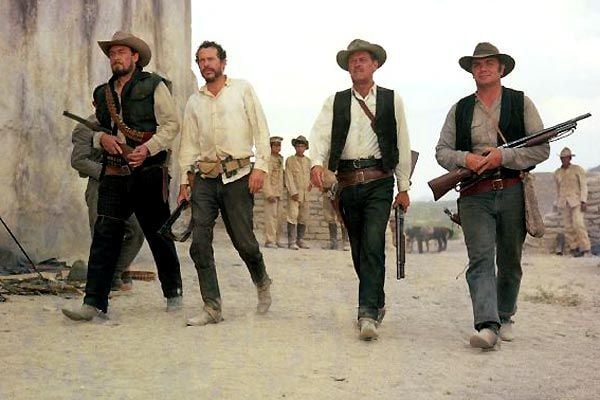
Cross of Iron

"I will show you how a Prussian officer can fight."
"And I will show you where the Iron Crosses grow."


Background
Prior to sending Peckinpah a copy of Willi Heinrich's novel 'The Willing Flesh' with a view to collaborating with the maverick director on an adaptation, Wolf C. Hartwig's experience as a producer was limited to such masterpieces of world cinema as 'Mit Eva fing die Sunde an' ('Sin Began With Eve') and 'Schulmadchen-Report' (you'll get that one without the subtitles) parts 1 to 10. What this purveyor of pornography with a penchant for schoolgirl uniforms thought he was getting into is a matter for speculation.

Shooting took place in Yugoslavia, when production costs were cheap. Nonetheless, by the time shooting began, Hartwig had secured considerably less than the $4 million the film was budgeted at. His failings as a producer also extended to securing locations, ensuring costumes were ready and sets built by the appropriate time in the shooting schedule, and arranging the hire of military vehicles and hardware. In particular, Peckinpah had depended on the provision of a fleet of tanks and several aircraft. The aircraft never materialised and only three rusting, barely mobile tanks were made available. It's one of Peckinpah's great achievements on 'Cross of Iron' that he manages to make said tanks look like an entire approaching army.

Peckinpah's drinking was pronounced. Days were lost due to blackouts or confusion over scenes already shot. Weddle's biography has Peckinpah, after the picture has wrapped, discussing with his DoP the logistics of a huge battle scene that would never be shot. With money not just running out but unavailable to begin with, Peckinpah sunk $90,000 of his own savings into the production. Then Hartwig and co-producer Alex Winitsky arrived on set with the news that the scripted denouement was not to be filmed and a new, audience-friendly and (crucially) cheap to film ending was to replace it. Peckinpah was so distraught that star James Coburn took it upon himself to inform Hartwig and Winitsky in vehemently unambiguous terms that the film was going to end the way Peckinpah intended it; he also threw their asses off the set.

'Cross of Iron' finished filming as per the original ending and to Peckinpah's dictates. Sadly, it made little impression at the box office and, desperate to recoup his investment in it, Peckinpah accepted another director-for-hire assignment: the execrable 'Convoy'.


Synopsis
The Russian Front, 1943. Sergeant Steiner (James Coburn) leads his tight-knit troop back from an incursion behind enemy lines to discover that a new officer has been transferred in. Captain Stransy (Maximillian Schell) is Prussian, rigidly bound by the hierarchy of rank and has one objective: to win the Iron Cross. To put it mildly, Steiner and Stransky don't get on. A Russian attack on their position results in heavy losses and Steiner is badly injured. While recuperating in a field hospital, Steiner enters into a brief relationship with a nurse, Eva (Senta Berger). Rather than spin out his convalescence, however, he rejoins several of his men who have been deemed fit enough to be returned to active duty. Back at the front line, Stransky attempts to solicit Steiner as a witness to a report that paints the German counter-attack as successful (actually it was a shambles) and his part in it heroic (actually he proved himself a coward). Steiner refuses. Another sortie behind enemy lines sees Steiner and his men faced with a dangerous crossing through no-man's-land. Stransky seizes the opportunity to take Steiner out ...


Analysis
David Weddle quotes James Coburn recalling pre-production on 'Cross of Iron'. The actor accompanied Peckinpah to the German film archives in Koblenz. They viewed German newsreel footage and Third Reich documentaries. In London they accessed similar archives. "We'd see this German newsreel film ... of some battle. Then when we got to London we saw the same footage edited completely differently for a propaganda film for the Russians. It's like there was this independent film unit out there shooting the war and selling the footage to both sides! Two totally different ideologies were editing it for their own purposes. So what we realised - and this really hit Sam - was that they were both liars."

This revelation clearly informs the opening credits sequence. A masterclass in montage and juxtaposition - right down to the soundtrack, which alternates between the innocent and plaintive strains of a child singing a folk song and a bombastically militaristic orchestral score - Peckinpah crafts a panoply of archive material into a provocative and brilliantly realised four minute mini-movie.


The opening credits already establish themselves as one of the film's great set-pieces. Others include the Russian onslaught and disastrous counter-attack, which segues into the sequence dealing with Steiner's experiences in the field hospital. Peckinpah's use of montage and editing are again unparalleled. In a purely imagistic fashion, he takes us from the visceral reality of the battlefield into a landscape that is bleaker, more disturbing and infinitely more difficult to conjure on film: that of his protagonist's psychological state, Steiner's mind fragmented by trauma. The cut from muzzle flash to the pencil beam of a nurse's torch strobing across Steiner's eyes is joltingly effective.

As the agitation of Steiner's mind subsides during his spell at the hospital, Peckinpah uses his relationship with Eva and a supposedly morale-boosting visit from a high-ranking office to make an almost Nietzschean comment on the effects on humanitarian behaviour by protracted conditions of war. "Do you love the war so much?" Eva demands at one point."Is that what's wrong with you, Steiner? Are you afraid of what you will do without it?" Steiner departs wordlessly and returns to the front. The scene is in stark contrast to an earlier moment during the bigwig's visit: the officer inspects the injured men, shaking hands and wishing them a quick recovery (naturlich: he wants them returned to active duty ASAP). Offering his hand to a heavily bandaged soldier in a wheelchair, a stump is thrust out at him in return. The officer hesitates then proffers his left hand. Another stump. The officer looks almost affronted and withdraws his hand. The soldier brings his leg sharply up in what can be taken as both a brutal parody of the Nazi salute and how much he'd like to kick the officer in the balls.


The blunt absence of sentimentality evidenced in these scenes is characteristic of 'Cross of Iron' at its most successful. Steiner's pragmatism is as unsparingly and minimalistically expressed as Pike Bishop's. His pre-reconnaisance instructions to the platoon: "Just bring what you need to kill with." On being questioned as to why some of his men died: "Bullets, mortar fire, artillery salvoes, bad luck, syphillis, the usual things." On religion: "I believe God is a sadist but probably doesn't even know it." The film's aesthetic demonstrates how Steiner's character has been formed: his antagonism towards his superiors is a natural by-product of his tight, "by example" leadership of his men. Steiner's only loyalty is to his men. There is no loyalty to country, to cause, to politics. As with Wolfgang Petersen's 'Das Boot', you quickly forget the characters are German; they simply become men, their souls brutalised by the horrors of war, their survival a day-to-day business. Uniforms look identical when plastered with mud or riddled with bullets. A photograph of Hitler is jarred from its position by mortar fire in an early scene and never rehung. Stransky's obsession with winning the Iron Cross is punctured when Colonel Brandt (James Mason) blithely says "Oh, we can give you one of mine" and unclips it from his tunic. The Iron Cross is thus devalued; worth no more than the "tin bill" that Will mocks Pat Garrett for wearing or the one that Sheriff Baker keeps in a kitchen drawer. The point is rammed home by Steiner (who, like Brandt, has been awarded the medal) in one of his frequent disagreements with Stransky:

Steiner: Why do you want it so badly? It's just a worthless piece of metal. Look.
Stransky: It's not worthless to me.
Steiner: Why is it so important to you? Tell me, Captain, why?
Stransky: Sergeant, if I go back without the Iron Cross, I couldn't face my family.

For all that the opening credits explicitly establish time, place and nationality, such specificity swiftly drains away as scene after scene plays out against the constant falling of shells in the background, In an early scene, a photograph of Hitler is jarred from its position when a shell lands nearby and is never rehung. The only other time Hitler is mentioned is during this telling exchange:

Steiner: Didn't your Fuhrer say that all class distinctions were to be abolished?
Stransky: I am an officer of the Wehrmacht! I have never been a Party member. I am a Prussian aristocrat and I don't want to be put into the same category.
Steiner: We agree for once.

'Cross of Iron' isn't about nationality; it's about class. It's about what smidgin of humanity can survive under continual bombardment, the omnipresence of death and the futility of war itself. It's about debunking the myth, present in cinema throughout the history of the medium, that conflict is iconic, heroic and glorious. It's about stealing the war movie back from propagandists. Sam Fuller's 'The Big Red One' posits that "the only glory in war is to survive". 'Cross of Iron' questions even this dictum. Peckinpah closes 'Cross of Iron' - his last great movie - with a quote from Berthold Brecht: "Don't rejoice in his defeat, you mean. For though the world stood up and stopped the bastard, the bitch that bore him is in heat again."


In 'Cross of Iron' there is no glory. None whatsoever.

Senin, 21 Desember 2009

Pat Garrett and Billy the Kid (2005 Special Edition)


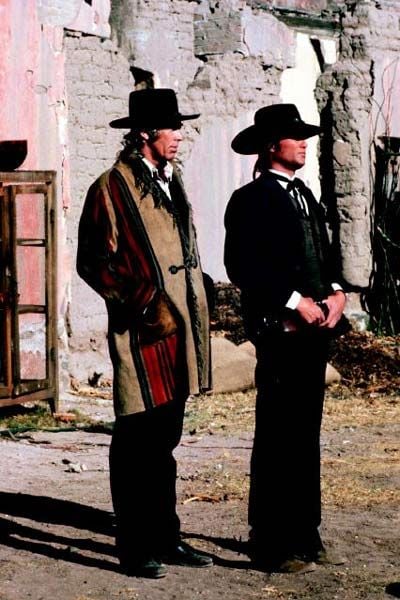
Since the cut-to-ribbons 1973 release of 'Pat Garrett and Billy the Kid' came and went from cinemas, two further incarnations have been available to home entertainment audiences. The 1988 Turner Preview Version - so called because it was essentially the edit swiped from MGM by parties sympathetic to Peckinpah - debuted on VHS billing itself as the director's cut. It was missing a scene between Garrett (James Coburn) and his wife (Aurora Clavel), but was otherwise considered definitive ... or as near to definitive as possible given the ravages and compromises the film suffered.

I've never seen the theatrical cut and I consider this a small mercy. I grew up with the "director's cut" on tape (an okayish print, though widescreened to the wrong ratio) and replaced it with the DVD (beautifully cleaned up transfer, proper aspect ratio) a few years ago. The DVD was a two-discer including the 2005 Special Editon. Cover blurb declares "for the first time since it left the cutting room, the film has the balance of action and character development Peckinpah wanted ... based on the director's notes and the insights of colleagues". It reinstates the scene between Garrett and his wife, yet - even allowing for this inclusion - runs seven minutes shorter than the 1988 Preview Version.

I held off watching the 2005 Edition for a long time. Reviews were mixed. I discovered an article which presented an in-depth comparison: many of the two dozen or so differences were flagged as detrimental. The 1988 Version is a movie I love whole-heartedly. It's this incarnation of 'Pat Garrett and Billy the Kid' that occupies a place on my personal faves list. So I left the 2005 Edition in the case and continued my love affair with the 1988 Version.

Then I decided to give over December to this Peckinpah tribute and figured if there was ever a time to give the 2005 Edition its day in the sun, then hell the time was now. I watched it Saturday evening. Mulled it over. Spent a while flipping between the two discs, running key scenes compare-and-contrast stylee. And I've emerged with mixed feelings.

On the whole, the 2005 Edition is a much tighter film. Some cuts are minor, little more than trimming: Billy (Kris Kristofferson) walking from the bar to join Garrett at a table near the start, for instance. It's just the walk from the bar that's cut - no loss to the film. Other cuts remove redundant dialogue, such as Lemuel (Chill Wills)'s drawled line about how all a cowboy needs is "loose boots, a tight pussy to play with and a warm place to shit" - a bit of vulgarity that adds nothing to the scene and isn't even particularly funny in a coarse, ornery sort of way (his earlier, as just as vulgar line, "she got an ass on her like a forty dollar cow and a tit, I'd like to see that thing filled full of tequila" has already established the kind of man Lemuel is). Getting rid of Garrett's "what you want and what you get" to Poe (John Beck) near the end is advantegous: it's an unconvincing line reading of a cliched line and the scene is punchier without it.

However, the removal of Ollinger (R.G. Armstrong)'s inspired and borderline surreal "I'll take you for a walk across Hell on a spiderweb" infuriates. Without it, J.W. Bell (Matt Clark)'s decision to draw on Ollinger lacks weight. True, Ollinger has kicked Billy to the floor, but Bell has, by this time, been both a hanger-on around Billy's outfit and a badge-wearing deputy; when he tells Ollinger "you've gone loco", it's not because of Ollinger's use of force but the intensity of his religious mania. A man who threatens to take someone "for a walk across Hell on a spiderweb" is clearly suffering some kind of delusional behaviour; losing this line makes Bell's stand-off with Ollinger come across as something of a mountain out a molehill.

The placement of the raft scene slightly earlier in the narrative works well: the scene still retains its poetic and elegiac qualities and moving it allows for events after Garrett's shooting of Holly (Richard Bright) and discovery of the Kid's location to snowball a little faster. Garrett is therefore hurried towards the inevitable denouement at Fort Sumner with a greater sense of the inexorable.If these were more or less the extent of the differences, I'd probably be hailing the 2005 Edition as masterful and kicking myself for putting off approaching it for so long. And maybe it's because I have shied away from it for four years - maybe I need to give a few more viewings and let it grow on me - that I'm conflicted about it. But there are three aspects of the 2005 Edition that I don't think I could reconcile myself to, no matter how many times I watch it.

The first is the excision of the freeze frame opening credits and the recutting of the Las Cruces/Old Fort Sumner montage. The first cross-cut between Garrett's assassination and Billy and co. plinking away at chickens is devoid of context and comes across as awkward and confusing. The sequence soon gels, though, and plays shorter than the 1988 Version; unfortunately, it's followed by a completely reimagined credits sequence, the credits (in yellow here instead of red) playing out over a series of airbrushed stills. A quick comparison of the title and Peckinpah's directed by credit (1988 Version followed by 2005 Edition) tell you all you need to know.


Secondly, the segue back to the Las Cruces assassination after Garrett rides away from Fort Sumner at the end - the bookends to the film allowing for a reading of the film entire as Garrett's dying thoughts as he plummets from the wagon, is removed entirely. The 2005 Edition ends on a freeze frame of the child who disgustedly throws stones at the departing Garrett running back and almost exiting the frame. It's an abrupt conclusion and an awkward image. Again, by way of comparison:


The third really narks me. As readers of yesterday's post will have noted, I like Peckinpah's scene as Will the coffin-maker. I think it's one of the key scenes in the film. It's rich in subtext. It evokes Sheriff Baker (Slim Pickens)'s yearning to depart the territory on the boat he's building; Will's building something quite different: a more predictable mode of conveyance by which most people who live by the gun depart the territory. It's also mind-bogglingly meta, the director directing the actor becoming the director as actor directing the character. And on top of all this, there's a wonderful Prospero analogy going on. The 2005 Edition kills the scene, cutting Peckinpah's dialogue to "so you've finally figured it out, huh" (cut to Garrett staring at Pete Maxwell's place) "go on, get it over with" (cut to Garrett striding determinedly in said direction). The effect is that Will almost seems to sanction Garrett's actions. Take away that fantastic line "When are you gonna learn you can't trust anybody - not even yourself, Garrett? You chicken-shit, badge-wearing son of a bitch" and Will seems to be giving Garrett permission, rather than hurling that one last bitter accusation at him.

I guess the ideal cut of 'Pat Garrett and Billy the Kid' would be a mixture of the 1988 and 2005 incarnations. But maybe that would only be my perfect version and nobody else's. Ultimately, because of the circumstances in which it was made, there will never be an absolutely definitive version of 'Pat Garrett and Billy the Kid'. But given the choice of what's currently available, the 1988 Version is the one I'd saddle up with.

Minggu, 20 Desember 2009

Peckinpah as Prospero


In a film defined by its protagonist confronting himself at every stage of the narrative - confronting his compromised morality; confronting the ramifications of the sell-out deal he has made with politicians and businessman, an uneasy alliance that will ultimately prove his destruction - two scenes in particular, scenes which are narratively and thematically "rhymed", put Pat Garrett (James Coburn) under the spotlight more nakedly than anywhere else.

In the first, Garrett enlists the help of Sheriff Baker (Slim Pickens) in hunting down Black Harris (L.Q. Jones), a member of Billy the Kid's gang from whom Garrett hopes to extract the Kid's current whereabouts. Baker is Garrett a few years down the line: a sheriff in title only and so disconnected to the job that he no longer bothers with the trappings of authority. Before siding with Garrett to confront Harris, Baker has to ask his wife (Katy Jurado) where his badge is. (Bob Dylan's 'Knockin' on Heaven's Door', written for the scene that follows, opens with the lyric "mama, take this badge from me / I can't use it anymore.") When Garrett first approaches Baker, he's busy in his backyard with timber and tools, building a boat.

"I'm gonna drift out of this damn territory," he tells Garrett, adding (with the kind of ornery frontier poetry so redolent of Peckinpah), "this town ain't got no hat-size no how." This ambition, however, remains unrealised. Baker is shot during the exchange of fire with Harris. Gut shot, to be specific. He stumbles down to the banks of the Rio Grande and sits, eyes glazed and short of breath, watching the slow patterns of light on water as the instrumental version of Dylan's ballad plays softly on the soundtrack.

Baker's death re-emphasizes to Garrett what he already understands: that his tracking down of the Kid is an act of treachery. When Garrett retributively shoots Harris, there's a complete denial of catharsis. "Us old boys oughtn't be doing this to each other," the dying Harris tells him; "ain't that many of us left." Harris's words are both a benediction for his killing of Baker and an accusation against Garrett.

Later, towards the end of the film, Garrett arrives at Fort Sumner. In tow are John Poe and Sheriff McKinley, their souls in hock to Governor Wallace and John Chisum, their consciences assuaged by social pretensions and the dollar bottom line. It's an uneasy alliance that Garrett has with them. Entering Fort Sumner, they spread out and slowly, picking their way through the nocturnal streets like doomsayers, go in search of the Kid. Garrett comes upon Will, a coffin maker, still practising his trade even though the sun is down and the citizenry are abed. Garrett greets him and stops to pass the time. Garrett takes a bottle from his inside coat pocket and offers it to Will, who refuses with a flip of his hand.

Garrett knocks back a slug. He stares across towards Pete Maxwell's house, where the Kid is staying. He's reticent; a man putting off the inevitable.

"You've finally figured it out, huh?" Will says, shooting a sideways look at Garrett. "I thought you was pickin' shit with the chickens, cuttin' yourself a tin bill."

Garrett continues staring at the Maxwell residence, unresponsive.

"Go on, get it over with," Will urges. But Garrett hangs back. As if encouraging him a few moments' hesitation longer, Will continues, "You know what I'm gonna do? Put everything I own right here - " (indicating the coffin) " - I'm gonna bury it in this ground and leave the territory."

Garrett pulls himself together and takes his leave of Will without a word. He walks - hell, stalks - away, not responding, not looking back (although his face hardens with self-loathing) as Will calls after him, "When are you gonna learn that you can't trust anybody - not even yourself, Garrett? You chicken-shit, badge-wearing son of a bitch."

It's an electrifying scene, and would have carried all the weight it does if Will had been played by some whiskery character actor. Eli Wallach, say, or Edmond O'Brien. But Will is played by Sam Peckinpah himself. And 'Pat Garrett and Billy the Kid' takes on a meta-textual element. Unlike that impresario of the cameo appearance Alfred Hitchcock, or his contemporary acolytes Quentin Tarantino or M Night Shyamalan, Peckinpah was not in the habit of appearing in his own movies. In fact, 'Pat Garrett and Billy the Kid' is a one-off. Nine films into his career, five still to go, Peckinpah essayed his one and only acting role*. This alone imbues Will's (small) part with significance.

Narratively, Will exists to remind Garrett of Baker's death: Baker is building a boat when Garrett encounters him, Will a coffin; Baker talks about drifting out of the territory, Will about leaving it; Baker opines that "this town ain't got no hat-size", Will muses on burying everything he owns and leaving. Both men personify leavetakings. Baker dies because of Garrett's quest against the Kid; Will, leaning on a half-finished coffin throughout the scene, is a man who buries the dead.

But there's also a subtext, one made all the more explicit for Peckinpah playing Will. The reference to everything he owns can easily be taken to mean his body of work as a director. The burial of it can be read as a metaphor for the ravages done to everything he'd made thus far, either during filming or in post-production, by the producers/studios/money men who compromised and made cuts to his films. Essentially, this is Peckinpah as Prospero, drowning his book in the last act of 'The Tempest'.

Prospero drowns his book; Peckinpah leaves the territory. 'Pat Garrett and Billy the Kid' was his last western.

But the scene is even more meta than that. When Will tells Garrett to "get it over with", the director has emerged from behind the camera where he was directing the actor (James Coburn) and - now a part of the fabric of his own film - explicitly directs the character. Garrett, walking grim-faced towards Pete Maxwell's place as Will's litany of abuse hangs in the air behind him, has been sent on his way to commit the act that history will judge him for.


*Excepting a non-speaking role as a cameraman in 'Convoy'.

Sabtu, 19 Desember 2009

PERSONAL FAVES: Pat Garrett and Billy the Kid

"It feels like times have changed."


Background
Everything augered well: a director coming fresh from his biggest commercial success to date, returning to the western genre of his first five movies; a script by a young but brilliant writer (Rudy Wurlitzer) seemingly attuned to the zeitgeist; a story based around one of the best known and most mythical histories of the Old West; a cast of genre stalwarts including Chill Wills, Slim Pickens, L.Q. Jones, R.G. Armstrong and Jason Robards, headed up by screen legend James Coburn and folk hero Kris Kristofferson; and a soundtrack by heir apparent to Kristofferson Bob Dylan, the singer-songwriter debuting in a supporting role. What could go wrong?

James Aubrey, that's what. Aubrey was the president of MGM and a hatchet man. He culled, curtailed and compromised MGM's film production, slashing budgets and fucking over filmmakers, and funnelled the money into the corporation's hotel/casino interests. Of all the producers Peckinpah battled with over the years, it is Aubrey who can properly be reckoned his nemesis. Their antagony was evident from the outset. Budget and shooting schedule were set way under what Peckinpah deemed necessary. The services of an engineer Peckinpah wanted on location (to ensure the cameras didn't suffer from the inclement weather conditions in Mexico) was denied. Consquently a damaged flange went undetected, rendering a week's worth of footage out of focus. Aubrey forbade reshoots. Peckinpah re-shot every bit of compromised footage on the QT.

Essentially, 'Pat Garrett and Billy the Kid' played out the way 'Major Dundee' had: Peckinpah rebelled against the studio while on location, going overbudget (by more than $1.5 million) and overschedule, only for the suits to take their revenge when he returned from location shooting. Every one of Peckinpah's films (except for 'Bring Me the Head of Alfredo Garcia') suffered from post-production interference, but this usually happened once he'd turned in his preferred cut. 'Pat Garrett and Billy the Kid' arguably has the distinction of being the one Peckinpah film for which a director's cut never really existed in the first place. With Aubrey dead set on muscling Peckinpah out and stripping 'Pat Garrett' down to an hour and a half of shoot outs and fuck anything resembling character development or narrative coherence, Peckinpah found himself bartering scenes while editing was still in progress, offering to make cuts here and there in order to safeguard, for example, the raft sequence.

A fine cut was produced for which two preview screenings were permitted. Since Peckinpah was not present at its erstwhile screening for the suits, and since so many compromises had been made already, it's dubious as to whether this can be considered Peckinpah's final cut. Aubrey wanted the length reducing and shanghaied the editing team into working to this end behind Peckinpah's back, threatening that non-compliance would result in his turning it over to less experienced editors whose only remit would be to hack it down to 90 minutes. What happened next is the stuff of legend. Remembering that a work print had been left in a screening room, Garth Craven and Sergio Ortega, assisted by Peckinpah's driver Chalo Gonzalez, gained entrance to said location under the cover of night, Mysteriously, the print wasn't there next morning. It was soon realised the print didn't have any sound. Funnily enough, another disappearance occurred.

The Aubrey-approved cut-to-ribbons 96 minute cut of 'Pat Garrett and Billy the Kid' was released in July 1973 to muted reviews and average box office. In October of the same year, MGM ceased film distribution and sold its entire back catalogue to United Artists, an event which precipitated Aubrey's resignation. "Mr Aubrey is no longer employed," Peckinpah mused shortly afterwards; "so maybe I have done something good for the world." A pyrrhic victory, maybe, but the fact still remains: James Aubrey was unemployed and Sam Peckinpah went on to make another five films.


Synopsis
Las Cruces, New Mexico, 1909. Ageing Sheriff Pat Garrett (James Coburn) is in dispute with landowner John Poe (John Beck) over a lease agreement. Garrett and Beck's association goes back to 1881 when Garrett tracked down his former friend and partner in crime Billy the Kid (Kris Kristofferson), but they've come to a parting of the ways. With Garrett old and embittered and publically critical of the Santa Fe Ring, Beck and his business partners consider him a liability - an embarrassing throwback to the old days - and are planning to assassinate him. In his last few moments alive, Garrett relives those infamous days and the terrible denouement that made him a sheriff and the Kid a legend.


Analysis
I've kept the synopsis short for two reasons: (i) 'Pat Garrett and Billy the Kid' is a simple story in the way that 'The Wild Bunch' is simple, ie. narratively (Peckinpah collaborator Gordon Carroll summarised the plot as "a man who doesn't want to run ... pursued by a man who doesn't want to catch him"); and (ii) this article's waltzing towards the 1,000 word mark and I haven't even started analysing the film yet.

There's probably another 1,000 words that can be written about the opening credits sequence. Events in Las Cruces, 1909 (Poe's betrayal of Garrett) and Fort Sumner, 1881 (Garrett's reunion with the Kid a week before he takes the post of sheriff, ie. just prior to his betrayal of Billy) are intercut. When Garrett rides into Fort Sumner, he finds the Kid and his minions amusing themselves shooting the heads off a bunch of chickens buried up to their necks in the dirt. At Las Cruces, Poe's henchman mumbles something about checking a harness, instead pulling a rifle from a saddle roll; another gunman crawls through the sagebrush, ready to take up his position. The shots that follow cut between target practice and cold-blooded murder. Billy's men blast the heads of chickens; Poe's open fire on Garrett. Timeframes overlap. So does the soundtrack. "Damn near perfect," one of Billy's acolytes declares, apropos of a summarily despatched chicken ... but the words echo as Garrett takes a shot and slumps to the ground. Peckinpah's use of editing ramps up the emotional impact of the sequence: a potshot Billy takes at a chicken seems to travel through time and strike Garrett; purposefully aimed coups de grace by Poe's men result in the heads being blasted off helpless fowl.

Peckinpah's signature freeze frames are used as bluntly and brilliant as in 'The Wild Bunch'. As Garrett struggles to rise from the dusty ground only to sink back defeatedly, Peckinpah isolates the moment. He uses this image to accompany the film's title. He arrives at his "directed by" credit in equally iconoclastic fashion. The 1909 prologue documenting Garrett's death throes gives out the 1881 Fort Sumner sequence, and a very much alive - and younger (though still notably middle-aged) Garrett comes riding into town. Billy the gang don't notice him, so busy are they decimating the local feathered populace. Hopping off his horse, he hefts his rifle and, while Billy's still aiming, sights on a chicken and blows its head off. Billy's boys go diving for cover, panic written on their faces. Billy turns round, slowly and wryly, and greets his old friend with a grin. Some spiky banter ensues (it's clear some of the Kid's hangers-on aren't too happy to see Garrett), then the two of them head off to the bar for a couple of shots of whisky and the business at hand:

Garrett: Times are changin', Billy. You want it straight?
Billy: If that's what you're here for.
Garrett: The electorate want you gone. Out of the country.
Billy: Well, are they tellin' me or are they askin' me?.
Garrett: I'm askin' you. But in five days I'm makin' you, when I take over as sheriff of the county.

Peckinpah's directed by credit appears at this point, in a freeze frame that enforces the pause between "I'm makin' you" and "when I take over as sheriff". It might not be as quotable as "if they move, kill 'em" in 'The Wild Bunch', but by God it gives the line some weight!

The dynamic has thus been established: Garrett and the Kid are equally protagonist and antagonist. Neither are exactly heroes, though Peckinpah both empathisizes with the weight of world-weary experience that seems to be etched into every line on Garrett's face, and appreciates the self-aggrandizing behaviour of Billy (particularly in his escape from the Lincoln County jail). Neither are entirely villains, either, even though Billy is a notorious outlaw who refuses to change his ways, and Garrett is a former outlaw who commits the greater sin (certainly in the grand scheme of Peckinpah's aesthetics) of not remaining true to himself and trying to change with the times.


Oh yes, Garrett is the first (and last) of Peckinpah's western protagonists to break with the tradition of Steve Judd, Pike Bishop and co. and Cable Hogue. This is perhaps the most significant element of the dynamic/antagonism between Garrett and Billy - it's summed up during their conversation just after the opening credits:

Billy: Sheriff Pat Garrett. Sold out to the Santa Fe Ring. How does it feel.
Garrett: It feels like times have changed.
Billy: Times maybe, but not me.

Which makes it pretty clear that, since neither Garrett or the Kid are entirely good guy or bad guy, the real villain of the piece is the changing times. Or rather the men who are responsible for changing them. The men responsible for political corruption, financial chicanery, corporate conspiracy and the fencing off of frontier territory, the free and open spaces partitioned, owned, leased and jealously guarded. Men like high-living politico Governor Wallace (Jason Robards), eminence grices Holland and Norris (the power behind Wallace's throne), grasping landowner John Chisum (Barry Sullivan) and toadying parvenu on the make Poe. If 'The Wild Bunch' and 'The Ballad of Cable Hogue' depict technology as the instrument of change, then 'Pat Garrett and Billy the Kid' looks back to 'Ride the High Country' ("the days of the forty-niners are past and the days of the steady businessman have arrived") - only here the steady businessman has been replaced by the rapacious businessman, the dollar-obsessed businessman, the businessman who rapes the land and values human life lower than his profit margin. Corruption and bribery are rife. At an interview with Wallace, the Governor offers Garrett an incentive towards Billy's expedited apprehension:

Wallace: We're offering a reward of one thousand dollars for the Kid's capture. You can have five hundred now.
Garrett: Well, I aim to bring the Kid in. But until I do, you'd better take your five hundred dollars and shove it up your ass and set fire to it.

One of the most curious aspects of 'Pat Garrett and Billy the Kid' - and I'm damned if I can work out whether it's a flaw or a masterstroke - is how determinedly Peckinpah keeps the Chisum/Wallace/Poe conspiracy offscreen. True, all three of them get at least one significant scene (Garrett's encounter with Wallace is thorny; with Chisum, cautious), but they remain backgrounded, shadows that creep around the edges of Garrett's pursuit of Billy. The depiction of Chisum in particular is borderline bland. It's as if Peckinpah is saying "yup, these are the villains, these are the guys hellbent on destroying the old ways, these are guys without souls who answer only to money and power and influence, but by Christ they're nobodies - they ain't really men".

Peckinpah has more time for Deputies Bell (Matt Clark) and Ollinger (R.G. Armstrong), the latter completing the triumvirate of fanatical religious types the actor specialised in (following on from Knudsen in 'Ride the High Country' and Dahlstrom in 'Major Dundee'. Both are in the way when Billy liberates himself from Lincoln Country jail. Kristofferson's characterisation of Billy melds ruefulness and cold determination when he comes up against Bell. It's a different story with Ollinger. The two men have already entered into a spirited disagreement over spiritual matters, Ollinger committed to making sure Billy "gets with god" ("I'll take you for a walk across Hell on a spiderweb") and Billy responding to Ollinger's pious "On your knees" with a pithy "Kiss my ass". Billy's summary dispatching of Ollinger burns with the visceral and iconic intensity that fuelled Peckinpah's reputation as "Bloody Sam".

Peckinpah has more time for Sheriff Baker (Slim Pickens) and Black Harris (L.Q. Jones), whose exchange of fire after Garrett co-opts the former to help in smoking out the latter results in Baker's agonisingly slow passing, stumbling down to the river, gut-shot, and sitting by the slowly flowing waters, the silvery play of light on the surface, as his breathing grows shallower and the life ebbs out of him. At the same time terrible and utterly beautiful, it's one of the greatest scenes Peckinpah ever shot. Likewise the narratively pointless but poetically eloquent scene where Garrett, in a playful throwback to the outshooting-Billy-at-Fort-Sumner scene, accidentally provokes an exchange of fire with a passing raftsman, only for both men to pause, reflect and lower their guns at the critical moment. Both of these scenes are redolent of Peckinpah the humanitarian, Peckinpah the poet, Peckinpah the wounded romantic, desperately aching for a time that's changed and bitterly regretful of the forces that changed it. They give the lie to the cliche of Peckinpah as a purveyor of violence for its own sake.


Peckinpah has more time for a coffin-maker named Will ... of whom more tomorrow. I've expended about 2,500 words already and I think that one short scene between Garrett and Will (who serves, variously, as conscience, ghost and alter ego) deserves an article of its own. For now, I'll just say that 'Pat Garrett and Billy the Kid' - given its troubled production, its director's tendency to drinking to insensation on set, the disservices done to it in editing, and its rejection of propulsive/exciting/urgent pacing typical of a chase narrative - ought to be a complete mess. And certainly there's a wonky, woozy, slightly off-kilter feel to the film. Watching it is like being punch-drunk. But it's also multi-layered, a film that repays repeated viewings. A film that worms its way under your skin and disseminates its genius slowly and subconsciously.

Senin, 14 April 2008

"Ain't like it used to be" - the cinema of Sam Peckinpah

(Written for Film at 11’s American cinema blog-a-thon)


"I wasn't trying to make an epic. I was trying to tell a simple story about bad men in changing times."

That's how Sam Peckinpah described 'The Wild Bunch' (1969), his fourth film and arguably the fullest synthesis of his trademark themes and concerns. It begins with the titular outlaw gang, led by Pike Bishop (William Holden), executing a bank robbery disguised as soldiers. Bounty hunters, including Pike's former partner Deke Thornton (Robert Ryan) are lying in wait for them. Ryan has bargained his way out of jail and put his soul in hock to a railroad boss out to get the bunch.

Already the film is rich in compromised morality. The bunch shoot their way out, losing one of their members, and head for safety. When they come to divide their loot, they find that far from escaping with a hefty payroll they have risked their lives for a few sacks of washers.

Crossing the border into Mexico, they form an uneasy alliance with debauched revolutionary General Mapache (Emilio Fernandez), agreeing to rob an army train and deliver to him a cache of guns and ammunition. Things are complicated by the presence of Commander Frederick Muhr ("of the Imperial German Army"); the year is 1913, Europe on the brink of war and the shadow creeping across America. A way of life - the freedom of the frontiers - is already beginning to disappear. Mapache tootles around the hacienda courtyard that constitutes his personal fiefdom in a motor car. "Damned ugly thing," one of the bunch mutters, the very concept of a horseless carriage an affront to him. And here we have the key themes of Peckinpah's work:

*Times change, yet Peckinpah's heroes - men of a certain era, men of a certain mindset - would rather die than change with them.

*Technology encroaches, its results only ever destructive.

During the opening sequence of 'Pat Garrett and Billy the Kid' (1973), newly elected Sheriff Pat Garrett (James Coburn) rides into Old Fort Sumner and, pardon the pun, lays down the law to his former partner William H Bonney, aka Billy the Kid (Kris Kristofferson):

Garrett: Times are changin', Billy. You want it straight?
Billy: If that's what you're here for.
Garrett: The electorate want you gone. Out of the country.
Billy: Well, are they tellin' me or are they askin' me?
Garrett: I'm askin' you. But in five days I'm makin' you, when I take over as sheriff of the county.
Billy: Sheriff Pat Garrett! Sold out to the Santa Fe Ring. How does it feel?
Garrett: It feels like times have changed.
Billy: Times, maybe, but not me.

A scant four years separate 'The Wild Bunch' and 'Pat Garrett and Billy the Kid'. In many ways they tread the same path: both are elegiac despite their moments of violence; both mourn the passing of the Old West. The tone is different, though. There is a defiance to 'The Wild Bunch', never mind the almost nihilistic futility of the bunch's final stand. Early in the film, Pike dismisses the inevitability of the bunch being pitted against superior numbers: "I wouldn't have it any other way." The way he says it, you know he means it. By the end, he proves it. The bunch are finally outnumbered not just by Mapache's private army but, in a thematic sense, by history itself. Their world changes - globally.

In 'Pat Garrett and Billy the Kid', social and political upheavals are more localised - the former outlaw Garrett earns his appointment as sheriff by hunting down Billy the Kid; lawyers and landowners pull the strings behind the scenes - and the effect is, if anything, even more devastating. There is a weariness, almost a sense of defeat, in every frame. The closest Garrett comes to an act of defiance is to reject an offer of $500 for an outright assassination of the Kid, snarling, "You can take that five hundred dollars and shove it up your ass and set fire to it."

'Pat Garrett and Billy the Kid' isn't as redolent as other Peckinpah films in images of modernity creeping into the milieu of the western - unlike 'Ride the High Country' and 'The Ballad of Cable Hogue', both of which, like 'The Wild Bunch', feature cars: one almost runs down Steve Judd (Joel McCrea) in the former, the other proves a lot more damaging to Cable Hogue (Sam Robards) in the latter - but it spells out the death of the west just as poignantly, most notably in the slow, painful death of Sheriff Baker (Slim Pickens), gut shot and stumbling down to the river as the acoustic version of Bob Dylan's 'Knockin' on Heaven's Door' plays on the soundtrack.

In 'The Ballad of Cable Hogue' (1970), the eponymous prospector, betrayed by his partners and left to die in the desert (chalk up another recurring theme: the amount of characters who end up pitted against men they used to ride with, a bitter contravention of Pike's code of honour that "when you side with a man you stay with him and if you can't do that you're like some animal - you're finished"), finds water as if by a miracle and not only survives but, having negotiated the bureaucratic necessities of filing a claim on the land and acquiring financial backing, opens a way station between two towns on a main stagecoach route. His dreams of romance with local good-time girl Hildy (Stella Stevens) are ruined by his obsession with revenge; his prosperity is threatened by - yes! - the arrival of the horseless carriage.

A decade beforehand, Peckinpah's second film (and his first bona fide masterpiece) 'Ride the High Country' (1961) provided a virtual blueprint for the rest of his career. His weather-beaten protagonists Steve Judd and Gil Westrum (Randolph Scott) are men in their twilight years, suspicious of bankers and businessmen and not at all impressed by the callous live-fast-die-young ethos of the younger generation ('Ride the High Country' was made in 1961, remember: the youth-of-today analogy is pretty clear). For all that Westrum, trying to lure his upright friend into a robbey, is a study in compromised morality, Judd strives always to do the right thing, to remain true to a rigid code of honour.

Westrum: Partner, you know what's on the back of a poor man when he dies? The clothes of pride. And they're not a bit warmer to him dead than they were when he was alive. Is that all you want, Steve?
Judd: All I want is to enter my house justified.

All I want is to enter my house justified. What a line! See the film just once and that line will haunt you years later. With Peckinpah, who (mostly uncredited) rewrote whole tranches of the screenplays he optioned, the dialogue is just as incisive as the images. There's a beautifully resonant line in 'The Wild Bunch', spoken by one of the elders at gang member Angel's village, the bunch hiding out there after the robbery-gone-wrong. Observing two of Bishop's most hard-bitten heavies innocently larking around with a couple of the village girls, he comments, "In our hearts we all want to be children again, even the worst of us. Perhaps the worst most of all."

Or how about the line that old man Sykes (Edmond O'Brien) comes out with at the end? Reflecting on an uncertain future, the times having changed beyond anything he can hold out against, he says wearily, "It ain't like it used to be, but it'll do."

An epitaph for changing times, the old ways betrayed and shot down by modernity. A ten-word summation of Peckinpah's over-riding theme as an artist, as a film-maker and as a man.