Background
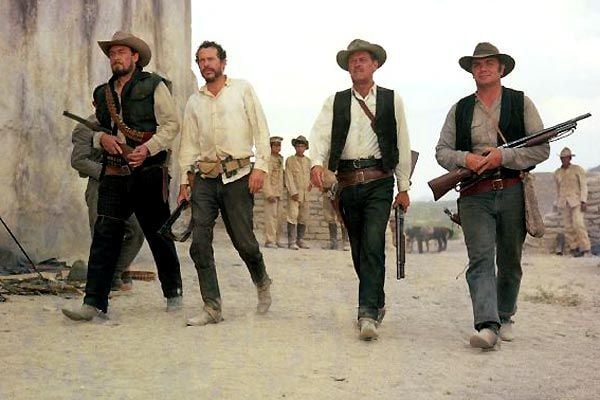
Opting for a complete change of pace after 'The Wild Bunch', Peckinpah threw himself enthusiastically into 'The Ballad of Cable Hogue'. It went overschedule and overbudget (which Peckinpah production didn't?) but on the whole the shoot progressed smoothly. The problems started when Peckinpah found out that producer Phil Feldman had acquiesced to the studio heads who wanted 'The Wild Bunch' cut down to a commercially preferably two hour running time. Peckinpah's reaction was one of vociferous outrage, even threatening legal action against Warner Brothers. The result was, in Stella Stevens's words, that the studio "didn't release 'Cable Hogue' - they flushed it."
Opting for a complete change of pace after 'The Wild Bunch', Peckinpah threw himself enthusiastically into 'The Ballad of Cable Hogue'. It went overschedule and overbudget (which Peckinpah production didn't?) but on the whole the shoot progressed smoothly. The problems started when Peckinpah found out that producer Phil Feldman had acquiesced to the studio heads who wanted 'The Wild Bunch' cut down to a commercially preferably two hour running time. Peckinpah's reaction was one of vociferous outrage, even threatening legal action against Warner Brothers. The result was, in Stella Stevens's words, that the studio "didn't release 'Cable Hogue' - they flushed it."

Synopsis
Betrayed by his partners Bowen (Strother Martin) and Taggart (L.Q. Jones), disillusioned prospector Cable Hogue (Jason Robards) is left for dead in the desert. Miraculously, he finds water. Better still, he finds it slap bang on a stagecoach route between the towns of Gila and Dead Dog. Excavating a well, he sets up shop, charging 10 cents per drink of water. Along comes the Reverend Joshua Sloane (David Warner), Hogue's second customer. (Hogue shoots the first after he demonstrates a marked refusal to fork out the 10c.) The preacher reminds Hogue that there's such a thing as land rights. The determinedly anti-social Hogue "goes in among them" and heads into Dead Dog to register a claim. It's here he meets saloon girl Hildy (Stella Stevens), with whom he gradually forms a romantic relationship. Meanwhile, with a bank loan to fund the building of a way station around the watering hole (which Sloane has named Cable Springs) and a contract with the stagecoach line, he begins to develop a successful business. Although Hogue's feelings for Hildy are sincere (in stark contrast to Sloane's rampant lechery), ultimately he finds himself torn between Hildy's dreams of moving to San Francisco and his long-held grudge against Bowen and Taggart.

Analysis
The release of 'The Ballad of Cable Hogue', unattended by any whisper of publicity, can be interpreted in one of two ways: (a) the studio were taking their revenge on an outspoken and troublesome director; (b) the studio didn't know what the fuck they had on their hands and had even less idea of how to market it. For my money, it's a little bit of Column A and a little bit of Column B. Whether I'm right or wrong, it's easy to see how studio incomprehension contributed to its demise at the box office.
Thematically, it's a natural and organic follow-up to 'The Wild Bunch'. Its hero is a man who has outlived his times; a man at odds with his former partners in crime. Its dominant theme is the encroachment of technology/modernity into the Old West. Subplots effect a comparison of the ties of loyalty and friendship between men with the transience of romantic relationships between men and women. To further 'The Wild Bunch' comparison, Strother Martin and L.Q. Jones play Bowen and Taggart as a reprisal of Coffer and T.C., the bickering bounty hunters from the previous film. Rounding out the Peckinpah Irregulars, Slim Pickens and R.G. Armstrong return from 'Major Dundee'. Yes, sir, 'Cable Hogue' has all the markings of Peckinpah's cumulative aesthetic as a filmmaker thus far.
And yet it's sooooo different. For a start it's a comedy. Granted, most of Peckinpah's films are imbued with a degree of humour (sometimes of the gallows variety: cf 'Bring Me the Head of Alfredo Garcia') but entire set pieces are played as broad comedy: Hogue's first encounter with Hildy (a scene defined by laddish close-ups of her decolletage and bug-eyed double-takes on Hogue's part), Hogue visiting Hildy as a paying customer and suffering the detumescent effects of a gospel meeting outside ("lost it," he opines ruefully), Sloane taking a pratfall down the stairs in the saloon, Hogue and Sloane's comic banter as they build the way station, Sloane lecherously pursuing a young "widow" only for her husband to prove inconveniently alive and well ... Apart from the opening scene after Bowen and Taggart double-cross him, and the last quarter of the film which details Hogue's settling of the score with them and Hildy's return from San Francisco, virtually every scene is played for laughs.
The dialogue sparkles. Take Slim Pickens' stagecoach driver, urged by one of his passengers not to tarry because "it's getting dark". "Surely does about this time," he observes; "damnedest thing I ever saw." Or the exchange between Hogue and Cushing (Peter Whitney), the banker he approaches for the loan:
Cushing: Are you trying to tell me you've found water?
Hogue: There's a preacher out in my diggings. He'll tell you. You wouldn't doubt a man of the gospel, would you?
Cushing: Of course. That's the first man I'd doubt.
Hogue: Well, I'll be damned. Looks like I came to the right place after all.
Hogue: There's a preacher out in my diggings. He'll tell you. You wouldn't doubt a man of the gospel, would you?
Cushing: Of course. That's the first man I'd doubt.
Hogue: Well, I'll be damned. Looks like I came to the right place after all.
Or there's Sloane, warning Hogue against his obsession with avenging himself on Bowen and Taggart, quotes scripture: "Vengeance is mine, sayeth the Lord, and I shall repay." "Well, that's fair enough by me," Hogue muses, "just as long as He don't take too long and I can watch." Earlier, when Sloane first stumbles upon Hogue's watering hole, he pleads "Cast thy bread upon the water and let this man of God have his just needs." Hogue's reply: "Ten cents, you pious bastard, or I'll bury you."

Which brings us to the subject of religion, and 'The Ballad of Cable Hogue' makes another divergence from Peckinpah's other works. R.G. Armstrong was in four of Peckinpah's six westerns; in three of them - 'Ride the High Country', 'Major Dundee', 'Pat Garrett and Billy the Kid' - he plays, respectively, a lay preacher, an ordained preacher and a deputy who comes on like a preacher with a badge and a gun. All of these characters are God-fearing and convinced that everyone else should be fearing Him as well. In 'The Ballad of Cable Hogue', Armstrong plays the gruff stagecoach boss who never once pulls out a Bible, quotes chapter and verse or pistol-whips someone in the name of the Lord. No, sir, it's David Warner who's wearing the collar and preaching the word here, and that's because the Reverend Joshua Sloane is a preacher of a very different ilk from the standard issue R.G. Armstrong characterisation.
For most of the film, Sloane's biblical reveries have about them the ring of an actor revelling a great Shakespearean solliloquy, savouring the words, indulging in the performance of them. But it's clear from very early on that he's interested less in salvation than fornication. He carries pictures of his "congregation" ("Why, that one's as naked as a jaybird's ass," Hogue observes when Sloane shows him the snaps). He rides into Dead Dog with Hogue declaring "If I cannot rouse heaven, then I intend to raise hell". He almost gets his wicked way with an emotionally vulnerable woman, only to be interrupted by her husband. Put simply, Sloane is the kind of person Knudsen, Dahlstrom or Ollinger would take outside and forcibly secure the most heartfelt repentance from. And yet, in the bittersweet final scene, it's Sloane who delivers a heartfelt eulogy and truly expresses something that is profound and poignant.
Maybe it's because Hogue has rubbed off on him. For all Sloane's priapic obsessions - and despite the fire and brimstone preacher at Dead Dog whose gospel meeting is interrupted and inadvertently made a mockery of by Hogue; and whose self-righteous congregation run Hildy out of town - it's Cable Hogue who communes with God. Left in the desert by Bowen and Taggart, Hogue begins his long trek out of the wilderness. Peckinpah plays this against the opening credits sequence, employing arguably the most effective use of split screen that any filmmaker has ever achieved from that ordinarily rather hokey and gimmicky technique. Richard Gillis's almost impudently optimistic song 'Tomorrow is the Song I Sing' unspools for a couple of verses, split screen returns to full screen and Hogue tilts his eyes grouchily towards the heavens and offers up a succinct conflation of prayer, observation and request: "Ain't had no water since yesterday, Lord. Gettin' a little thirsty. Just thought I'd mention it. Amen."

A few more credits, another verse or two, more split screen images depicting the continuing plight of our hero (the sun seems higher and brighter; his face is burned, his lips cracked), then he communes with the Almighty again: "Yesterday I told you I was thirsty and I thought you might turn up some water! Now if I've sinned, you just send me a drop or two and I won't do it no more. Whatever in the hell it was I did." A pause then, with a little more humility: "I mean that, Lord."
But Hogue has to reach a point of acceptance, a point where he's practically at death's door, before the miracle is delivered. Collapsed, his eyes barely open, a sandstorm howling around him, he is at first embittered and defiant - "If you don't think I put in my suffering time, you ought to try going dry for a spell ... Careful now, you're about to get my dander up" - then finally resigned: "Lord, you call it, I'm just plain done in. Amen." And here, at his lowest ebb, having laid himself down as if to die, Hogue finds water. And this during the opening credits! Even as his director's credit appears, Peckinpah has established 'The Ballad of Cable Hogue' as something of a parable. The desert setting and Sloane's christening of the way station Cable Springs reinforce the parallels. Hogue and Hildy's romantic idyll points up the Garden of Eden metaphor.
Of course, in any Garden of Eden there is always a serpent. There are several snakes in 'The Ballad of Cable Hogue' - he uses them as a key ingredient for the 'desert stew' he serves to stagecoach passengers, as well as employing those not yet consigned to the pot against Bowen and Taggart when he eventually comes face to face with his old enemies again - but this being a Sam Peckinpah film, the real serpent is modernity, personified here (pace 'Ride the High Country' and 'The Wild Bunch') in the form of the automobile. "Ugly lookin' damn thing, ain't it?" Slim Pickens' stagecoach driver says, both acting as a mouthpiece for Peckinpah (using the exact same turn of phrase levied at Mapache's car in 'The Wild Bunch') and subtly implying that the effect of motorised transport will be as detrimental to Hogue's business as to the stagecoach.

No more can be said here without compromising the ending. Let's just say that there's a reason that it's Hogue who truly finds God. Cable Hogue exemplifies - perhaps more fully than any other character in Peckinpah's filmography - one of the director's most enduring thematic concerns: that a world defined by machines is a godless place.