Background
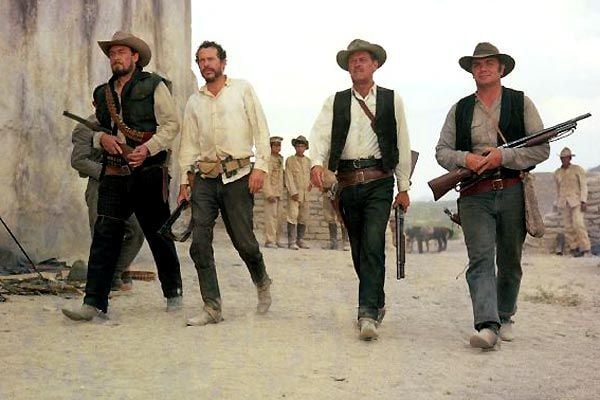
The disappointment of 'The Deadly Companions' didn't stop Peckinpah from being offered another directing gig very quickly. 'Guns in the Afternoon' was a long, rambling script by N.B. Stone. This time round, Peckinpah was permitted to take a shot at rewriting it. He cut out the cliches, rewrote the majority of the dialogue, gave the story real depth and moral density, and changed the title. With western movie legends Joel McCrea and Randolph Scott on board, an excellent supporting cast, and ace lensman Lucien Ballard as cinematographer, 'Ride the High Country' emerged as Peckinpah's first fully articulated artistic statement as a film-maker. Nonetheless, he spent such an inordinate amount of tim editing the film, that the studio had him locked out of the editing room and finished the job quickly. 'Ride the High Country' then suffered the ignominy of being released on the first half of a double-bill with plodding historical effort 'The Tartars'. Critical response proved the studio wrong: 'Ride the High Country' garnered superlative reviews and picked up a slew of film festival awards - the Silver Leaf in Sweden, the Silver Goddess in Mexico, the Paris Critics' Award and the Grand Prix in Belgium.

Synopsis
Ageing ex-lawman Steve Judd (Joel McCrea) takes a job guarding shipments of gold being transported to the bank from the mining town of Coarsegold. He ropes in his former partner Gil Westrum (Randolph Scott) and cocky young gunslinger Heck Longtree (Ron Starr) as back-up. Gil and Heck plot to steal the shipment, but Gil is agitated at the thought of double-crossing Steve and subtly tries to sound him out as to his integrity. Overnighting at a farm owned by preacher Joshua Knudsen (R.G. Armstrong), Heck takes a shine to Knudsen's headstrong daughter Elsa (Mariette Hartley) but is rebuffed. Mariette, against her father's wishes, intends to marry Billy Hammond (James Drury), one of five brothers working a claim in Coarsegold. The phrase "white trash" could have been specifically invented for these boys. When Billy incapacitates himself on the wedding night, his brothers crowd into the bridal suite figuring on consummating the marriage on his behalf. Steve, Gil and Heck intervene and Elsa leaves with them. Gil fails to appeal to Steve's baser instincts and he and Heck put their plan into action. Meanwhile, the Hammond brothers are on their trail and things come to a head at Knudsen's farm.

Analysis
With 'Ride the High Country', Sam Peckinpah made his first bona fide masterpiece. As a stand-alone film, it's lovingly crafted, graced with excellent performances, and deeply nostalgic without ever sacrificing the realities of the moral conundrums and physical dangers facing its world-weary protagonists. Viewed as an integral part of Peckinpah's filmography, it represents a quantum leap from 'The Deadly Companions' and practically serves as a blueprint for the remainder of his directorial career.
Within the first five minutes, Steve Judd has been identified as an old-timer (the quintessential Peckinpah protagonist is an older man) and almost run over by the unexpected intrusion of a motor car along the rutted street of a frontier town (cars as the harbingers of unwanted and destructive technological progress reappear in 'The Wild Bunch' and 'The Ballad of Cable Hogue'). Judd watches two young boys being dragged away from the sight of a gyrating belly-dancer (children bearing witness to the crudities and violence of the adult world provide a recurring motif - beginning with Kit's ill-fated son in 'The Deadly Companions'). Later, discussing the terms of his contract with the bank manager, he's told "the days of the forty-niners are past and the days of the steady businessman are here" (big business replacing - indeed, literally fencing off - the freedom of the open range is savagely critiqued in 'Pat Garrett and Billy the Kid').
Cast-wise, the seeds of Peckinpah's most creative actor/director relationships are present. The nucleus of what you might call the Peckinpah Irregulars - Warren Oates, John Davis Chandler, L.Q, Jones - are present and correct, while R.G. Armstrong essays the first of three theologically motivated characters he'd play for Peckinpah (Knudsen would be followed by the Reverend Dahlstrom in 'Major Dundee' and Deputy Ollinger in 'Pat Garrett and Billy the Kid'), all of them unhinged to some degree or other.
Knudsen's protective/jealous behaviour towards Elsa (he strikes her when she questions his authority) is her catalyst to run away from home and betrothe herself to Billy Hammond. Steve and Gil reluctantly allow her to ride with them. Arriving in Coarsegold, Heck sees Elsa to the Hammonds' camp where he is mocked and driven away by the brothers. Knudsen's earlier comment - "that mining town is a sinkhole of depravity" - is borne out. It's a rough and squalid place peopled by the boozing, brawling likes of the Hammonds. Social activities centre on a brothel whose garish and obese madame, Kate (Jenie Jackson) is more obviously in charge of things than the pathetically drunken Judge Tolliver (Edgar Buchanan). Elsa starts regretting her decision immediately. Still, she goes through with the wedding. The ceremonies are conducted at the brothel. Kate appoints herself maid of honour. Four tired and bored looking whores act as her flower girls.

If Coarsegold is Elsa's purgatory, then the inner demons that Gil and Heck come to wrestle with during the course of the film travel with them on the trail. The gold collected (there's nowhere near the amount the bank anticipated), Elsa rescued from a fate worse than Billy Hammond (ie. his brothers), and Judge Tolliver menaced by Gil in order to beat the ministrations of a miners' court appointed to try Elsa's case, Steve leads his companions on the long trek back to town. Gil, banking on convincing Steve to join him and Heck in making off with the gold, admits defeat after a conversation where he lampoons his old friend for being a poor man wearing "the clothes of pride" and Steve responds, "I want to enter my house justified."
This is one of the most famous and resonant lines in Peckinpah's filmography, establishing Steve's rigid code of ethics and effectively contrasting the simple beliefs of a man of honour (Steve) with the sanctimonious rhetoric of Knudsen. It would be the easy way out, critically, to look at Knudsen and Dahlstrom and Ollinger, not to mention the god-fearing townsfolk who run Hildy out of town in 'The Ballad of Cable Hogue' or get caught in the crossfire in 'The Wild Bunch', and declare that Peckinpah was anti-religion. But the issue, as with much of subject matter in his films, is a lot more complex and a lot less simple than that. A conversation between Elsa and Steve serves as a rueful encapsulation of Peckinpah's aesthetic of grey areas, compromised morality and the tendency of the things in life to not be as they should:
Elsa: My father says there's only right and wrong, good and evil. Nothing inbetween. But it's not as simple as that, is it?
Steve: No, it isn't. It should be. But it isn't.

Shades of grey in the relationship between Gil and Heck, the younger man all cocky and big-talking at the start, but Gil's influence gradually being replaced by Steve's. "That old man is about half rough," Heck muses begrudgingly after Steve teaches him a lesson for treating Elsa disrespectfully. Later, when the Hammond wedding party is whooping it up at Kate's place and Heck looks utterly wretched and broken, it's Steve who offers the words of comfort and buys him a drink, not Gil. Shades of grey, too, in Peckinpah's depiction of the Hammonds: disreputable and no respecters of women's rights they might be, there's some far-removed, tobacco-stained, bastard version of Steve's code of ethics to which they are somehow, inexplicably, beholden. When they have Steve and Gil pinned down, and Steve invites them to "finish this thing out in the open", the elder Hammond suggests they "catch 'em when they raise up", Billy immediately rounds on him, affronted, and demands "Ain't you got no sense of family honour?"
'Ride the High Country' is a 90-minute western which the studio treated as a B-movie. It's astoundingly complex, flawlessly executed and remains one of the jewels in Peckinpah's crown.